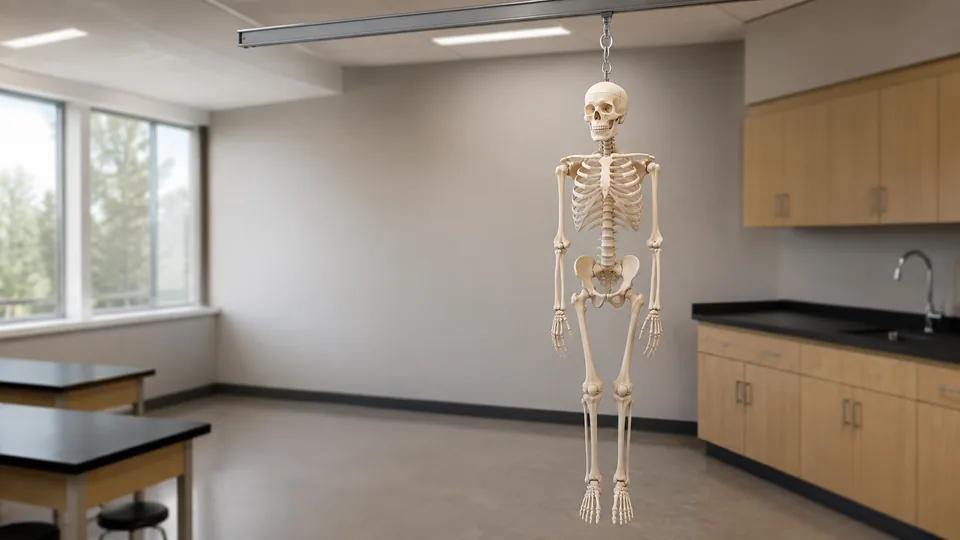
Suspending a skeleton changes the way its joints and proportions read. The spine hangs naturally, the rib cage stays visible from every side, and students can circle the model rather than peering around a fixed support. Yet the listings gathered under “hanging skeleton” range from classroom-grade anatomical replicas to compact study models and lightweight decorative props, so the differences are far bigger than a few inches of height.
For serious anatomy study, prioritize accurate proportions, articulated joints, removable components, and a stable suspension or rolling stand. A student labeling the foramina and bony landmarks of the skull needs finer detail than an artist checking limb proportions. Likewise, a teacher rolling a model between lab stations has different priorities from someone hanging a lightweight skeleton above a seasonal display.
The Axis Scientific Classic Human Skeleton is the strongest overall educational choice here. Its life-size, articulated construction is paired with substantial study material, numbered stickers, a rolling stand, and a dust cover. Buyers seeking painted muscle attachments may prefer the 70.8-inch Muscle Insertion and Ligament model, while compact study spaces are better served by the 31-inch Axis Scientific Mini.
Quick Answer
Choose the Axis Scientific Classic Human Skeleton for a comprehensive life-size teaching package. The 70.8-inch Muscle Insertion and Ligament model is the more visually detailed option for studying attachment points, while the Axis Scientific Mini offers an appealing balance of articulation and portability. For lightweight seasonal hanging rather than anatomy instruction, the HBSTK two-pack is easier to suspend and pose.
For a fast side-by-side view, the table below highlights the size, articulation, and study features that separate these nine picks.
Best Hanging Skeleton Models Comparison Table
| Product | Best For | Size | Key Feature |
|---|---|---|---|
| Axis Scientific Classic Human Skeleton | Overall anatomy study | 167 cm | 206 articulated bones and extensive study bundle |
| 70.8-Inch Muscle Insertion and Ligament Model | Muscle attachment study | 70.8 inches | Painted origins, insertions, ligaments, nerves, and artery detail |
| Axis Scientific Life Size Skeleton | Classroom mobility | About 5 feet 6 inches | Pelvic-mounted rolling stand |
| NLShan Human Skeleton Model | Full-size value | 70.8 inches | 206 articulated bones and three posters |
| Axis Scientific Mini Human Skeleton | Compact teaching | 31 inches | Removable limbs and metal stand |
| breesky Human Skeleton Model | Entry-level desk study | 17.7 inches | Small footprint and movable limbs |
| 17.72-Inch Mini Skeleton Anatomy Model | Students and artists | 17.72 inches | Poseable limbs with firm joint positioning |
| HBSTK Posable Skeleton Two-Pack | Lightweight hanging displays | 36.5 inches each | Top hanging loops and adjustable joints |
| Descholle 3-Foot Skeleton | Compact seasonal displays | 3 feet | Lightweight hanging and standing design |
The full reviews below explain where each model fits, including the important divide between educational anatomy replicas and decorative hanging skeletons.
1. Axis Scientific Classic Human Skeleton With Study and Numbering Guide: Best Overall

The Axis Scientific Classic earns the top position by pairing a 167-centimeter, 206-bone model with the learning resources needed to make that scale useful. Its articulated construction supports close observation of joint relationships, while the detachable skull and removable calvarium open areas that remain hidden on simpler one-piece models. Picture a study group gathered around the skull before an exam, turning it carefully rather than trying to interpret overlapping lines in a printed diagram.
The bundle is unusually complete. It includes a five-caster rolling stand, dust cover, assembly instructions, a product manual covering 172 advanced landmarks, a 27-page color guide, and 189 stickers for active labeling. Those stickers can turn a quiet lab corner into a practical recall station: identify the landmark, place the number, then check the guide. The stand provides mobility and display support, although buyers specifically planning overhead suspension should confirm that their chosen hook and mounting arrangement can safely carry the complete model.
Pros
- Life-size 167-centimeter model with 206 articulated bones
- Detachable skull with a removable calvarium
- Includes 189 stickers for active identification exercises
- Five-caster stand and dust cover support regular classroom use
- Multiple guides provide substantially more context than a basic model alone
Cons
- Requires considerably more storage space than a desktop skeleton
- Its extensive educational bundle may be unnecessary for basic art reference
This package makes the most sense for anatomy students, instructors, tutoring centers, and professional offices that expect the model to remain in regular use. The included references are the decisive advantage over stripped-down alternatives, particularly for learners who benefit from touching and labeling structures. Buyers seeking painted muscle origins or ligament detail should look at the second pick, but this is the most rounded skeleton-and-study package in the group.
To buy this product, click here.
2. 70.8-Inch Human Anatomy Model With Muscle Insertions and Ligaments: Best Detailed Option
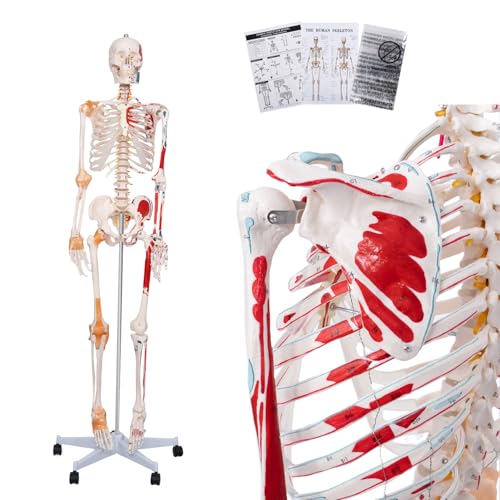
Color markings make an enormous difference once a lesson moves beyond naming bones. This 70.8-inch model marks muscle origins and insertion points and adds flexible joint ligaments, turning the pale surface into a busier, more informative map. The listing also specifies numbered bones, nervous-system detail, and carotid artery representation. For a kinesiology student tracing how a muscle crosses a joint, those painted areas can make the relationship click much faster than a plain skeleton.
The model has a removable skull cap, movable jaw, three detachable teeth, and hinged extremities for positioning. A five-wheel metal stand helps it move between a lecture space and a smaller demonstration area, while the included cover keeps dust out of the many painted and recessed details. Color illustrations, assembly instructions, and a skeletal poster round out the package. All that visual information creates a denser learning tool, though beginners interested solely in bone names may find a plain model easier on the eyes.
Pros
- Painted muscle origins and insertion points add functional context
- Flexible ligaments illustrate selected joint relationships
- Life-size format is suitable for group demonstrations
- Removable skull cap and detachable teeth support closer inspection
- Rolling stand, cover, illustrations, and poster are included
Cons
- Dense color coding may feel visually crowded during basic skeletal study
- Large dimensions demand dedicated floor and storage space
This is the most compelling pick for buyers studying muscle attachments, joint mechanics, or the relationship between skeletal and selected neurovascular structures. It suits advanced students and teaching rooms better than casual desktop use. Someone preparing an introductory bone-identification lesson may prefer the cleaner Axis Classic, but learners hungry for layered visual detail will have more to explore here.
To buy this product, click here.
3. Axis Scientific Life Size Skeleton Model for Anatomy Study: Best for Classrooms

Busy teaching spaces need a skeleton that can move without becoming an awkward two-person lifting job. This Axis Scientific model stands about 5 feet 6 inches and uses a pelvic-mounted rolling stand, placing support close to the body’s center rather than leaving the skeleton swinging loosely from a tall overhead hook. Five casters let an instructor roll it beside a lecture table, then pull it closer when students need to inspect a joint.
Its 206-bone structure is fully articulated across major regions and can demonstrate motions such as flexion, extension, and abduction. Three learning resources and 189 numbered stickers support labeling drills, while PVC construction, corrosion-resistant hardware, and a dust cover are practical additions for rooms where chalk dust, fingerprints, and daily movement are part of the scenery. Axis Scientific also lists a three-year warranty and US-based support, a useful consideration for institutions planning repeated use.
Pros
- Life-size articulated construction supports visible demonstrations
- Pelvic-mounted stand offers a stable classroom display arrangement
- Rolling casters simplify movement between teaching areas
- Includes three study resources and 189 numbered stickers
- Dust cover and listed three-year warranty add long-term value
Cons
- Pelvic mounting provides a different presentation from freely suspended hanging
- Full-size storage can be awkward in crowded classrooms or small offices
Schools and training rooms should place this model high on the list, especially where several instructors share equipment. Its main appeal is the marriage of anatomical scale and practical mobility. A freely hanging model may offer more natural suspension through the spine, but the pelvic stand reduces sway while an instructor points to landmarks, which can be far less fiddly during a packed lesson.
To buy this product, click here.
4. NLShan 70.8-Inch Human Skeleton Model: Best Full-Size Value

For buyers who want full adult scale without the largest educational bundle, the NLShan offers a straightforward 70.8-inch format. The listing describes 206 articulated bones, a detachable skull, and a removable calvarium. These features cover the core interactions many students need: following the vertebral column, comparing the shoulder and pelvic girdles, and opening the skull for a clearer view of its internal form.
A five-wheel rolling bracket makes repositioning easier, and the washable surface can be wiped when fingerprints and ordinary room dust build up. Three colorful posters accompany the model, giving a class somewhere to check labels while another student handles the skeleton. Its broad feature set looks attractive for home study, classrooms, and educational offices, although the listing supplies less detail about the reference materials than Axis Scientific provides for its study bundles.
Pros
- 70.8-inch height provides a full-scale anatomical reference
- Features 206 articulated bones
- Detachable skull and removable calvarium permit focused study
- Five-wheel bracket supports movement around a classroom
- Includes three colorful reference posters
Cons
- Included study resources appear less extensive than the top Axis bundles
- Its full-size footprint is unsuitable for most desks and narrow shelves
This model targets students, educators, and office users who care more about life-size visualization than a deep stack of manuals and labeling accessories. Imagine wheeling it beside a treatment-room whiteboard for an educational explanation, then returning it to a corner under cover. Buyers comparing value should examine the included resources and mounting design as closely as the height, since those details shape daily usefulness.
To buy this product, click here.
5. Axis Scientific Mini Human Skeleton Model With Metal Stand: Best Compact Option

At 31 inches, this Axis Scientific Mini sits in a sweet spot between tiny desktop figures and floor-standing classroom skeletons. Major joints at the shoulders, elbows, wrists, hips, knees, and ankles move, so the model remains useful for demonstrating basic position and alignment. A tutor can place it on a lab bench, rotate a limb, and still leave enough room for notebooks and a laptop.
The arms, legs, and skull cap detach for regional study. That modular construction is handy for traveling instructors who would rather carry one compact model than wrestle a full-size skeleton through a doorway. A metal stand keeps it upright, and the color study manual labels landmarks such as the frontal bone, mandible, sternum, sacrum, atlas, and axis using photographs of the model. Axis Scientific lists a three-year warranty and US-based support for this model as well.
Pros
- 31-inch scale balances visibility with portability
- Major joints are articulated for positional demonstrations
- Arms, legs, and skull cap can be removed
- Metal stand creates a stable desktop presentation
- Photo-based study manual identifies key landmarks
Cons
- Reduced scale makes small landmarks harder to inspect than on life-size models
- Less visible from the back of a large lecture room
This is the strongest compact choice for tutors, students with limited room, and educators who travel between sites. It provides much of the interaction people expect from a larger teaching skeleton without taking over a bedroom or office. Large-group instructors should stay with a life-size pick, but for close-range study around a table, the 31-inch format is remarkably practical.
To buy this product, click here.
6. breesky 17.7-Inch Human Skeleton Model: Best for Beginners

Small apartments and crowded study desks leave little patience for a five-foot model looming beside the chair. The breesky skeleton measures 17.7 inches tall and sits on a 4.75-by-4.75-inch base, making it easy to keep within arm’s reach during reading or online lessons. Its movable arms and legs add some positional flexibility without turning the model into a complicated assembly project.
The removable skull cap and moving jaw bring useful interaction to an entry-level design. The listing is candid about the basic detail level in the skull, ribs, and spine, so this should be viewed as an introductory reference rather than a substitute for a full-size advanced model. For someone learning the broad layout of the axial and appendicular skeleton, however, the uncluttered form can feel approachable instead of overwhelming.
Pros
- 17.7-inch height fits neatly on desks and shelves
- Compact 4.75-inch-square base uses little surface space
- Movable arms and legs support simple pose changes
- Removable skull cap provides a closer look at the cranial area
- Basic presentation is accessible for introductory study
Cons
- Anatomical detail is more limited than on larger educational models
- Small scale is poorly suited to group teaching from across a room
Beginners, casual learners, and artists checking broad proportions are the natural audience. It is also easier to store between sessions, slipping onto a bookcase rather than claiming a permanent patch of floor. Advanced anatomy students who need precise landmarks should step up to the 31-inch Axis Mini or a life-size model, where extra scale makes subtle features easier to separate.
To buy this product, click here.
7. 17.72-Inch Mini Skeleton Anatomy Model: Best for Artists

Pose retention matters when a drawing session runs longer than expected. This 17.72-inch PVC model has movable arms and legs, and its joints are described as having enough resistance to hold standing and bent positions. That makes it appealing for artists sketching gesture, balance, or the angle between major limb segments. Set the pose, move the lamp, and study the resulting shadows across the rib cage and pelvis.
The skull, spine, ribs, and major joints have visible textural definition, while the model can be assembled and disassembled for transport or storage. Its hard PVC construction is intended for repeated handling and display. Although the listing presents it for educational teaching as well as artwork, the miniature scale naturally limits how much fine anatomy can be shown. Its strength lies in broad form and pose rather than advanced landmark identification.
Pros
- Poseable arms and legs support varied figure arrangements
- Joint resistance helps the model maintain selected positions
- 17.72-inch scale is convenient for a drawing desk
- Hard PVC construction suits repeated repositioning
- Assembly and disassembly simplify transport and storage
Cons
- Miniature proportions limit inspection of small skeletal landmarks
- Provides less documented study support than models with manuals or posters
Artists, homeschool students, and visual learners should find this model most appealing. It can bridge the gap between a rigid display figure and a bulky classroom skeleton, particularly where pose matters more than labeling. Medical and anatomy students preparing for detailed practical identification will gain more from a larger model with removable regions and a structured reference guide.
To buy this product, click here.
8. HBSTK 36.5-Inch Posable Skeleton Two-Pack: Best for Lightweight Hanging Displays

The HBSTK set is built around quick, theatrical hanging rather than formal anatomy instruction. Each skeleton measures about 36.5 inches and includes a top string, so suspending one from a porch beam or indoor ceiling point is simpler than rigging a heavy educational model. Major joints at the jaw, shoulders, elbows, wrists, hips, knees, and ankles can be adjusted and locked into poses, which opens plenty of scene-building possibilities.
Both skeletons use lightweight PP plastic with a weathered-bone finish. The neck inserts into the spine during setup, and the figures can hang, sit, or be propped into a display. Picture one clinging to a fence while the second dangles near the doorway, creating a layered scene without the weight or expense of two medical teaching models. The trade-off is clear: these are decorative props and should not be selected for accurate landmark study.
Pros
- Two skeletons are included for coordinated displays
- Top strings make hanging straightforward
- Multiple major joints can be adjusted and posed
- Lightweight PP plastic is manageable during installation
- Figures can hang, sit, or be propped in different scenes
Cons
- Decorative construction is unsuitable for serious anatomical education
- Three-foot scale lacks the classroom visibility of a life-size skeleton
Choose this set for Halloween scenes, photo areas, stage dressing, or playful classroom décor where accurate anatomy is not the objective. Its two-pack format and hanging loops are the real attractions. Students seeking an educational skeleton should skip it, since a movable decorative joint does not communicate anatomical structure with the precision expected from a scientific model.
To buy this product, click here.
9. Descholle 3-Foot Realistic Mini Skeleton: Best Compact Seasonal Option

The Descholle skeleton fills the gap between tiny tabletop props and unwieldy oversized decorations. At three feet tall, it can hang near a porch, sit within a compact haunted-house scene, or stand on a suitable flat surface. Flexible joints permit several poses, while the detailed skull and bone textures create a recognizable skeletal silhouette from a short distance.
Its lightweight, collapsible construction simplifies setup and off-season storage. The listing describes sturdy, weather-resistant plastic and suitability for temporary covered outdoor use, though sheltered placement remains the sensible choice for any seasonal prop exposed to unpredictable wind and rain. A small balcony or narrow entryway can accommodate it without the bony elbows swallowing the whole walkway. Like the HBSTK set, this is a decorative skeleton rather than a scientific teaching replica.
Pros
- Three-foot size works in compact display areas
- Supports both hanging and standing arrangements
- Flexible joints allow creative pose changes
- Lightweight design is easy to position and remove
- Collapsible construction reduces storage demands
Cons
- Decorative anatomical detail is insufficient for formal study
- Covered outdoor placement is more appropriate than full exposure
This is a practical pick for small porches, indoor party scenes, photo booths, and buyers who lack storage room for a giant prop. It is easier to maneuver than a life-size educational skeleton and less visually busy than a multi-piece decoration pack. Anyone shopping for anatomy coursework should choose one of the first seven products, where articulation and removable parts serve a learning purpose rather than a spooky pose.
To buy this product, click here.
How to Choose a Hanging Skeleton Model
Separate Educational Models From Decorative Props
This distinction should come first. Educational skeletons aim to represent bone relationships, major landmarks, and joint movement at a useful level of fidelity. Decorative models emphasize low weight, dramatic texture, simple hanging loops, and poseability. A Halloween prop can look delightfully creepy above a doorway, but that does not make its skull sutures or joint construction suitable for coursework.
Check how the manufacturer describes the intended use and supporting materials. Study manuals, numbered structures, removable calvaria, anatomical posters, muscle markings, and named landmarks signal a learning-focused product. Weathered paint, hanging strings, collapsible bodies, and scene-building language point toward decoration.
Match the Scale to the Viewing Distance
Life-size models are easier to see during lectures and provide more room for detailed structures. They also demand floor space, tall storage, and a sturdy mounting system. Imagine rolling a 70-inch skeleton through a packed lab during class change. Casters and a stable stand suddenly matter as much as the ribs.
Models around 17 to 31 inches suit desktops, tutoring sessions, artists, and students working in bedrooms or shared apartments. Their smaller landmarks are harder to distinguish, but the whole skeleton remains visible at close range. Measure the intended space before buying, including the stand’s footprint and the clearance needed for extended arms.
Examine the Suspension and Stand Design
“Hanging” can describe several support arrangements. Some skeletons hang from a hook on an overhead stand, while others mount through the pelvis or attach to a compact metal support. Decorative figures may use a simple cord loop. Each approach changes how freely the body moves and how safely it can be handled.
A freely suspended skeleton presents the spine and pelvis without a support rod passing through the torso, but it may swing during demonstrations. Pelvic mounting creates a steadier pointing surface. Rolling bases help in classrooms, provided the casters fit through doorways and around furniture. For overhead installation, verify the load capacity of the hook, ceiling anchor, and connecting hardware independently.
Look for Useful Articulation
More motion is useful only where it supports the intended lesson. Articulated shoulders, hips, elbows, knees, wrists, and ankles help students visualize limb position and basic joint actions. Flexible ligaments add context around selected joints, while locking decorative joints help a prop keep its pose but may bear little resemblance to human movement.
Read listings carefully for the difference between “movable,” “articulated,” and “anatomically natural movement.” Also check whether limbs detach. Removal can simplify regional study, transport, and repair, yet frequently handled connections require sensible care.
Choose the Right Level of Labeling and Color
Plain ivory models keep attention on bone shape and are easier to use for self-testing. Numbered landmarks and removable stickers add structure without covering every surface. Painted muscle origins and insertions create a richer reference for biomechanics and kinesiology, though the extra color can feel like visual static during a beginner’s first week of bone identification.
Think about the next course or teaching task, not solely the first one. A nursing or anatomy student may value a numbered guide, while an artist may prefer clean contours. Instructors covering muscular attachments can save explanation time with color-coded markings visible from several feet away.
Assess Removable Parts and Included Resources
A removable skull cap reveals internal cranial form, and a moving jaw makes the skull more interactive. Detachable limbs help instructors isolate regions, while removable teeth can support focused discussion of skull structures. These components also create small pieces that need careful storage, particularly in classrooms where many hands use the same model.
Reference manuals, posters, labeling stickers, assembly guides, covers, and stands affect value beyond the skeleton itself. A cheaper bare model may require separate learning materials and storage protection. Compare the whole package before deciding which listing genuinely meets the lesson plan.
Plan for Cleaning, Storage, and Movement
Skeleton models collect dust in narrow gaps around the vertebrae, ribs, teeth, and hardware. A fitted cover reduces cleaning, while wipeable PVC or plastic surfaces suit frequent handling. Use gentle methods consistent with the manufacturer’s instructions so painted markings and labels stay intact.
For seasonal models, collapsible or detachable construction prevents the skeleton from dominating a closet all year. For educational models, a rolling stand can make daily movement safer and less awkward. Clear a storage route before assembly, because a full rib cage has a knack for catching door frames at exactly the wrong moment.
Best Hanging Skeleton Models FAQ
Are Hanging Skeleton Models Better Than Pelvic-Mounted Models?
Neither support style is universally better. Freely hanging models allow unobstructed viewing around the spine and pelvis but can sway while someone points to a landmark. Pelvic-mounted models tend to stay steadier during classroom demonstrations and are often easier to roll between locations.
What Size Skeleton Is Best for Anatomy Students?
A life-size model is preferable for detailed landmark identification and group instruction. Students with limited space may find a 31-inch model more practical, particularly if it has articulated joints and removable components. Models around 17 inches work best for broad orientation, pose reference, and introductory review.
Can a Halloween Skeleton Be Used for Anatomy Study?
A decorative skeleton may illustrate rough body proportions, but it should not be relied upon for accurate anatomical study. Decorative products prioritize appearance, low weight, and poseability. Coursework calls for a scientific model with documented landmarks, realistic proportions, and educational support materials.
Should a Skeleton Model Have a Removable Skull?
A detachable skull is useful for close inspection, while a removable calvarium provides access to the cranial interior. These features matter for detailed head and skull study. They are less critical for artists studying whole-body proportions or teachers focusing on limb movement.
Are Muscle Origin and Insertion Markings Worth Having?
They are valuable for kinesiology, movement science, physical therapy education, and advanced anatomy lessons. The markings help learners connect muscles with the bones and joints they influence. Beginners concentrating on bone names may find an unpainted model cleaner and easier to read.
How Should a Full-Size Skeleton Be Stored?
Keep it upright on its compatible stand in a dry indoor area with enough clearance around the arms and base. Use a dust cover where one is supplied, lock or stabilize rolling casters as appropriate, and avoid placing the model where passing bags or chairs can strike it.
Can I Hang a Life-Size Skeleton From the Ceiling?
Ceiling suspension should be attempted only after confirming the model’s supported hanging method and the safe load ratings of every attachment point. A ceiling hook, anchor, chain, and connector must all suit the total load. A compatible manufacturer stand is usually the simpler solution for classrooms and rented spaces.
What Features Matter Most for Classroom Use?
Prioritize life-size visibility, stable mounting, smooth casters, articulated joints, durable hardware, removable study regions, and clear reference resources. A cover is useful in dusty rooms, while numbered stickers or posters can support quizzes and rotating lab stations.
Final Verdict
Among these nine picks, the Axis Scientific Classic Human Skeleton With Study and Numbering Guide is the strongest overall educational package. Its 167-centimeter frame, 206 articulated bones, removable cranial component, five-caster stand, dust cover, stickers, and substantial study guides cover the needs of many students and instructors in one purchase. It demands room, but that generous scale is precisely why landmarks remain visible during close study and small-group demonstrations.
The 70.8-inch Muscle Insertion and Ligament model is the standout alternative for advanced visual detail, particularly where muscle attachments and joint structures drive the lesson. Smaller spaces should look toward the Axis Scientific Mini, whose 31-inch scale, removable limbs, articulation, and metal stand make it easier to live with. Buyers planning a seasonal hanging scene rather than anatomy education can choose the lighter HBSTK two-pack. Before ordering, measure the display area, decide whether free suspension or stand-mounted stability matters more, and match the model’s anatomical detail to the work it actually needs to perform.
