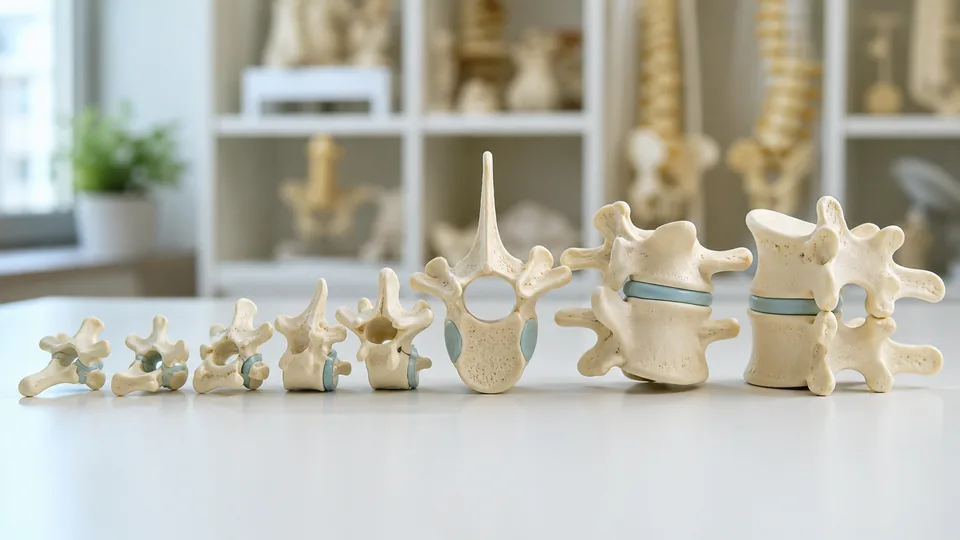
The difference between memorizing “L4” on a page and seeing a lumbar vertebra from three angles is enormous. Spinous processes suddenly jut backward, nerve roots squeeze through narrow openings, and an intervertebral disc becomes something you can point to rather than another colored patch in a textbook. Vertebrae models bring that spatial anatomy into focus for students, teachers, clinicians, artists, and curious learners.
Yet these models serve very different purposes. A flexible, full-length spine is useful for demonstrating curves and broad movement, while an enlarged L4-L5 model makes disc herniation easier to explain across a desk. Common buying mistakes include choosing a model that is too large for the workspace, expecting a compact lumbar model to show cervical anatomy, or paying for extensive detail that will rarely be used. Scale, anatomical coverage, flexibility, color coding, stability, and visible nerves or vessels matter far more than flashy listing language.
Different buyers will land in different places, but the breesky 34.6-inch Spine Model offers the strongest balance for broad anatomy study. It covers the full vertebral column, includes a pelvis and key neurological and vascular structures, and bends for movement demonstrations. The more specialized options below may be better for cervical study, lumbar instruction, or progressive degeneration.
Quick Answer
Best overall: The breesky 34.6-inch Spine Model combines life-size proportions, flexible positioning, a pelvis, nerves, arteries, and a visible lumbar herniation. For a lower-cost, desk-friendly lumbar study aid, the breesky Lumbar Spine Model is the better fit. Clinics explaining progressive vertebral changes may prefer the premium GPI Anatomicals 4-Stage Vertebrae Model, while the EVOTECH SCIENTIFIC model is the standout choice for focused cervical anatomy.
For a fast side-by-side view, the table highlights the scale, anatomical region, and defining feature of each selection.
Best Vertebrae Models Comparison Table
| Product | Best For | Scale or Coverage | Key Feature |
|---|---|---|---|
| breesky 34.6-Inch Spine Model | Overall anatomy study | Life-size full spine | Flexible spine with pelvis, nerves, and arteries |
| Human Anatomical Lumbar Herniation Model | Budget demonstrations | Focused lumbar region | Shows disc prominence during bending |
| breesky Lumbar Spine Model | Students | Life-size lumbar spine | Five vertebrae, sacrum, nerves, and stand |
| 2-Piece Lumbar Spine Model Set | Comparative teaching | Life-size and 1.5-times enlarged components | Separate lumbar and herniation models |
| NLShan Colored Full-Size Spine Model | Color-guided learning | 34.6-inch full spine | Colored structures and removable femur heads |
| EVOTECH SCIENTIFIC Neck Vertebrae Model | Cervical anatomy | Life-size neck region | Brainstem, muscles, nerves, and arteries |
| 34.6-Inch Flexible Spine Model | Classroom reference | Life-size full spine | Flexible column with anatomy chart |
| NLShan Scientific Lumbar Spine Model | Compact displays | Life-size lumbar region | Five vertebrae, sacrum, coccyx, and stable base |
| GPI Anatomicals 4-Stage Vertebrae Model | Degeneration education | Four comparative vertebral models | Normal through advanced degenerative changes |
The detailed reviews below explain where each model shines and which limitations matter in a classroom, office, or home study space.
1. breesky 34.6-Inch Life-Size Spine Model | Best Overall

Broad anatomical coverage earns this breesky model the top spot. Its 34.6-inch vertebral column shows the vertebral bodies, spinous and transverse processes, spinal canal, facet joints, nerve branches, and vertebral artery. The occipital bone at the top and complete male pelvis below give the spine context, so learners can follow the column from skull base to sacrum instead of studying disconnected segments.
A flexible internal wire lets an instructor bend, twist, and rotate the column. Picture a physical therapy lesson where a rigid classroom skeleton cannot hold a lateral curve. This model can be positioned to make that curve visible, then returned to its stand. A herniated disc between L4 and L5 also provides a clear focal point for lumbar discussions, while removable femur heads broaden its usefulness for pelvic orientation.
Pros
- Life-size column provides a coherent view of cervical, thoracic, and lumbar regions
- Flexible core supports bending, twisting, and positional demonstrations
- Includes nerves, vertebral artery, pelvis, sacrum, and occipital bone
- Visible L4-L5 herniation supports focused lumbar instruction
- Metal stand and washable PVC suit repeated display and handling
Cons
- Full-length construction needs more storage and display room than a lumbar model
- Broad coverage is less focused than an enlarged regional model for tiny landmarks
This is the sensible choice for buyers who need one model to handle general anatomy, patient education, and movement demonstrations. Chiropractic students, anatomy instructors, artists, and clinic staff can all pull useful lessons from it. Buyers studying a single cervical or lumbar structure in depth may prefer a regional model, but this breesky delivers the most versatile foundation among these nine picks.
To buy this product, click here.
2. Human Anatomical Lumbar Herniation Model | Best Budget Pick

For buyers concentrating on lumbar disc mechanics, this compact model avoids the bulk and expense of a full vertebral column. Its central purpose is straightforward: it shows how an intervertebral disc becomes prominent as the lumbar segment bends. That moving visual can turn an awkward explanation involving hand gestures and a sketch pad into a quick, understandable demonstration.
The model uses PVC that is easy to wipe down and suits a desk, teaching bench, or student study area. A medical student can rotate it while reviewing disc anatomy, while an educator can use it to introduce herniation before moving to more detailed diagrams. Its narrow scope is the attraction here. Every inch of the model directs attention toward the lumbar disc rather than surrounding skeletal structures.
Pros
- Focused design demonstrates lumbar disc herniation mechanics
- Compact format fits easily on a desk or classroom bench
- PVC construction is simple to clean and maintain
- Useful for student review and short patient-education discussions
- Accessible option for buyers who do not need a complete spine
Cons
- Limited anatomical coverage makes it unsuitable for full-column study
- Provides less contextual detail than models that include the sacrum, pelvis, or several vertebral levels
Choose this model for a tightly focused teaching task rather than a complete vertebral anatomy curriculum. It makes sense in a small office, at a tutoring table, or inside a student’s study kit. Teachers presenting to a large room will likely want a bigger display, and advanced learners may need more visible landmarks, nerves, and adjacent structures.
To buy this product, click here.
3. breesky Life-Size Lumbar Spine Model | Best for Students

This breesky model occupies a useful middle ground between a tiny disc demonstrator and a floor-to-skull spinal column. It presents all five lumbar vertebrae with intervertebral discs, the sacrum, lumbar nerves, and spinal cord. A herniated disc adds pathology-oriented context, yet the life-size proportions preserve the spatial relationships students need for routine anatomy review.
Portability is where the design clicks. The stand is removable, and the model can be taken apart when closer inspection is useful. Imagine carrying it from a dorm room to a study group, setting it upright beside a laptop, then passing the segment around as classmates identify nerve pathways. Its compact footprint and wipe-clean PVC are far easier to manage than a full-size spine in that situation.
Pros
- Shows all five lumbar vertebrae with intervertebral discs
- Includes the sacrum, spinal cord, nerves, and a herniated disc
- Life-size scale supports realistic spatial study
- Removable stand makes transport and storage more convenient
- Components can be taken apart for closer examination
Cons
- Does not provide cervical or thoracic anatomy
- Smaller presentation format may be harder to see from the back of a large classroom
Students, tutors, and clinicians seeking a portable lumbar reference should place this high on the list. It includes considerably more regional context than a two-vertebra disc model without becoming a storage headache. Buyers planning whole-spine biomechanics lessons should step up to the full-size breesky, while lumbar-focused learners get better day-to-day convenience here.
To buy this product, click here.
4. 2-Piece Lumbar Spine and Herniated Disc Model Set | Best for Comparative Teaching

Side-by-side teaching often works better than repeatedly turning one model around and asking learners to imagine the missing comparison. This two-piece kit addresses that problem with a life-size lumbar model containing five vertebrae, the sacrum, and spinal discs, plus a dedicated herniated-disc model. The enlarged component emphasizes the L4-L5 area at 1.5 times scale, making the disc relationship easier to see.
That pairing fits a classroom table particularly well. One group can trace lumbar alignment on the complete segment while another studies the enlarged herniation, then the pieces can swap places. Detachable components assemble without tools and keep transport manageable. The PVC construction is intended for repeated educational handling, a practical detail where models tend to travel between cabinets, desks, and eager hands.
Pros
- Includes two complementary models for direct comparison
- Full lumbar segment shows five vertebrae, sacrum, and discs
- Enlarged component makes L4-L5 features more visible
- Detachable, tool-free design supports transport and storage
- Useful for classroom stations and focused clinic explanations
Cons
- Two separate pieces require more organization than a single compact model
- Coverage remains confined to the lumbar region
Educators who frequently contrast broad lumbar alignment with a close view of disc herniation will get the most from this set. It is also appealing for small-group labs where two learning stations are more useful than one elaborate display. Buyers seeking a single grab-and-go object might favor the breesky lumbar model, but the comparative value of this pair is hard to miss.
To buy this product, click here.
5. NLShan 34.6-Inch Colored Full-Size Spine Model | Best for Color-Guided Learning

Bone-white models can become a visual jumble for a beginner staring at dozens of similar contours. The NLShan model uses different colors to distinguish structures, helping learners orient themselves before memorizing finer landmarks. Its 34.6-inch full-spine format also includes nerves, arteries, a lumbar column, and removable femur heads, creating a broad reference from the upper spine through the pelvis.
The listing describes a flexible spinal design based on human bone anatomy, with PVC construction that can be cleaned after handling. Color cues can be especially useful during patient education or an introductory class. Instead of saying “follow this tiny structure downward,” an instructor can point to a distinct color and keep the conversation moving. Artists studying posture may also appreciate seeing how the full column meets the pelvis.
Pros
- Color differentiation helps beginners identify adjacent structures
- Full-size format shows overall spinal alignment
- Includes nerves, arteries, lumbar structures, and pelvis
- Removable femur heads add pelvic and hip context
- Flexible, washable PVC construction suits teaching and display
Cons
- Color coding may be less desirable for buyers seeking a uniformly bone-colored reference
- Full-height model is less convenient to transport than a regional spine segment
This NLShan is a strong choice for visual learners, introductory anatomy courses, and conversations where fast structure recognition matters. Its color treatment is the key reason to choose it over another life-size spine. Advanced students who prefer subtle, specimen-like coloration may lean elsewhere, while beginners can benefit from the immediate visual separation.
To buy this product, click here.
6. EVOTECH SCIENTIFIC Life-Size Neck Vertebrae Model | Best for Cervical Anatomy

Cervical anatomy becomes crowded very quickly. Vertebrae sit near nerves, arteries, muscles, and the brainstem, so a bare stack of seven bones tells only part of the story. EVOTECH SCIENTIFIC includes all seven cervical vertebrae, upper thoracic vertebrae, spinal nerves, vertebral arteries, surrounding muscles, and the brainstem in one life-size regional display.
Color coding separates the major tissue groups: arteries are red, nerves yellow, muscles brown or red, and the brainstem orange. During a neck-anatomy lesson, those colors offer instant orientation amid the dense tangle of structures. A stable white base supports tabletop viewing, and PVC construction helps the model retain its shape through regular classroom or office use.
Pros
- Provides focused coverage of all seven cervical vertebrae
- Includes brainstem, upper thoracic vertebrae, muscles, nerves, and arteries
- Color-coded structures support quick visual identification
- Life-size proportions preserve realistic regional relationships
- Stable base makes it practical for tabletop demonstrations
Cons
- Specialized cervical coverage does not support lumbar or pelvic study
- Dense surrounding anatomy may feel visually busy for a learner studying vertebral bones alone
Massage therapy programs, chiropractic trainees, anatomy students, and educators concentrating on the neck will find far more relevant detail here than on a generic lumbar model. It is also useful for explaining how nerves and vessels travel around the cervical column. Buyers needing broad posture demonstrations should choose a complete spine, but focused neck instruction is this model’s turf.
To buy this product, click here.
7. 34.6-Inch Flexible Human Spine Model | Best With Reference Chart

This 34.6-inch model combines a familiar life-size vertebral column with a handy anatomy chart. The model depicts vertebral bodies, spinous and transverse processes, spinal canal, facet joints, vertebral arteries, nerve branches, an L4-L5 herniation, the sacrum, pelvis, and occipital bone. The chart gives learners somewhere to check terminology while the three-dimensional column supplies the shape and depth.
Flexibility supports demonstrations of spinal curvature, flexion, extension, and rotation. In a busy lab, an instructor might bend the column into position, ask students to identify the affected region, then direct them to the chart for reinforcement. A metal support and 7-by-7-inch base provide a defined tabletop footprint, useful information for anyone measuring a shelf or presentation area before ordering.
Pros
- Life-size spine covers the complete vertebral column
- Flexible construction supports movement and curvature demonstrations
- Includes nerves, arteries, pelvis, sacrum, and occipital bone
- Visible L4-L5 herniation adds a focused teaching feature
- Included anatomy chart connects physical study with labeled reference
Cons
- Requires substantially more vertical storage space than a lumbar segment
- The broad full-spine format offers less enlargement of individual vertebrae
This model suits classrooms and self-directed learners who like moving between a labeled reference and a physical object. The chart gives it a practical edge over a similarly configured spine sold alone. Buyers who already own detailed wall charts may prefer the top-ranked breesky, while anyone building a study station from scratch may appreciate the bundled reference.
To buy this product, click here.
8. NLShan Scientific Lumbar Spine Model | Best Compact Display

A model that stays upright and ready often gets used more than one tucked into a cupboard. The NLShan Scientific Lumbar Spine Model pairs a compact format with a sturdy base, making it well suited to a desk, office shelf, or small teaching station. It displays five lumbar vertebrae, the sacrum, coccyx, and spinal discs at life size.
The stand is removable, which helps when the model needs to travel between a classroom and an office. Assembly is straightforward, and PVC construction supports routine handling. For a teacher pointing out how the lumbar column transitions into the sacrum, the inclusion of the coccyx provides useful lower-end context without bringing a full pelvis into the already crowded workspace.
Pros
- Shows five lumbar vertebrae, sacrum, coccyx, and spinal discs
- Life-size design supports realistic regional study
- Solid base keeps the model upright for display
- Removable stand improves portability and storage
- Compact footprint fits offices and smaller learning spaces
Cons
- Does not include the neurological detail listed for some competing lumbar models
- Fixed regional coverage cannot demonstrate whole-spine alignment
This NLShan model works best for buyers who value a tidy, stable lumbar display over extensive extras. It covers the bony transition through the coccyx clearly and does not dominate a desk. Students requiring visible spinal nerves may prefer the breesky lumbar option, while offices wanting a straightforward skeletal reference can keep this one within easy reach.
To buy this product, click here.
9. GPI Anatomicals 4-Stage Vertebrae Model | Best Premium Comparative Model

GPI Anatomicals takes a different route from the full-column models. Four vertebral displays sit side by side, progressing from normal anatomy through bulging or herniated disc, bone and disc degeneration, and advanced osteoporosis. The final stage shows compression and bone spurs, letting viewers compare structural change without swapping pieces or relying on several separate illustrations.
The models share a display base and come with an information card. Each vertebral model measures 3.5 by 2.75 by 3 inches, while the complete base measures 10.625 by 6.25 inches. Set on a consultation desk or classroom counter, the sequence reads from left to right in a clean visual progression. That immediacy is compelling, particularly where the lesson concerns change across stages rather than spinal movement.
Pros
- Displays four spinal conditions in a direct side-by-side sequence
- Shows normal anatomy, herniation, degeneration, and advanced osteoporosis
- Includes visible compression and bone-spur changes
- Shared display base keeps all four stages organized
- Information card supports structured educational discussions
Cons
- Higher-end positioning may exceed the needs of casual home learners
- Static vertebral stages cannot demonstrate whole-spine curves or flexible movement
This is the most purposeful option for teaching progressive structural change. Clinics, health-science classrooms, and educators who repeatedly compare normal and degenerative anatomy can justify its specialized format. A student learning vertebral levels or spinal curvature should buy a complete spine instead, but few models here communicate progression as quickly as this four-stage display.
To buy this product, click here.
How to Choose a Vertebrae Model
Match the Anatomical Region to the Lesson
Start with what needs to be visible. A complete spine makes sense for studying vertebral regions, overall curvature, and the relationship between the skull and pelvis. It also creates a striking classroom presence. The trade-off is space: a roughly three-foot model is awkward to carry through a crowded hallway and needs a tall storage area.
Regional models are easier to handle and usually provide a cleaner view of a specific area. A lumbar segment supports lessons about L1 through L5, discs, the sacrum, and nerve roots. A cervical model is the sharper tool for neck muscles, vertebral arteries, and the brainstem. Think of the study session itself. If every question concerns the lower back, hauling out a full spine adds bulk rather than insight.
Decide Between Life-Size and Enlarged Anatomy
Life-size scale preserves realistic proportions. This matters for spatial learning, drawing reference, and understanding how neighboring structures fit together. Students preparing for practical identification often benefit from seeing landmarks at approximately their natural scale rather than learning from an oversized interpretation.
Enlargement has a different advantage. A 1.5-times model can make a disc, nerve, or vertebral opening easier to see across a table. It is especially useful when several learners crowd around one teaching station. Enlarged models sacrifice realistic size, so they work best as supplements or focused demonstrators rather than universal references.
Look Closely at Flexibility and Movement
A flexible core is valuable for explaining spinal curves, rotation, lateral bending, flexion, and extension. It lets an instructor hold the column in a visible position while discussing the involved region. That tactile shift from straight to curved can make biomechanics feel far less abstract.
Flexibility matters less for static landmark identification. A rigid model on a stable base may be easier to point at, label, or sketch because the anatomy does not drift out of position. For progressive degeneration, separate static stages are often clearer than a bending model. The right mechanism follows the lesson, rather than serving as a feature collected for its own sake.
Evaluate Included Nerves, Vessels, and Soft Tissues
Bare-bone vertebrae models are clean and approachable, which helps beginners focus on processes, bodies, and arches. More elaborate models add spinal nerves, arteries, muscles, discs, and the spinal cord. Those structures provide vital context for advanced study, yet they can create a busy thicket of colors and shapes for someone learning vertebrae for the first time.
Check the listing for each structure you genuinely need. Cervical teaching may benefit from vertebral arteries and surrounding muscles, while lumbar instruction often centers on discs and nerve roots. Avoid assuming that every full-size model includes the same soft-tissue details. Product photographs and supplied specifications should confirm what is present.
Consider Color Coding
Color coding is wonderfully quick in a lively class. Yellow nerves and red arteries stand out immediately, helping a student follow an instructor’s finger before the moment slips away. Distinct colors also make patient-facing educational conversations easier to follow without burying the viewer in terminology.
A neutral bone-colored model may be preferable for artistic reference or realistic skeletal study. Bright colors can pull attention away from subtle bone contours, and different manufacturers may use color in different ways. Choose colors for clarity, then verify the legend or listing rather than treating color alone as anatomical identification.
Check the Stand and Storage Footprint
Stability sounds dull until a tall spine begins swaying beside a laptop. A metal support and broad base are useful for full-column models, especially in spaces where students regularly reposition them. Compact models benefit from removable stands, which allow close handling and easier packing.
Measure the intended shelf, cabinet, or desktop. Pay attention to height as well as base width, and leave room to lift the model off its support. A sturdy model that cannot fit inside the available storage area quickly becomes an inconvenient piece of office furniture.
Balance Detail With Everyday Usability
More components can deepen a lesson, but every removable piece creates another item to track. Models passed around a classroom should be easy to reassemble and durable enough for repeated contact. Washable PVC is common among these selections and offers practical upkeep for shared learning spaces.
For individual study, portability may matter more than maximum detail. A compact lumbar segment can move from shelf to backpack with little fuss, whereas a full spine offers broader anatomy at the cost of convenience. Buy for the lessons that happen every week, not the rare presentation that might happen someday.
Best Vertebrae Models FAQ
Is a Full-Spine Model Better Than a Lumbar Model?
A full spine is better for vertebral regions, spinal curves, posture demonstrations, and the relationship between the skull, sacrum, and pelvis. A lumbar model is better for close study of L1 through L5, discs, nerve roots, and the lumbosacral transition. The stronger choice depends on the anatomical region used most often.
What Scale Is Best for Anatomy Students?
Life-size models offer realistic proportions and are a strong general choice. Enlarged models make small structures easier to see during group instruction. Many students benefit from a life-size primary model paired with enlarged diagrams or a focused regional demonstrator.
Do Vertebrae Models Show Herniated Discs?
Some do, but the feature is not universal. Several models in this guide depict a lumbar herniation, commonly around L4-L5, while the GPI model presents herniation as one stage in a comparative sequence. Verify the listing if disc pathology is central to the intended lesson.
Are Flexible Spine Models Anatomically Accurate in Every Position?
Flexible models are educational representations for illustrating curves and broad movement. Their bendable cores are helpful for visualization, but they do not recreate every constraint of living ligaments, muscles, joints, and soft tissues. Use them as spatial teaching aids rather than biomechanical simulators.
Are Color-Coded Models Better for Beginners?
They often make nerves, vessels, muscles, and separate regions faster to identify. This can reduce confusion during an introductory lesson. Learners focused on realistic bone appearance or artistic reference may prefer neutral coloration, so color coding is a learning preference rather than an automatic mark of quality.
Which Vertebrae Model Is Best for a Small Desk?
A lumbar segment such as the breesky Lumbar Spine Model or NLShan Scientific Lumbar Spine Model is easier to accommodate than a 34.6-inch column. The NLShan’s stable base makes it particularly display-friendly, while the breesky adds nerves and a herniated disc for deeper regional study.
Can These Models Be Used for Patient Education?
Yes, they can support general visual explanations of spinal anatomy and structural changes. A compact disc model may clarify a focused lumbar discussion, while the GPI display shows progressive changes side by side. These products are educational aids and do not replace individualized evaluation or professional medical instruction.
How Should a PVC Anatomy Model Be Cleaned?
Follow the manufacturer’s care directions. For models described as washable or wipe-clean, a soft damp cloth is generally the gentlest approach. Avoid aggressive solvents, abrasive pads, and forceful bending, since painted details, flexible cores, and small attached structures may require careful handling.
Final Verdict
The breesky 34.6-Inch Life-Size Spine Model is the strongest overall choice because it covers the complete vertebral column while adding a flexible core, nerves, a vertebral artery, pelvis, occipital bone, and L4-L5 herniation. It can move from a broad lecture on spinal regions to a focused demonstration of curvature without swapping models. That versatility makes it particularly appealing for anatomy classrooms, chiropractic study, art reference, and general patient education.
More specialized needs deserve a specialized pick. The Human Anatomical Lumbar Herniation Model offers a budget-friendly route to focused disc demonstrations, while the EVOTECH SCIENTIFIC Neck Vertebrae Model brings cervical nerves, vessels, muscles, and the brainstem into one detailed regional view. For premium side-by-side instruction, the GPI Anatomicals 4-Stage Vertebrae Model communicates progressive structural changes with impressive clarity. Match the model to the anatomical region, viewing distance, storage space, and type of lesson, and it will become a reference people actually reach for rather than another object gathering dust on a high shelf.
