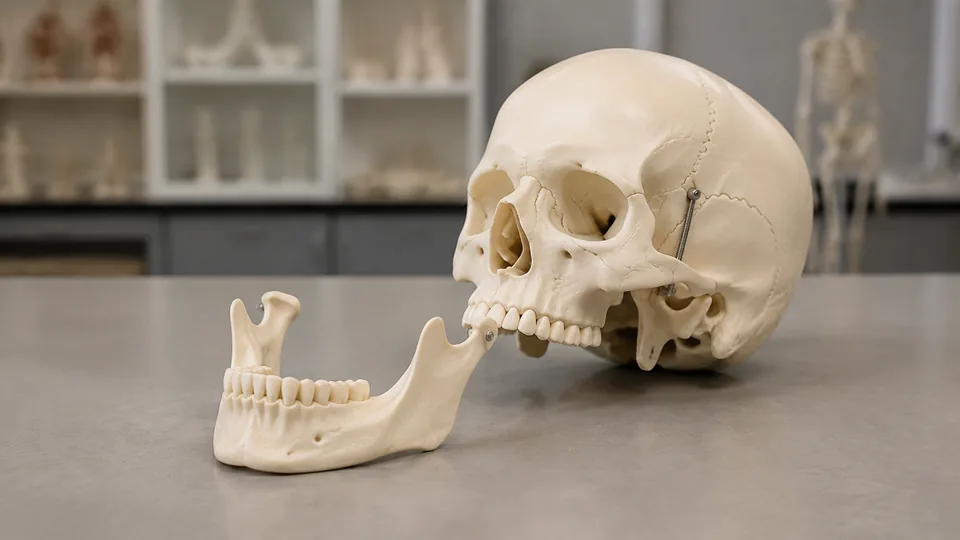
The jaw is where skull anatomy stops feeling like a flat map and starts making spatial sense. Lift the mandible, trace the condylar process toward the temporal bone, then remove it to inspect the surrounding landmarks. That simple bit of movement can make a study session far more memorable, whether you are learning cranial anatomy, explaining mastication to a class, or sketching the head from several angles.
Models in this category differ more than their ivory-colored shells suggest. Some have fully detachable mandibles, while others use springs to create an articulated jaw. Removable calvaria, visible foramina, clear sutures, color coding, permanent labels, and realistic proportions can also separate a serious study aid from a decorative replica. A common buying mistake is concentrating on appearance while overlooking scale, internal access, and how securely the pieces reconnect.
Different users naturally have different priorities. A medical student may want a life-size, three-part model with accessible cranial fossae, while an art student might care more about bone texture and silhouette. The Anatomy Lab Human Skull Model is the strongest all-around choice here because it combines life-size proportions, a removable calvaria, and an articulating mandible in a straightforward educational design.
Quick Answer
Best overall: The Anatomy Lab Human Skull Model offers the most balanced combination of scale, separable parts, classroom utility, and approachable value. For highly portable revision, the Axis Scientific miniature is the clever pick, complete with 57 labeled structures and a matching guide. Visual learners should look toward the Medarchitect colored model, while artists and collectors seeking a textured, aged reproduction may prefer the handmade Nose Desserts replica.
For a quick side-by-side view, the table below highlights the differences that matter most before the detailed reviews.
Best Skull Models With Removable Jaw Comparison Table
| Product | Best For | Scale or Size | Jaw and Study Features |
|---|---|---|---|
| Anatomy Lab Human Skull Model | Best overall | Life-size | Articulating mandible, removable calvaria, three-part design |
| Human Adult Skull Anatomical Model | Students using an atlas | 9 inches high | Articulated mandible, magnetic calvaria, included chart |
| Life-Size 3-Part Human Skull Model | Studying foramina and fossae | Life-size | Articulated mandible, magnetic skull cap, clear sutures |
| Axis Scientific Miniature Skull | Portable study | 3.5 inches high | Articulating jaw, removable cap, 57 labeled structures |
| Laser-Etched Anatomical Skull | Permanent reference labels | Life-size | Detachable mandible, removable calvaria, etched numbering |
| Merinden Skull Model | Everyday classroom use | 7.2 by 4.2 by 4.95 inches | Articulated mandible, magnetic calvaria, included chart |
| RONTEN Painted Medical Skull | Color-guided instruction | Life-size | Spring-attached moving jaw, removable cap, painted structures |
| Medarchitect Colored Skull Model | Identifying cranial bones | Life-size | Three-part construction, 22 bones shown in nine colors |
| Nose Desserts Aged Skull Replica | Artists and realistic display | 6.75 by 6 by 5 inches | Unattached mandible, hollow one-piece cranium, textured finish |
The reviews below look more closely at how each jaw mechanism, removable component, and visual aid fits a particular kind of buyer.
1. Anatomy Lab Human Skull Model: Best Overall

The Anatomy Lab model hits the practical sweet spot for students, teachers, artists, and anatomy enthusiasts. Its life-size form gives cranial landmarks enough room to inspect without turning a desk into a crowded laboratory bench. The three-part arrangement separates into the calvaria, cranial base, and mandible, allowing a learner to move from the outer sutures to the interior cavity during the same revision session.
An articulating jaw adds useful movement for demonstrating the relationship between the mandible and the rest of the skull. Picture an instructor rotating the model through a small classroom, opening the jaw to discuss the mandibular condyle and then lifting the cap to reveal the inner surface. That versatility is the chief reason this model ranks first. The manufacturer also states that its US-based medical team inspects models for anatomical accuracy, a reassuring detail for buyers seeking an educational tool rather than a spooky shelf ornament.
Pros
- Life-size proportions support close study and classroom demonstrations
- Three separable sections provide access to exterior and interior anatomy
- Articulating mandible helps illustrate basic jaw relationships
- Removable calvaria makes the cranial cavity easier to inspect
- Backed by US-based customer support and a stated replacement or refund policy
Cons
- Basic uncolored presentation requires an atlas for quick bone identification
- Lacks the permanent numbering found on specialized labeled models
This is the sensible choice for someone who wants one skull to cover coursework, demonstrations, drawing reference, and general display. Visual learners who rely heavily on color coding may favor the Medarchitect or RONTEN models, but the Anatomy Lab skull offers a cleaner view of natural-looking boundaries. Its balanced feature set makes it easier to keep using after the first anatomy course ends.
To buy this product, click here.
2. Human Adult Skull Anatomical Model, 3 Part: Best for Atlas-Based Study

Standing 9 inches high, this three-part skull gives learners a generously sized reference for locating fissures, processes, sutures, and major bones. The listing states that it was cast from a real adult specimen, which makes it attractive to buyers who want realistic proportions and recognizable surface anatomy. Its PVC construction can be washed, a useful trait when the same model passes through many hands around a study table.
The skull cap uses magnets and small pegs, so opening the cranium should feel more deliberate than wrestling with a loose lid. The articulated mandible supplies the movement expected from a removable-jaw study model, while the included colorful skull chart provides a convenient visual bridge. During a late-night review, that chart can sit beside the model as you trace a suture with one finger and confirm the structure with the other, reducing the constant shuffle between several books.
Pros
- Large 9-inch height gives anatomical landmarks ample visibility
- Three-part construction separates the calvaria, base, and mandible
- Magnets and pegs help align the removable skull cap
- Washable PVC is convenient for shared educational settings
- Includes a colorful reference chart for guided study
Cons
- Unnumbered skull surfaces may slow rapid landmark drills
- Larger format takes more bag and desk space than compact models
Students who like pairing a physical model with a printed guide have the clearest reason to choose this option. It suits home study, tutoring, and smaller classroom demonstrations where the model can be passed around for close inspection. Buyers needing permanent labels on the skull itself should move toward the laser-etched pick, while commuters will find the Axis Scientific miniature much easier to carry.
To buy this product, click here.
3. Life-Size 3-Part Human Skull Model: Best Detailed Basic Model

Clear foramina, fossae, sutures, and individual bone boundaries give this model a more study-focused character than a plain decorative skull. Those openings and depressions matter during cranial anatomy lessons because they turn vague names on a page into physical locations. The realistic bone texture adds another layer of visual reference, especially for art students practicing the planes and shadow pockets of the face.
Its removable calvaria attaches with magnets and small pegs, balancing easy access with secure replacement. Below it, the articulated mandible makes the model useful for discussing jaw placement or setting up a side-profile drawing. A colorful skull chart is included for reference. Imagine a small study group gathered around a kitchen table: one person calls out a landmark, another locates it on the skull, and a third checks the chart. This model is built for that tactile rhythm.
Pros
- Life-size format is suitable for close study and teaching
- Clearly presented foramina, fossae, and sutures support landmark identification
- Magnetic, pegged calvaria offers practical access to the interior
- Articulated mandible adds a useful moving component
- Includes a colorful skull chart for cross-referencing structures
Cons
- Natural-color exterior lacks instant color separation between bones
- Small pegs require reasonably careful handling during repeated disassembly
This model makes sense for learners who care more about openings, depressions, and suture definition than bold labels or painted regions. It is especially well matched to anatomy and physiology coursework where students repeatedly identify structures from different angles. Anyone planning fast, label-driven drills may prefer the laser-etched model, but this one keeps the surface uncluttered for practical examinations and drawing.
To buy this product, click here.
4. Axis Scientific 3.5-Inch Miniature 3-Part Human Skull Model: Best Compact Option

Portability is the Axis Scientific model’s big trick. At 3.5 inches tall, it can sit beside a laptop, slip into a lab bag, or travel between home and campus without hogging precious space. Despite its small stature, the skull separates into three parts, with a removable cap and articulating jaw that provide access to external and internal features.
The model identifies 57 structures, including major bones, sutures, foramina, and the anterior cranial fossa. Its full-color manual uses photographs of this exact skull, helping users connect each numbered marking with what is physically in hand. That direct correspondence is valuable on a cramped dorm-room desk where opening a huge atlas can feel like unfolding a road map. Axis Scientific also lists a three-year warranty and US-based support, which strengthens the appeal for students carrying it from class to class.
Pros
- Highly portable 3.5-inch size fits small desks and study bags
- Three-part construction retains useful removable anatomy
- Features 57 labeled structures for organized revision
- Photo-based manual corresponds directly with the model
- Supported by a stated three-year warranty and US-based service
Cons
- Small scale makes tiny landmarks harder to inspect than on life-size skulls
- Less suitable for demonstrations viewed from across a classroom
This is the standout choice for commuters, students in tight living spaces, or anyone who wants a second skull for quick review. The labels and matching manual create a structured learning path without demanding a permanent study station. It is less convincing as an artist’s proportion reference or a whole-class teaching aid, so buyers needing real-scale relationships should choose one of the life-size models instead.
To buy this product, click here.
5. Upgraded Laser-Etched Human Skull Anatomical Model: Best Permanent Labeling

Handwritten markings can fade, smear, or become awkward to read after repeated handling. This life-size model addresses that headache with laser-etched fonts and numbers cut permanently into the surface. For learners who build revision sessions around numbered structures, the regular, uniform markings can make rapid identification drills feel cleaner and less frustrating.
The model still offers the physical access expected from a serious three-part skull. Its calvaria, cranial base, and mandible separate, allowing users to study the internal cavity and lower jaw independently. The non-toxic PVC surface can be cleaned without wiping away the etched reference points, according to the listing. In a busy classroom, where fingertips, dry-erase dust, and the occasional coffee splash are facts of life, permanent markings carry genuine practical value. An instruction sheet accompanies the model for reference.
Pros
- Laser-etched numbers and fonts resist smudging and fading
- Life-size construction supports realistic spatial study
- Three-part design includes a separable mandible and calvaria
- Markings remain readable after routine surface cleaning
- Includes an instruction sheet for identifying references
Cons
- Visible numbers make it less suitable for unprompted identification practice
- Etched text creates a less natural appearance for art reference or display
Choose this model for repeated coursework, tutoring sessions, or classroom stations where labels receive constant use. It removes the anxiety of painted numbers gradually rubbing away and gives beginners a clear set of reference points. Students preparing for an unlabeled practical exam may still need to cover the markings or pair it with a plain skull, while artists are likely to prefer an uninterrupted bone-colored surface.
To buy this product, click here.
6. Merinden Human Skull Anatomy Model: Best for Everyday Classroom Use

The Merinden skull is a straightforward teaching model measuring 7.2 by 4.2 by 4.95 inches. Its form was reportedly cast from a real adult specimen, with fissures, sutures, processes, and major cranial regions represented for study. That size gives instructors and students a manageable physical reference that can move from a shelf to a demonstration table without fuss.
Three sections separate at the calvaria, cranial base, and mandible. Magnets secure the removable skull cap, while the articulated jaw lets a teacher demonstrate movement and then detach the lower section for closer inspection. Washable PVC helps with routine upkeep, and the included colorful chart adds quick visual guidance. This is the kind of model that works well during tutoring: point, rotate, remove the cap, check the chart, then hand it over so the learner can repeat the sequence.
Pros
- Manageable dimensions suit desks, shelves, and teaching tables
- Three-part design provides access to the cranial cavity and mandible
- Magnetic skull cap simplifies opening and replacement
- Washable PVC supports regular shared handling
- Colorful reference chart is included for guided learning
Cons
- Smaller than some full-size alternatives listed here
- No permanent surface labels for rapid numbered drills
The Merinden is a practical middle-ground choice for parents, tutors, teachers, and students who want common educational features without a strongly specialized presentation. Its washable surface and magnetic cap fit repeated everyday handling particularly well. Buyers needing large, room-visible color separation should consider the Medarchitect model, while those seeking detailed numbering will get more direction from the Axis Scientific or laser-etched options.
To buy this product, click here.
7. RONTEN Painted Medical Skull Model: Best for Guided Demonstrations

Brightly painted structures make the RONTEN skull easy to follow during a guided explanation. Instead of watching a learner squint at several pale boundaries, an instructor can point to a colored region and connect it with the included skull diagram. The life-size, three-piece format separates into the cranium, skull base, and mandible, giving the colors a useful spatial framework.
The jaw attaches with a spring that allows it to open slightly while helping prevent accidental detachment during ordinary demonstrations. That mechanism makes this pick distinct from skulls whose lower jaw is simply lifted away. A nursing instructor discussing basic cranial structure, for example, can open the mouth and rotate the model without immediately juggling a loose mandible. The PVC construction aims for a bone-like tactile feel and a practical weight for desk or bookshelf display.
Pros
- Painted structures create strong visual separation during instruction
- Life-size proportions support realistic orientation
- Three-piece construction opens the skull for internal study
- Spring-attached jaw provides movement while remaining connected
- Includes a skull diagram for matching colored regions
Cons
- Jaw opens only slightly, offering less range than a fully detachable mandible
- Bright colors are less suitable for naturalistic art reference
This model belongs in a teaching environment where visual clarity takes priority over a realistic bone finish. Color can help beginners orient themselves before moving to a plain practical-exam model, and the retained jaw reduces the chance of placing a loose piece on the wrong lab table. Buyers specifically seeking a completely removable mandible should choose one of the other three-part designs, since the spring mechanism emphasizes attached movement.
To buy this product, click here.
8. Medarchitect Human Colored Skull Model: Best for Identifying Cranial Bones
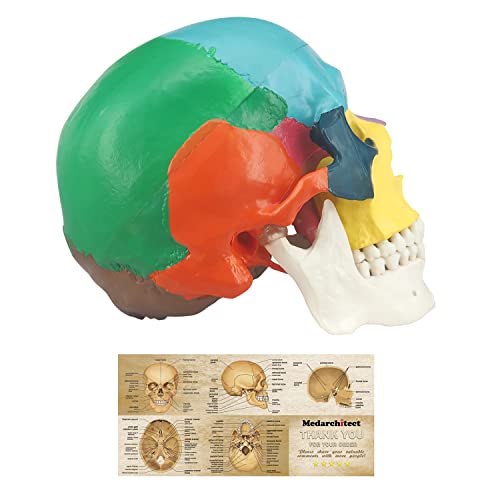
The Medarchitect model turns the skull into a bright visual map. Its 22 individual bones are presented across nine colors, with each bone or paired set receiving distinct treatment for faster identification. For a beginner confronting terms such as sphenoid, temporal, zygomatic, and parietal for the first time, those crisp color changes can make the boundaries feel far less slippery.
This is a life-size, three-part anatomical model supplied with a colorful reference chart. The format supports study from multiple directions rather than locking the user into a single lateral view. Picture a teacher at the front of a room asking students to locate the frontal bone. A bold color is easier to recognize from several seats away than a faint natural suture, which gives this skull particular value for introductory demonstrations and visual learners.
Pros
- Displays 22 skull bones using nine distinct colors
- Color separation helps beginners recognize neighboring bones
- Life-size form works well for demonstrations and desk study
- Three-part construction provides more access than a fixed replica
- Includes a colorful chart for matching bones and regions
Cons
- Painted finish does not resemble natural bone coloration
- Color cues can reduce the challenge of practical identification exercises
Visual learners and introductory anatomy classes are the clearest audience for this model. It can build confidence before students move to an uncolored skull, where boundaries must be recognized from shape and suture position alone. Artists seeking natural light and shadow should skip the saturated finish, while advanced learners may prefer the detailed foramina or permanent numbering offered by other selections.
To buy this product, click here.
9. Nose Desserts Aged Earth-Brown Human Skull Replica: Best for Artists

This handmade replica trades the tidy classroom-white finish for an aged earth-brown surface with tonal and textural variation. Cast directly from a real human skull, it emphasizes bone texture, separated teeth, eye orbits, sutures, optical canal openings, and the interior nasal cavity. Its dimensions are 6.75 inches long, 6 inches high, and 5 inches wide, with a listed circumference of 19 inches.
The lower jaw is fully unattached, giving artists freedom to position the mandible separately for profile studies, still-life arrangements, or theatrical displays. The cranium is a hollow, intact piece without a split skull cap. Set under a desk lamp, the deep orbits and mottled brown surface create strong shadows that a clean teaching skull rarely produces. Each handmade piece can vary in color tone and surface texture, adding character while reducing the uniformity expected from conventional classroom models.
Pros
- Direct-mold casting emphasizes realistic proportions and surface anatomy
- Fully separate mandible allows flexible artistic positioning
- Aged earth-brown finish creates dramatic texture and shadow
- Detailed teeth, eye orbits, sutures, and nasal cavity support observation
- Handmade construction gives each replica individual tonal variation
Cons
- One-piece cranium provides no removable calvaria for interior study
- Loose jaw lacks the controlled movement of an articulated mechanism
Artists, sculptors, photographers, and collectors have the strongest reason to choose this distinctive replica. Its texture and removable lower jaw create expressive possibilities that polished educational models cannot quite match. Medical students focused on the cranial fossae should select a three-part classroom model instead, since the intact cranium restricts access from above. This is the specialized, premium-feeling choice in the group rather than the most versatile academic option.
To buy this product, click here.
How to Choose a Skull Model With a Removable Jaw
Decide Between a Detachable and Articulated Mandible
A completely detachable mandible gives you the clearest access to the lower jaw. It can be turned over, held close to an atlas, or positioned separately for drawing. The trade-off is simple: a loose part can slide off a crowded desk or become separated from the cranium in a shared classroom.
An articulated mandible stays connected and opens through a hinge or spring arrangement. This setup is handy for demonstrating basic movement and keeping all parts together. Check the listing language carefully, since “moving,” “articulated,” and “removable” can describe different mechanisms. The RONTEN jaw, for instance, uses a spring and opens slightly, while several other models here separate into a mandible, cranial base, and calvaria.
Match the Scale to the Learning Environment
Life-size skulls are generally better for understanding adult proportions, studying landmarks, and teaching a group at close range. They also give fingers and pointers more space to trace fine structures. At home, though, a full-size skull can quickly claim half a small desk once an atlas, laptop, and notebook join the party.
Miniature models solve that storage problem beautifully. The 3.5-inch Axis Scientific skull can travel in a bag and remain within reach during quick study breaks, but its small landmarks demand close viewing. A lecturer speaking to a room will usually benefit from a life-size, high-contrast model, while a commuter revising alone may happily accept reduced scale for portability.
Look Beyond the Removable Jaw
A separable mandible is useful, yet the calvaria often determines how much cranial anatomy a model can reveal. A removable skull cap exposes the internal base and cranial fossae, expanding the model’s educational range. Magnetic caps are convenient for frequent opening, while pegs can help with alignment. Both components deserve gentle handling, particularly around narrow projections and small connecting points.
An intact cranium still has value for silhouette, surface texture, and external landmarks. The Nose Desserts replica illustrates that distinction. Its hollow, unsplit skull is compelling for art and display, but it cannot offer the top-down internal access of a three-part educational model.
Choose Natural, Colored, or Numbered Surfaces
Natural bone-colored models force learners to recognize structures through contours, sutures, and position. That makes them useful for art reference and for practicing without visual prompts. The downside appears early in a course, when one pale bone seems to melt into the next under flat room lighting.
Colored models separate neighboring bones instantly, which can make an introductory lesson click faster. Numbered surfaces support rapid drills, especially when paired with a keyed guide. Permanent laser etching is preferable for frequent shared use because routine handling will not smear the references. Learners preparing for an unmarked practical assessment should eventually practice with hidden labels or a plain skull as well.
Examine Anatomical Detail and Included Study Aids
Foramina, fossae, sutures, processes, tooth sockets, and the nasal cavity are more relevant to serious study than a broadly skull-shaped outline. Product descriptions should explicitly mention the landmarks you need. Dentistry, general anatomy, drawing, and classroom demonstration place different demands on a replica, so greater detail is useful only where it supports the lesson.
A matching chart or photo-based manual can reduce the friction of starting. The Axis Scientific guide uses photographs of its exact model, while several life-size picks include colorful charts. Such aids are convenient, but they do not replace a course atlas or instructor. Think of the model as a three-dimensional reference that helps connect approved learning materials with physical space.
Consider Handling, Cleaning, and Storage
PVC appears across many educational models because it is practical and commonly described as washable. Cleaning guidance from the seller should still be followed, especially around painted labels, springs, magnets, and joined teeth. Harsh scrubbing can be risky around fine projections regardless of the main shell material.
Store detachable jaws and calvaria together, preferably in a stable container or dedicated shelf area. A classroom model may be opened hundreds of times across multiple terms, so secure alignment and readable markings matter more there than they would for an untouched display piece. For artists, surface finish and shadow may carry more weight than easy sanitizing, which leads to a very different purchase.
Best Skull Models With Removable Jaw FAQ
Is a Removable Jaw Better Than a Hinged Jaw?
Neither mechanism is universally better. A fully removable jaw is easier to inspect from every angle and can be positioned independently for drawing or demonstration. A hinged or spring-attached jaw keeps the mandible with the skull and illustrates limited movement more conveniently. Choose according to whether separable access or controlled articulation matters more.
Should a Skull Model Also Have a Removable Skull Cap?
A removable calvaria is highly useful for studying the cranial cavity, fossae, and internal base of the skull. Students covering both external and internal cranial anatomy will usually gain more from a three-part model. Artists concentrating on exterior form may be perfectly comfortable with an intact cranium and separate mandible.
Are Life-Size Skull Models Actually the Size of a Human Head?
A bare adult skull looks smaller than a living head because it lacks skin, muscle, hair, ears, and other soft tissues. Listings may also use “life-size” somewhat broadly, so check stated measurements whenever dimensions affect your work. A model around adult cranial proportions is useful for spatial reference, while exact requirements should be verified against the individual listing.
Are Colored Skull Models Good for Anatomy Students?
Colored models are especially helpful during early lessons because they make neighboring cranial bones easier to separate visually. They can also improve visibility during classroom demonstrations. Students should eventually practice without color prompts if their course assessments use plain specimens or uncolored models.
Do Numbered Skull Models Make Studying Easier?
Numbers create an organized path for drills and self-quizzing, provided the model includes a clear corresponding key. Laser-etched markings are well suited to repeated handling because they resist smearing. A numbered model can become less challenging once the locations are memorized, so covering the labels occasionally creates a stronger recall exercise.
Can These Models Be Used for Dental Study?
A skull with a detailed mandible and complete teeth can help visualize general dental orientation, jaw position, and surrounding bony anatomy. Fine dental education may require a specialized model with removable teeth, roots, nerves, or other structures. Verify those features explicitly rather than assuming every skull model includes them.
What Is the Best Skull Model for Drawing?
Artists usually benefit from natural proportions, visible sutures, clear planes, deep cavities, and a jaw that can be positioned independently. The Nose Desserts aged replica is particularly appealing for dramatic texture and shadow, while a plain life-size educational skull gives a cleaner bone-colored reference. Brightly colored teaching models can distract from value and form studies.
How Should an Anatomy Skull Model Be Cleaned?
Follow the manufacturer’s care instructions first. For models described as washable PVC, gentle wiping is generally more appropriate than soaking hardware or scrubbing painted areas. Keep moisture away from magnets, springs, and joins unless the seller confirms that full washing is safe, then dry the model before reassembly and storage.
Final Verdict
The Anatomy Lab Human Skull Model is the strongest overall pick among these nine models. Its life-size proportions, removable calvaria, articulating mandible, and uncomplicated three-part layout cover the needs of most students and teachers without locking the buyer into a specialized color or labeling system. It is equally comfortable beside an anatomy atlas, at the front of a small classroom, or under a lamp for basic drawing practice.
Needs at the edges of the category call for different tools. The Axis Scientific miniature packs 57 labeled structures into a portable model that suits commuters and tight desks. The Medarchitect colored skull gives visual learners clear bone separation, while the Nose Desserts aged replica offers the richest texture for artists and display. Before buying, decide whether you need a fully detachable jaw, attached articulation, internal cranial access, or strong visual cues. That choice matters far more than how impressive the skull looks on a product page.
