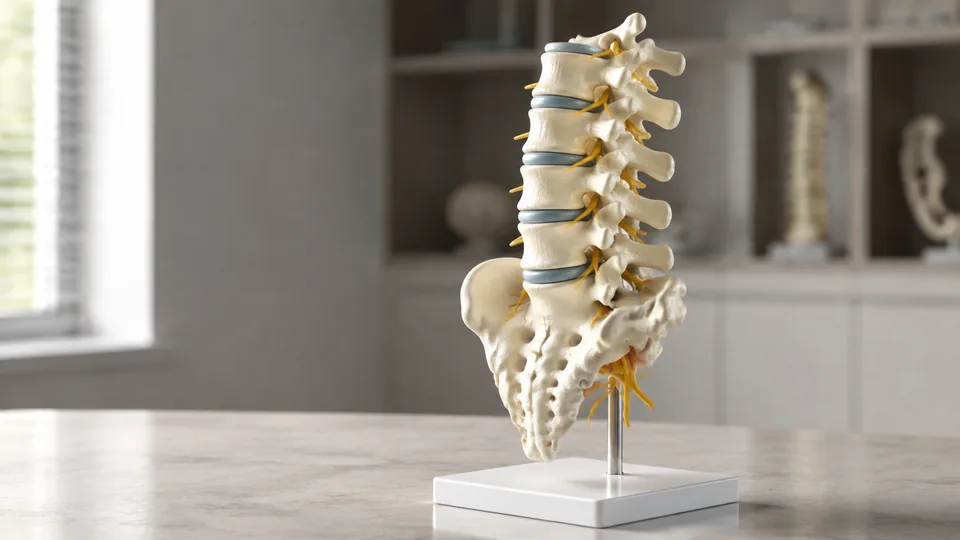
The lower back looks straightforward in a textbook until someone tries to trace a nerve root around a vertebra, explain an L4-L5 disc herniation, or visualize how the lumbar column meets the sacrum. That is where a three-dimensional model earns its desk space. The strongest lumbar spine models make crowded anatomical relationships visible, while weaker choices may omit the nerves, limit movement, or wobble during a demonstration.
Scale, anatomical scope, flexibility, and mounting matter more than glossy presentation. A compact five-vertebra model works beautifully for desk-side patient education and solo study, while a 34-inch vertebral column gives a classroom or chiropractic office far more context. Buyers also have different priorities. Some need an enlarged disc mechanism they can bend and point to, while others need the pelvis, arteries, and full spine in one sweeping view.
The breesky Life-Size Lumbar Spine Model is the strongest overall choice here because it combines all five lumbar vertebrae, discs, nerves, spinal cord structures, a herniated disc, and a removable stand in a portable format. It lands in the useful middle ground between a tiny disc demonstration and a towering full-column model.
Quick Answer
For a balanced model suited to study, office demonstrations, and patient conversations, choose the breesky Life-Size Lumbar Spine Model. The Human Anatomical Lumbar Herniation Model is the appealing budget pick for focused disc demonstrations. Buyers who need a full vertebral column and broader anatomical context should look toward the Axis Scientific Life-Size Spine Model.
Short on reading time? The table offers a clean snapshot of the nine models before the detailed reviews.
Best Lumbar Spine Models Comparison Table
| Product | Best For | Scale or Scope | Key Feature |
|---|---|---|---|
| breesky Lumbar Spine Model | Best overall | Life-size lumbar region | Five vertebrae, nerves, herniated disc, and stand |
| Axis Scientific Spine Model | Premium anatomical reference | 34-inch full spine | Pelvis, nerves, arteries, stand, and manual |
| Human Anatomical Lumbar Herniation Model | Budget disc demonstration | Focused lumbar section | Shows disc behavior during bending |
| NLShan Scientific Lumbar Spine Model | Stable desktop display | Life-size lumbar region | Five vertebrae, sacrum, coccyx, and solid base |
| 2-Piece Lumbar Spine Model Set | Comparative teaching | Life-size model plus enlarged detail | Separate lumbar and herniated-disc models |
| NLShan Lumbar Disc Herniation Model | Enlarged L4-L5 study | 1.5 times life-size | Flexible disc demonstration |
| Flexible 34.6-Inch Spine Model | Classroom biomechanics | 34.6-inch full spine | Flexible column, pelvis, nerves, and chart |
| Ruiishunyy Lumbar Disc Model | Portable demonstrations | 1.5 times life-size | Flexible discs with nerve structures |
| breesky 34.6-Inch Spine Model | Full-spine movement study | 34.6-inch full spine | Positionable column with pelvis and metal stand |
The reviews below explain where each model fits, from a crowded student desk to a room-wide anatomy lesson.
1. breesky Life-Size Lumbar Spine Model: Best Overall

Five lumbar vertebrae sound like a small slice of anatomy, yet this focused scope is precisely what makes the breesky model practical. The listing specifies intervertebral discs, lumbar nerves, spinal cord structures, the sacrum, and a herniated disc. During a desk-side explanation, a viewer can follow the bony stack downward without cervical and thoracic anatomy cluttering the scene. That clean focus can turn an awkward finger-pointing conversation into a much clearer visual lesson.
Portability also gives this model an edge over the full-length columns farther down the list. Its removable stand allows it to sit upright for display and come apart for transport or closer study. The PVC surface is described as washable, which is useful when the model passes through many hands in a lab or classroom. Picture carrying it between a lecture room and a study cubicle rather than wrestling with a three-foot stand in the hallway. That everyday convenience is a substantial part of its appeal.
Pros
- Displays all five lumbar vertebrae with intervertebral discs
- Includes lumbar nerves and spinal cord structures
- Herniated disc supports focused pathology demonstrations
- Removable stand improves portability and close inspection
- Washable PVC suits repeated educational handling
Cons
- Focused lumbar scope does not show relationships across the entire vertebral column
- Smaller presentation footprint is less visible during room-wide lectures
This is the sensible choice for medical students, physical therapy educators, chiropractors, and clinicians who need lumbar detail without dedicating a corner of the room to a full spine. Artists studying whole-body proportions and teachers covering cervical-to-sacral relationships should choose a complete column instead. For most lumbar-specific lessons, though, the combination of anatomical coverage, stand stability, and grab-and-go size is hard to beat.
To buy this product, click here.
2. Axis Scientific 34-Inch Life-Size Spine Model: Best Premium Option

For educators who want the lumbar vertebrae framed by the rest of the backbone, the Axis Scientific model provides a broad, life-size view. Its 34-inch column includes vertebrae, spinal nerves, arteries, the lumbar region, and a male pelvis. That sweep of anatomy helps a student see why the lower back cannot be understood as an isolated stack. Follow the curve from the upper spine toward the sacrum, and posture suddenly feels spatial rather than abstract.
The included stand keeps the tall model ready for a lecture, clinic discussion, or independent review session. A full-color product manual adds reference material, a welcome inclusion for learners who appreciate a bridge between the physical structure and written terminology. This model is also flexible, according to the listing, so it can support demonstrations of spinal form and movement. Set beside a compact L4-L5 model, it becomes the context piece that answers the bigger “where does this fit?” question.
Pros
- Life-size 34-inch format provides full vertebral context
- Includes spinal nerves, arteries, lumbar column, and male pelvis
- Flexible construction supports movement demonstrations
- Durable stand keeps the tall model displayed upright
- Full-color product manual provides an added study reference
Cons
- Full-length format requires more display and storage space than lumbar-only models
- Broader anatomical scope may be excessive for a narrowly focused disc lesson
Choose the Axis Scientific model for a teaching lab, chiropractic office, anatomy classroom, or serious home study station where full-column context carries real value. A commuter student may find its size cumbersome, while an instructor presenting to several people will appreciate the larger silhouette. Among these nine picks, it is the polished premium alternative for buyers who would rather see the lumbar region connected to the complete spine.
To buy this product, click here.
3. Human Anatomical Lumbar Herniation Model: Best Budget Pick

This compact model strips the lesson down to a question many learners struggle to picture: what happens to an intervertebral disc as the lumbar segment bends? Its structure is intended to demonstrate curved vertebrae and disc protrusion, making it more dynamic than a rigid display piece. In a short tutoring session, that direct mechanism may be more memorable than twenty minutes spent squinting at arrows in a diagram.
The model is made from PVC and is marketed for medical classrooms, physical therapy education, office demonstrations, and anatomy study. Its concentrated design makes it easy to pick up, position, and pass across a table. That simplicity has a trade-off, since it does not offer the five-vertebra overview or whole-spine orientation of larger picks. Still, a learner revising disc mechanics the night before an assessment may value focused clarity over a forest of extra structures.
Pros
- Focused design demonstrates lumbar disc herniation mechanics
- Curved positioning helps visualize disc behavior during movement
- Compact form is convenient for desks and small teaching spaces
- PVC construction is straightforward to maintain
- Useful for students, educators, and office-based explanations
Cons
- Limited anatomical scope offers less regional context than five-vertebra models
- Compact format is less effective for demonstrations to a large room
Buy this model for a focused, affordable teaching aid rather than a comprehensive lumbar reference. It suits students learning the basic mechanics of disc protrusion and educators who need a small prop for a quick explanation. Anyone studying nerve pathways, sacral relationships, or individual landmarks across all five lumbar vertebrae will gain more from the breesky or NLShan life-size options.
To buy this product, click here.
4. NLShan Scientific Lumbar Spine Model: Best Desktop Display

The NLShan Scientific model emphasizes the bony architecture of the lower spine, showing five lumbar vertebrae alongside the sacrum, coccyx, and spinal discs. That coverage is useful for tracing how the lumbar column transitions into the pelvis-side end of the axial skeleton. On an office shelf it has enough anatomical presence to invite a closer look, yet its compact footprint avoids the looming, slightly awkward feel of a complete hanging spine.
A solid base is central to this model’s appeal. Anyone who has nudged a flimsy teaching prop and heard it clatter across a desk knows why stability matters. The stand is removable, and assembly is described as straightforward, making the model easier to carry between rooms or inspect from different angles. PVC construction supports repeated classroom handling, while the life-size format preserves a realistic sense of vertebral proportion.
Pros
- Shows all five lumbar vertebrae at life size
- Includes the sacrum, coccyx, and spinal discs
- Solid base supports steady desktop presentations
- Removable stand makes transport and close study easier
- Compact design fits classrooms, offices, and study areas
Cons
- Listing emphasizes skeletal and disc anatomy rather than extensive vessel detail
- Compact scale has less visual impact in a large lecture hall
This NLShan model fits buyers who care about a clean, upright lumbar display with sacral and coccygeal context. It works particularly well for one-to-one teaching, small-group anatomy review, and a student’s permanent study station. Select a flexible herniation model for movement mechanics, or a full-length model for global spinal curvature. For stable, uncluttered lumbar anatomy on a desk, this is an appealing choice.
To buy this product, click here.
5. 2-Piece Lumbar Spine Model Set: Best for Comparative Teaching

Two complementary views give this set its teaching punch. It pairs a life-size lumbar model containing five vertebrae, the sacrum, and spinal discs with a dedicated herniated-disc demonstration model. An instructor can establish the normal regional layout on one piece, then shift attention to the enlarged area around L4-L5. That side-by-side progression is far easier to follow than repeatedly rotating one model and asking everyone to remember the previous angle.
The enlarged design highlights disc spacing, alignment, and herniation details, while detachable construction supports packing and setup without tools. High-grade PVC is specified for both frequent handling and easy maintenance. The set naturally occupies more table space than a single compact model, yet it can also serve two small study groups at once. Picture one pair identifying vertebrae while another discusses the disc mechanism, then swapping models with a quick clack on the tabletop.
Pros
- Includes two distinct models for regional and focused study
- Life-size lumbar piece shows five vertebrae, sacrum, and discs
- Enlarged herniation piece highlights the L4-L5 region
- Supports clear comparison between broader anatomy and disc pathology
- Detachable, tool-free design simplifies transport and storage
Cons
- Two-piece kit requires more storage space than a single lumbar model
- May provide more teaching material than a buyer needs for basic personal study
This set makes the most sense in classrooms, training rooms, and clinics where a sequence of explanations matters. It is also useful for a study partnership that wants both an overview and a magnified point of interest. Buyers seeking one tidy shelf display could reasonably favor the first or fourth pick. For comparison-based teaching, however, the dual-model arrangement is the standout feature.
To buy this product, click here.
6. NLShan Lumbar Disc Herniation Model: Best Enlarged L4-L5 Model

Small anatomical relationships become much easier to discuss once they are enlarged, and this NLShan model uses a 1:1.5 scale to focus attention on the fourth and fifth lumbar vertebrae. Its intervertebral disc and spinal nerve structures support a concentrated look at the region. For a student trying to understand which structure sits where, the extra visual breathing room can feel like switching on a brighter desk lamp.
The listing highlights the model’s ability to demonstrate what happens as the segment bends and curls. That movement makes it useful for teaching disc behavior rather than leaving the piece frozen in one neutral position. PVC construction keeps the model suitable for repeated educational handling, while its portable size works in offices and anatomy classes. The narrow L4-L5 emphasis is purposeful, though it leaves surrounding lumbar levels outside the lesson.
Pros
- 1.5-times enlargement improves visibility of focused structures
- Centers attention on the commonly studied L4-L5 region
- Includes intervertebral disc and spinal nerve anatomy
- Movement supports demonstrations of bending and curling
- Portable PVC construction suits small learning spaces
Cons
- Focused L4-L5 scope does not represent the complete lumbar column
- Enlarged scale is less suitable for judging true life-size proportions
This is a smart fit for tutors, students, and educators who repeatedly cover disc behavior at L4-L5 and want the relevant details enlarged. It is less appropriate as a sole model for a complete lumbar anatomy course, where five vertebrae and the sacrum provide needed orientation. Pairing it with a textbook or full lumbar model would create a more rounded study setup.
To buy this product, click here.
7. Flexible 34.6-Inch Human Spine Model: Best for Classroom Biomechanics

Static models show anatomy, but a flexible full spine can make posture and movement far easier to grasp. This 34.6-inch model bends, twists, and demonstrates flexion and extension, giving educators a broad platform for discussing spinal biomechanics. It includes vertebral bodies, processes, the spinal canal, joints, vertebral arteries, nerve branches, a herniated disc between L4 and L5, the pelvis, sacrum, and occipital bone.
Its 7-by-7-inch base and metal support are intended to steady the tall structure, a useful feature during energetic classroom demonstrations. The included anatomy chart adds a flat reference that students can consult while examining the three-dimensional column. Imagine a group gathering around after class, one learner holding the chart while another traces the lumbar curve toward the pelvis. That interplay between reference and physical form gives this model particular classroom value.
Pros
- Flexible column demonstrates bending, twisting, and spinal curvature
- 34.6-inch format provides clear full-spine context
- Includes nerves, arteries, pelvis, sacrum, and occipital bone
- Shows a herniated disc between L4 and L5
- Metal support and anatomy chart strengthen its teaching utility
Cons
- Tall format is cumbersome for frequent transport or compact storage
- Full-spine detail can distract from a tightly focused lumbar lesson
Educators covering movement, regional relationships, and whole-spine orientation should place this model near the top of their list. It brings far more context than a two-vertebra disc piece and can be seen more readily by a small group. A student with limited shelf space may prefer a compact lumbar model. In a classroom or clinic presentation area, the flexible column and included chart create a versatile teaching station.
To buy this product, click here.
8. Ruiishunyy Lumbar Disc Herniation Model: Best Portable Demonstration Model

Ruiishunyy’s model takes the enlarged, focused route, presenting the L4-L5 area at 1.5 times life size. Two flexible discs, spinal cord elements, and nerve components help viewers see how the section changes during bending and twisting. Rather than pointing at a printed bulge and hoping the idea lands, an educator can manipulate the model and let the changing geometry carry the explanation.
High-quality PVC is specified for durability and straightforward care, while the compact configuration makes the piece easy to carry into a tutorial room or place beside a laptop. This model is particularly approachable for short demonstrations where setup time needs to be minimal. It does not attempt to cover every lumbar vertebra or the complete sacral transition. Its strength comes from staying close to one vivid, tactile lesson.
Pros
- 1.5-times scale makes the L4-L5 area easier to inspect
- Flexible discs demonstrate changes during bending and twisting
- Includes spinal cord and nerve components
- Compact structure is convenient for travel and tabletop teaching
- PVC material supports routine educational handling and cleaning
Cons
- Does not provide the full five-vertebra lumbar overview
- Focused design offers limited value for whole-spine orientation
Consider this Ruiishunyy model when portability and disc movement are the leading priorities. It should serve instructors moving between small classrooms, students who want a tactile revision aid, and clinicians seeking a concise educational visual. For detailed landmark identification across the entire lumbar region, the first, fourth, or fifth pick supplies broader coverage. This one wins by staying compact and easy to demonstrate.
To buy this product, click here.
9. breesky 34.6-Inch Flexible Spine Model: Best Full-Spine Movement Model

The 34.6-inch breesky expands the lesson from five lumbar vertebrae to the complete vertebral column. It depicts vertebral bodies, spinous and transverse processes, the spinal canal, facet joints, arteries, nerve branches, an L4-L5 herniated disc, pelvis, sacrum, and occipital bone. For artists, chiropractic students, and anatomy learners, that continuous structure helps connect lower-back landmarks with the curves and proportions above them.
A flexible internal core allows the column to bend, twist, rotate, and hold positions for demonstration. The model comes with a metal stand and base, plus removable femur heads. Washable PVC construction is useful in shared teaching environments, where fingerprints and marker dust have a habit of appearing by Friday afternoon. While the model demands more storage room than the compact picks, its broad movement range gives instructors plenty to work with.
Pros
- Full 34.6-inch column shows the lumbar region in whole-spine context
- Flexible core bends, twists, rotates, and holds positioned shapes
- Includes nerves, arteries, pelvis, sacrum, and occipital bone
- L4-L5 herniated disc supports lower-back demonstrations
- Metal stand and washable PVC suit repeated presentation use
Cons
- Large model takes more effort to transport and store
- Extensive full-spine anatomy may be unnecessary for lumbar-only revision
This breesky is best for buyers who value movement demonstrations as much as anatomical identification. It suits a classroom platform, clinic display, or artist’s reference area better than a cramped dorm desk. The Axis Scientific model has the advantage of an included manual, while this model emphasizes flexible positioning and removable femur heads. Select it when the lesson needs the lumbar column to move as part of a connected spine.
To buy this product, click here.
How to Choose a Lumbar Spine Model
Start With the Anatomical Scope
Match the model’s coverage to the lesson. A five-vertebra lumbar model is ideal for identifying L1 through L5, comparing disc spaces, and examining the transition toward the sacrum. A two-vertebra model places a bright spotlight on disc mechanics but leaves little room for regional orientation. For a student repeatedly quizzed on lumbar landmarks, broader coverage will usually be more useful than a single dramatic disc feature.
Full-spine models solve a different problem. They show how lumbar lordosis relates to thoracic and cervical curves, where the sacrum sits below the lumbar column, and how the pelvis frames the lower end. A teacher discussing posture may benefit from that long visual line. Someone explaining one L4-L5 relationship across a small desk may find it unnecessarily busy.
Decide Between Life-Size and Enlarged Anatomy
Life-size models preserve realistic proportions. They help learners develop a physical sense of how large vertebrae and discs are relative to one another, which can support anatomy study and artistic reference. Their familiar dimensions also make them comfortable for one-to-one explanations, since the structure does not look exaggerated.
An enlarged model sacrifices true scale for visibility. The 1.5-times models here spread the key structures out, making disc and nerve relationships easier to point at. That is handy in a tutorial where three people are leaning over the same table, each trying to see the same small feature. Choose enlargement for clarity and life-size construction for proportion.
Look Closely at Flexibility
Rigid anatomy models are well suited to landmark identification and stable display. They sit quietly on a shelf, ready for a learner to trace processes and spaces without the column slumping away. Flexibility becomes valuable when the lesson turns toward flexion, extension, twisting, curvature, or changes around an intervertebral disc.
Movement still needs to match the teaching goal. A flexible two-vertebra section illustrates local disc behavior, while a bendable 34-inch column demonstrates global spinal positioning. Neither format replaces detailed educational instruction, but the right physical movement can make a difficult spatial concept click much faster.
Check Which Structures Are Actually Included
“Detailed” is too vague to guide a purchase. Look for a listing that names the structures relevant to your work, such as the spinal nerves, spinal cord elements, arteries, facet joints, sacrum, coccyx, or pelvis. A skeletal model can be excellent for bone study while remaining limited for a lesson centered on nerve pathways.
Herniated-disc features deserve the same scrutiny. Some products present a fixed example, while others use flexible discs to illustrate changes during bending. Think about the moment the model will be used. Pointing out a visible protrusion calls for one design, while demonstrating changing mechanics calls for another.
Consider the Stand and Storage Footprint
A stable base prevents the irritating wobble that can derail a precise demonstration. Compact lumbar models with removable stands are easy to reposition and pack away, making them practical for shared offices or students who move between rooms. Check that the base suits the available shelf or desk rather than assuming every “portable” model will fit neatly.
Full spine models need vertical clearance and floor or counter space around the stand. They make a stronger visual impression, especially for a group, but they are awkward companions on a crowded workstation. Measure the intended display area and picture the transport route too. A model that fits the classroom may still be a nuisance in a narrow storage cupboard.
Balance Durability With Educational Detail
PVC appears throughout this category because it is lightweight and relatively easy to wipe clean. For a shared classroom, robust construction and uncomplicated surfaces can matter as much as tiny molded landmarks. Models passed from hand to hand face bumps, drops, and plenty of enthusiastic bending, so construction should match the expected workload.
More pieces and flexible components create additional teaching possibilities, but they also require more organized handling. A simple fixed model may remain the better purchase for permanent display. A detachable set earns its keep where learners actively compare structures, assemble components, or carry the model between teaching spaces.
Best Lumbar Spine Models FAQ
Is a Full Spine Model Better Than a Lumbar-Only Model?
That depends on the learning goal. Full spine models provide context for spinal curves, the pelvis, and relationships between regions. Lumbar-only models place the five lower vertebrae, discs, nerves, and sacrum within easier reach, making them more efficient for focused study and desk-side teaching.
Should Medical Students Choose a Life-Size or Enlarged Model?
Life-size models are useful for learning realistic proportions and the arrangement of a complete lumbar region. Enlarged models make compact relationships around discs and nerves easier to inspect. Students covering a broad lumbar anatomy syllabus will generally gain more versatility from a life-size five-vertebra model, while an enlarged L4-L5 piece works well as a focused supplement.
What Features Help Explain a Herniated Disc?
Look for a clearly represented intervertebral disc, adjacent vertebrae, and nearby nerve structures. Flexible discs add value when the teaching goal involves showing changes during bending or curling. A fixed herniation feature can still work well for identifying the location and discussing surrounding anatomy.
Do Lumbar Spine Models Need a Stand?
A stand is helpful for display, hands-free instruction, and quick reference. Removable stands add portability because the user can bring the model closer for inspection. Very small disc models may work without a substantial stand, but a tall full-spine model benefits greatly from a sturdy base and metal support.
Are PVC Anatomy Models Easy to Maintain?
PVC models are generally straightforward to wipe clean, and several products here are specifically described as washable or easy to maintain. Follow the seller’s care guidance and avoid harsh cleaners unless the instructions permit them. Flexible structures should be repositioned carefully rather than forced beyond their intended range.
Which Model Type Works Best for a Classroom?
A full-size spine has greater visibility and provides broad anatomical context for a group. A two-model set can be better for small-group stations because learners can compare regional anatomy with an enlarged disc example. Classroom size, lesson topic, and available storage should drive the decision.
Can a Lumbar Spine Model Be Used for Patient Education?
Yes, many of these models are marketed for educational discussions in clinics and offices. A clear physical model can help illustrate where structures sit and how they relate spatially. It remains an educational visual aid and does not replace an individualized explanation from a qualified healthcare professional.
What Is the Most Useful Model for an Anatomy Artist?
An artist studying overall posture and proportions may prefer a life-size full spine with a pelvis, such as the Axis Scientific or flexible breesky model. For close studies of lower-back bone shapes, a life-size five-vertebra lumbar model offers a less cluttered reference that can sit beside a sketchbook.
Final Verdict
The breesky Life-Size Lumbar Spine Model takes the top overall position. Its five vertebrae, intervertebral discs, nerves, spinal cord structures, herniated disc, and removable stand cover the features most buyers need without swallowing a large section of the room. It is equally at home beside a student’s notes, on a clinician’s desk, or at the front of a small teaching session.
For a focused and more economical disc demonstration, the Human Anatomical Lumbar Herniation Model keeps the lesson compact. The Axis Scientific 34-Inch Life-Size Spine Model is the premium alternative for educators who need the pelvis, vessels, nerves, full vertebral column, and an included manual. Before settling on one of these nine models, decide whether your recurring lesson is regional anatomy, disc mechanics, or whole-spine movement. That single choice will narrow the field faster than any long feature list.
