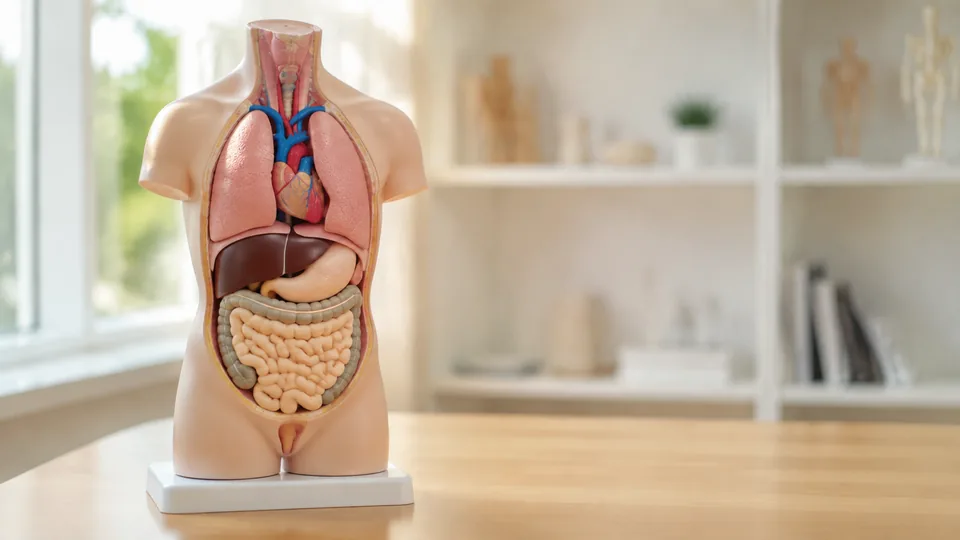
The first anatomy lesson often begins with a frustrating question: where does that structure actually sit? A diagram may show the heart, lungs, and diaphragm in neat colors, yet their spatial relationship can remain fuzzy until those parts are lifted, turned, and placed inside a three-dimensional torso. Beginner anatomy models bridge that gap, whether the learner is an eight-year-old assembling bones at the kitchen table or an adult preparing for an introductory anatomy and physiology course.
Size, removable components, educational guides, articulation, and anatomical scope matter more than flashy presentation. One common mistake is buying a specialized skull or skeleton when the learner needs a broad introduction to body systems. Another is choosing a tiny, intricate kit that feels fiddly rather than inviting. Different learners need different tools, but the Be Amazing! Toys Interactive Human Body Anatomy Figure offers the strongest overall balance of whole-body coverage, hands-on assembly, and beginner-friendly guidance.
For a fast starting point, the highlights and comparison table below show how the leading options differ.
Quick Answer
Best overall: The Be Amazing! Toys Interactive Human Body Anatomy Figure is a lively introduction to bones, muscles, organs, and movement. Younger learners seeking a compact activity may prefer the National Geographic Human Body Model, while college beginners studying cranial landmarks should look closely at the JENACAD Human Skull Model.
Best Anatomy Models for Beginners Comparison Table
| Product | Best For | Size and Parts | Key Learning Feature |
|---|---|---|---|
| Be Amazing! Interactive Human Body | Best overall | 14 inches, 60 pieces | Posable body with bones, muscles, and organs |
| National Geographic Human Body Model | Hands-on value | 9 inches, 32-piece set | Removable organs and glow-in-the-dark bones |
| Science Can Talking Human Body | Interactive learning | 15-plus removable structures | Explanation and quiz modes |
| Merinden Human Body Model | Introductory torso study | 11 inches, 15 parts | Detachable core organs and illustrated manual |
| EVOTECH Anatomy Model Bundle | Broad study coverage | Four separate models | Torso, skeleton, heart, and skull set |
| JENACAD Human Skull Model | College-level skull study | Life-size, 3 parts | 55 numbered landmarks |
| 15-Part Exploded Skull Model | Learning cranial bones | Palm-sized, 15 parts | Color-separated removable bones |
| Breesky Human Skeleton Model | Basic skeletal orientation | 17.7 inches | Movable limbs and removable skullcap |
| GobiDex Human Body Skeleton Kit | Beginner assembly activity | 12.6 inches, 40 pieces | Self-standing model with glowing bones |
The detailed reviews below explain where each model shines and which trade-offs deserve attention before it lands on a desk or classroom shelf.
1. Be Amazing! Toys Interactive Human Body Anatomy Figure: Best Overall
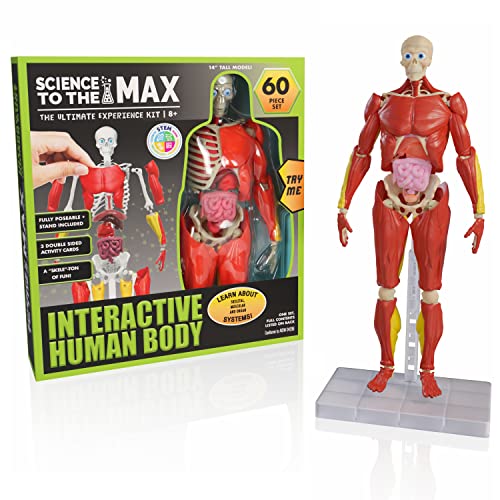
This 14-inch figure turns anatomy into a physical puzzle rather than a stack of names to memorize. Its 60 pieces cover bones, muscles, and organs, giving a young beginner a broad view of how body systems occupy the same limited space. The figure is articulated and posable, so a lesson can move from locating the femur to bending a leg and discussing what happens around the joint.
The adjustable stand makes the model easier to examine between assembly sessions, while colorful instruction cards introduce body structures and functions in approachable language. Picture a rainy afternoon at the kitchen table: pieces click into place, a muscle layer comes away, and suddenly the rib cage makes sense. That combination of assembly, movement, and guided learning earns it the top position.
Pros
- Sixty-piece design provides broad coverage of bones, muscles, and organs
- Articulated body helps connect anatomy with everyday movement
- Fourteen-inch height offers a useful balance of visibility and portability
- Adjustable stand supports posing and display
- Illustrated instruction cards give beginners a guided starting point
Cons
- Numerous pieces may require adult help during the first assembly
- Educational detail is aimed more toward children than college anatomy students
This is the strongest choice for families, homeschool lessons, and children ages eight and up who learn by taking things apart and rebuilding them. Older healthcare students will need more detailed landmarks, but young scientists receive a wonderfully tangible tour from head to toe. Its broad scope also makes it more versatile than a skeleton-only or skull-only model.
To buy this product, click here.
2. National Geographic Human Body Model for Kids: Best Value

Few things grab a child’s attention like squishy organs and bones that glow after the lights go out. This 32-piece set places nine removable organs, 18 glow-in-the-dark bones, and arm muscles inside a nine-inch body shell. Learners can use the included forceps to remove individual components, introducing an extra layer of concentration and fine-motor practice.
The organization chart is especially practical when the table becomes a colorful jumble of bones and organs. A detailed learning guide supplies context, while the stand keeps the assembled body upright for display. Its compact shell lacks the sweeping articulation of the Be Amazing! figure, yet it packs a satisfying anatomy activity into a smaller footprint, ideal for a crowded homeschool cart or bedroom shelf.
Pros
- Includes bones, muscles, and organs in one compact activity
- Nine removable squishy organs make internal anatomy approachable
- Eighteen glow-in-the-dark bones add memorable visual interest
- Forceps encourage careful removal and placement of small components
- Learning guide and identification chart support independent exploration
Cons
- Nine-inch body shell can make internal pieces feel small for some learners
- Less useful for demonstrating whole-body joint movement than an articulated figure
Choose this set for a curious child who enjoys science kits, sorting activities, and slightly gooey tactile details. The glow effect supplies the initial “whoa” moment, but the removable organs and identification materials give the kit lasting educational value. It suits individual or small-group work better than a demonstration viewed from the back of a classroom.
To buy this product, click here.
3. Science Can Talking Human Body Model: Best Interactive Option

Some beginners need feedback to stay engaged, and this talking model provides it through explanation and quiz modes. The first mode introduces body parts and their functions, while the second turns recall into a question-and-answer activity. That format can rescue a lesson that is drifting toward blank stares, especially for a child who responds to spoken prompts better than dense pages.
Learners can remove and examine more than 15 organs, muscles, and bones, then reinforce the experience with a 26-page illustrated book and four double-sided knowledge cards. The model, components, base, and learning materials form a cohesive kit for home projects. It requires three AA batteries that are not included, so having batteries ready prevents an anticlimactic first opening.
Pros
- Explanation mode provides spoken introductions to body parts
- Quiz mode encourages active recall rather than passive viewing
- More than 15 removable anatomical structures support tactile learning
- Includes a 26-page illustrated anatomy book
- Four double-sided knowledge cards extend study beyond the model
Cons
- Requires three AA batteries purchased separately
- Electronic interaction may distract learners who prefer quiet, self-paced study
This model fits children who enjoy buttons, quizzes, and a bit of chatter during science time. It can also help a parent guide a lesson without inventing every question on the fly. Buyers seeking a silent display piece or detailed college reference should look elsewhere, but for energetic introductory learning, the spoken guidance gives it a distinct personality.
To buy this product, click here.
4. Merinden 15-Part Human Body Model: Best Beginner Torso

The Merinden model takes a more traditional classroom approach, presenting major internal structures in an 11-inch torso. Its 15 detachable components include a two-part brain, heart, esophagus and aorta, four-part lungs, and skull. Removing those pieces reveals the layered arrangement that illustrations often flatten, which is the central reason to own a torso model.
A stable base keeps the figure upright while a learner identifies structures or follows the included colorful manual. Imagine reviewing the respiratory system at a small desk: the lung sections can be separated, the heart’s position becomes visible, and the relationship between chest organs feels less abstract. The model is compact enough for home study without shrinking into a pocket-sized novelty.
Pros
- Fifteen detachable parts support layered torso exploration
- Includes major structures from several body systems
- Eleven-inch format fits comfortably on a desk
- Colorful educational manual helps beginners identify components
- Stable base keeps the model upright during study
Cons
- Torso format does not show full arm and leg anatomy
- Provides fewer pieces than larger assembly-focused kits
This is a sensible step up for middle school, high school, homeschool, or adult beginners who want a recognizable academic model without filling an entire shelf. It is particularly useful for introductory lessons on thoracic organs and the brain. Learners focused on joints, limb bones, or detailed cranial landmarks will benefit more from a skeleton or dedicated skull.
To buy this product, click here.
5. EVOTECH Human Body, Skeleton, Heart, and Skull Model Set: Best Premium Set

One model rarely answers every beginner question. EVOTECH tackles that problem with a bundle containing a roughly 17.7-inch skeleton, an 11-inch torso, an approximately eight-inch heart on its base, and a half-size skull with brain. A learner can move from broad skeletal orientation to organ placement, then bring the heart close for more focused examination.
The models are hand-painted and supplied with several learning aids, including a body-system brochure, skeleton chart, heart manual, and mini-skull manual. A carrying case helps keep the collection together, which matters after a lesson spreads four models and assorted guides across a table. This set demands more storage and a larger investment than a single figure, but its breadth is hard to match.
Pros
- Four-model bundle covers skeletal, torso, cardiac, and cranial anatomy
- Different model sizes support both broad and focused study
- Includes multiple charts, brochures, and manuals
- Hand-painted components offer clear visual separation
- Carrying case simplifies storage and transport
Cons
- Larger collection requires more storage space than a single desktop model
- Greater scope may feel excessive for a child seeking one simple activity
The EVOTECH bundle suits a dedicated homeschool setup, tutoring room, teacher, or adult beginner expecting to study several body systems. It also allows two learners to examine different models at once, a welcome feature during shared study. Casual buyers may prefer one focused model, while committed beginners can grow into this collection over many lessons.
To buy this product, click here.
6. JENACAD Life-Size Human Skull Model: Best for Anatomy Students

The jump from a casual anatomy kit to a college lab practical can feel brutal. JENACAD’s life-size skull is built around active study, with 55 numbered landmarks that learners can identify and check against the supplied materials. Red-painted sutures stand out against the bone-colored surface, while black numbers make targeted review quicker during a late-night study session.
The skull separates into three main components: a magnetic skullcap, the cranium, and a removable mandible. Its spring-supported jaw demonstrates basic jaw movement and tooth relationships, and the life-size proportions offer more room to inspect landmarks than a miniature skull. A printed study card, downloadable guide, and guided study videos provide a structured route through a complicated subject.
Pros
- Fifty-five numbered landmarks support self-quizzing
- Life-size proportions make small cranial structures easier to locate
- Three-part design exposes the skull base and internal cavity
- Red sutures create strong visual separation between cranial bones
- Includes printed and digital study resources
Cons
- Specialized skull focus offers little help with torso or limb anatomy
- Spring-supported jaw requires gentle handling during repeated study
This model is a strong match for nursing, dental, allied-health, and introductory anatomy students who need more than a colorful children’s kit. Its numbered structures make practice concrete: cover the guide, name each landmark, then check the answer. A younger beginner exploring the whole body may find it too specialized, but students facing cranial terminology receive a much sharper tool.
To buy this product, click here.
7. 15-Part Color-Coded Exploded Skull Model: Best for Learning Cranial Bones
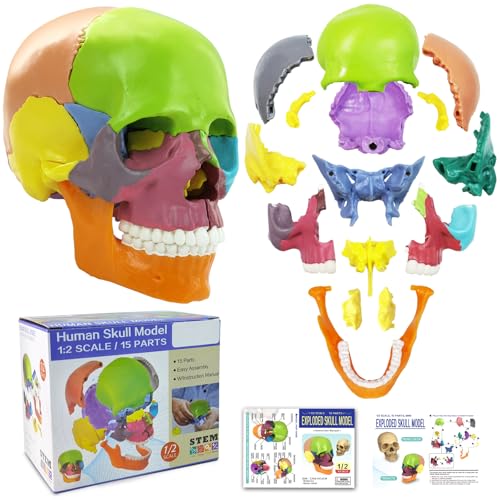
Cranial bones can blur into one pale shell in a textbook image. This palm-sized model separates the skull into 15 colored components, including paired facial bones and individual structures such as the mandible, vomer, and hyoid. Stable connectors along simplified sutures let the learner disassemble the skull and work through the satisfying puzzle of rebuilding it.
The model shows visible structures such as eye sockets, the nasal cavity, cranial cavity, teeth, and an articulating mandible. Color coding makes boundaries easier to spot at first glance, a useful aid for visual learners and art students mapping facial construction. The illustrated guide adds general information and questions, giving the pieces more purpose than a colorful desktop display alone.
Pros
- Fifteen detachable components demonstrate how skull bones fit together
- Color coding helps beginners distinguish adjacent bones
- Compact design is easy to carry and store
- Shows internal cavities and several visible cranial features
- Illustrated guide provides a framework for assembly and review
Cons
- Palm-sized format limits visibility during group demonstrations
- Repeated assembly may feel intricate for younger children with limited dexterity
Visual learners, artists, and students beginning osteology will appreciate the literal separation between bones. It is less suitable as a comprehensive introduction to body systems, since every lesson stays above the neck. Paired with a basic torso or skeleton, however, it clarifies skull construction in a way that a fixed, single-color replica cannot.
To buy this product, click here.
8. Breesky 17.7-Inch Human Skeleton Model: Best Basic Skeleton

For learning the broad map of the skeleton, simplicity can be refreshing. This model stands about 17.7 inches tall on a 4.75-by-4.75-inch base, large enough to recognize the spine, rib cage, limbs, and skull without taking over the room. Movable arms and legs allow basic posing, so learners can connect bone positions with familiar postures.
The skullcap can be removed, and the jaw moves while remaining attached to the model. Anatomical detail is intentionally basic, which keeps the figure approachable for first exposure but limits advanced landmark study. On a desk beside a labeled skeleton chart, it becomes a straightforward pointing tool: find the pelvis on paper, locate it in three dimensions, then trace the leg downward.
Pros
- Seventeen-inch scale is visible while remaining desktop friendly
- Movable arms and legs support basic demonstrations of posture
- Removable skullcap allows a look inside the cranial area
- Compact base requires relatively little surface space
- Simple design keeps attention on major skeletal structures
Cons
- Basic detail is less suitable for studying small landmarks and foramina
- Jaw moves but does not detach from the skull
This skeleton makes sense for beginners learning major bones, artists checking rough proportions, or teachers giving close-range demonstrations. It is approachable, portable, and refreshingly uncluttered. Students preparing for detailed practical exams should select a numbered or life-size model instead, since this figure emphasizes orientation over fine anatomical identification.
To buy this product, click here.
9. GobiDex Human Body Skeleton Model Kit: Best Assembly Activity

The GobiDex kit leans into the joy of building. Its 40 pieces cover bones, muscles, and organs, forming a self-standing model approximately 12.6 inches tall. Components are intended for repeated assembly and disassembly, allowing a child to learn through fingertips and trial rather than staring at a finished display behind glass.
Glow-in-the-dark bones add a playful payoff once the skeleton has absorbed light, and the illustrated manual explains the included anatomy in colorful terms. During a family science night, the glowing structure can prompt a second round of questions long after the formal activity ends. It targets children ages eight and up, making its educational depth and physical scale more suitable for early exploration than professional study.
Pros
- Forty-piece kit combines bones, muscles, and organs
- Repeated assembly encourages active spatial learning
- Glow-in-the-dark bones create a memorable visual feature
- Self-standing 12.6-inch format works well on a table
- Illustrated manual supports guided home or classroom activities
Cons
- Assembly format can require supervision to keep small pieces organized
- Child-focused presentation lacks the detailed labeling expected in college courses
Pick GobiDex for a beginner who would rather build than listen to a long explanation. Its glow feature supplies fun without replacing the core assembly lesson, and the mix of structural layers gives it broader scope than a plain skeleton. Adult students and serious anatomy learners will outgrow it quickly, but a child’s first encounter with internal anatomy should feel inviting, and this kit understands that assignment.
To buy this product, click here.
How to Choose an Anatomy Model for a Beginner
Start With the Learner’s Goal
A child asking why ribs protect the heart needs a different model from a nursing student memorizing cranial sutures. Whole-body kits introduce several systems at once and keep early lessons lively. Torso models concentrate on organ placement, skeletons clarify posture and bone relationships, and skulls serve learners with a focused interest in cranial anatomy. Start with the next lesson the buyer genuinely plans to study, not an imagined advanced course years away.
Match Detail to Experience Level
More detail sounds better, but dense numbering and tiny openings can overwhelm a first-time learner. Color-separated organs, broad bone shapes, and removable layers usually provide a gentler entry point. College students need clearer landmarks, realistic proportions, and reference materials that support active recall. A brightly colored 15-part skull may make bone boundaries immediately obvious, while a life-size numbered skull supports more exact identification once the basic map feels familiar.
Check Size and Viewing Distance
Miniature models slip neatly into a backpack and leave room beside a laptop, but small pieces are harder to manipulate and nearly invisible across a classroom. Models around 9 to 18 inches work well for individual study or a small group gathered around a table. A compact model can be excellent for nightly revision, while a teacher addressing a room needs larger, clearer structures or should pass the model among students.
Decide Between Removable Parts and Articulation
Removable components reveal layers and spatial relationships. They are especially useful for learning how the lungs, heart, liver, and digestive organs occupy the torso. Articulated models answer a different set of questions by showing how limbs change position. A learner focused on organ systems should prioritize detachable parts, while an artist or student studying basic movement may gain more from movable joints.
Look for Useful Learning Materials
A box of colorful pieces can become a guessing game without a key. Illustrated manuals, identification charts, numbered landmarks, and quiz cards turn the physical model into a repeatable study routine. One practical method is to identify a structure on the model, say its name aloud, check the guide, and then place or point to it again. Clear supporting material is especially valuable when a parent or tutor lacks an anatomy background.
Consider Assembly and Storage
Complex assembly creates memorable “aha” moments, yet it also creates loose pieces under chairs. Younger learners may need a divided container, resealable bag, or dedicated tray. Fixed skeletons are faster to begin using, while torso puzzles and exploded skulls demand patient reassembly. Check whether the listing includes a base, stand, organization chart, or case, then picture where the model will live between lessons.
Use the Model as an Educational Aid
An anatomy model works best beside a course guide, textbook, or teacher-led lesson. It provides a physical reference for visualizing location and structure, but simplified educational models cannot reproduce every variation or microscopic detail of a human body. For a beginner, that limitation is perfectly reasonable. The goal is a clear mental map that makes later study less intimidating.
Best Anatomy Models for Beginners FAQ
What Type of Anatomy Model Is Best for a Complete Beginner?
A removable whole-body or torso model is usually the easiest starting point because it introduces several major systems and shows where organs sit in relation to one another. Younger learners often benefit from color coding and larger pieces. Adult anatomy students should prioritize clear landmarks and useful reference materials.
Are Children’s Anatomy Models Accurate Enough for Learning?
They can be useful for basic identification, organ placement, and broad skeletal concepts. Many simplify fine landmarks and proportions to make assembly manageable, so they are less appropriate for advanced coursework. Treat them as introductory visualization tools rather than substitutes for detailed academic resources.
Is a Skeleton or Torso Model Better for Beginners?
A skeleton is better for major bones, posture, and limb relationships. A torso is better for lungs, heart, brain, digestive organs, and layered body cavities. Learners taking a general survey course may gain more immediate value from a torso or whole-body kit, while artists and movement-focused students may prefer a skeleton.
How Large Should a Beginner Anatomy Model Be?
For individual study, models measuring roughly 9 to 18 inches are generally manageable and visible at desk distance. Smaller pieces travel easily but can be fiddly. Classroom demonstrations require enough size and color contrast for students to see, or the model must be passed around for close inspection.
Do Removable Anatomy Models Help With Memorization?
Removable parts can support active recall because learners identify, remove, orient, and replace each structure. A simple routine works well: name the part before removing it, describe where it sits, then rebuild the model without looking at the guide. The physical sequence creates useful spatial cues.
Are Numbered Structures Better Than Color Coding?
They serve different stages of learning. Color coding makes boundaries obvious and reduces early confusion. Numbering supports self-testing and more precise identification, especially for college courses. Beginners can start with colors, then transition to numbered landmarks as terminology becomes familiar.
How Should Small Anatomy Model Parts Be Stored?
Keep them in a lidded container, divided organizer, or labeled resealable bags. Take a quick photo of the correctly assembled model and the organized pieces before the first lesson. That reference can save plenty of head-scratching when a tiny organ appears beneath the table a week later.
Can an Anatomy Model Replace a Textbook or Instructor?
No. Models are educational aids for visualizing three-dimensional relationships. They work best alongside reliable written materials, course instruction, and labeled diagrams. Simplification is common, particularly in compact and child-focused products, so learners should cross-reference unfamiliar structures.
Final Verdict
The Be Amazing! Toys Interactive Human Body Anatomy Figure is the strongest overall pick for most young beginners. Its 60-piece construction covers bones, muscles, and organs, while the articulated body links those structures to movement. It feels like a genuine project rather than a static ornament, and the illustrated cards help turn assembly into a guided lesson. For families seeking a smaller, tactile kit, the National Geographic Human Body Model offers excellent variety through removable organs, glow-in-the-dark bones, forceps, and a compact shell.
Older beginners should match the model to their course. The EVOTECH Anatomy Model Set supplies the broadest collection for sustained study, while the JENACAD Life-Size Human Skull gives college learners a focused system for reviewing cranial landmarks. Before purchasing, check the learner’s age, upcoming topics, available storage, and tolerance for small removable pieces. The right model should invite repeated handling and questioning, because the real value appears when a flat page finally turns into a clear three-dimensional picture.
