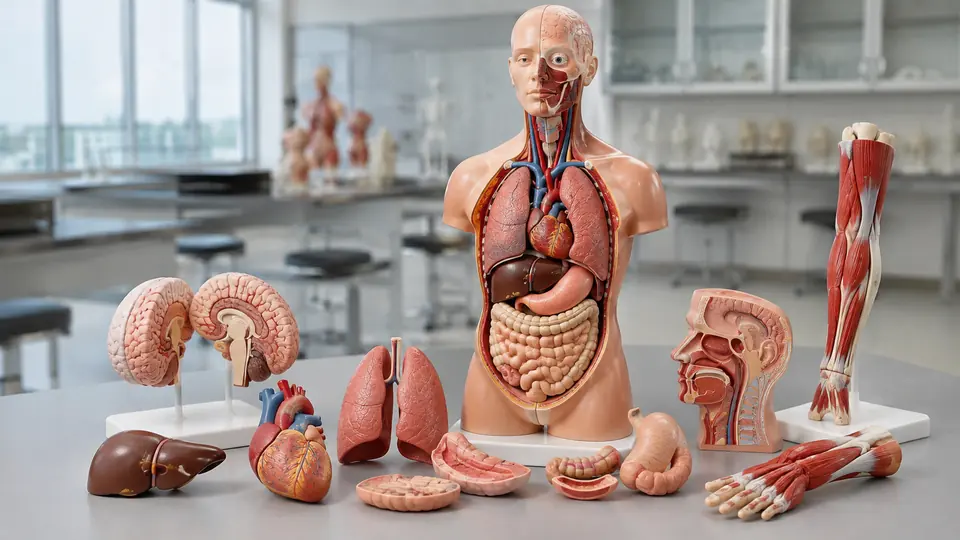
The heart looks tidy on a printed page, right up until you must explain how it sits beside the lungs and behind the sternum. That spatial puzzle is why medical students often add physical anatomy models to atlases, lab sessions, and digital resources. A removable torso can clarify organ relationships, while an articulated skeleton makes joint orientation far easier to picture during a late-night review session.
Useful models differ sharply in scope and detail. Some cover several body systems, while others focus on cranial landmarks, individual facial bones, or skeletal movement. Common buying mistakes include choosing a tiny model for detailed landmark study, overlooking whether parts detach, and assuming bright colors always mean accurate labeling. Scale, removable components, articulation, reference materials, storage space, and the structures emphasized by a course should drive the decision.
Different students will naturally land on different picks. The EVOTECH anatomical body set is the strongest overall choice here because it combines torso, skeleton, heart, skull, brain, study cubes, and reference guides in one portable package. Students concentrating on osteology may gain more from the life-size NLShan skeleton, while those drilling cranial foramina should look closely at the numbered life-size skull.
For a quick snapshot before the detailed reviews, the table compares the nine selected models by study focus, size, and hands-on features.
Quick Answer
Best overall: The EVOTECH anatomical body model set offers the broadest mix of structures for students moving between organ systems, skeletal anatomy, and cranial review. For osteology and classroom demonstrations, the NLShan life-size skeleton supplies full-body scale and a rolling stand. The 55-number labeled life-size skull is the focused pick for cranial landmarks and skull-base study.
Best Anatomy Models for Medical Students Comparison Table
| Product | Best For | Size | Hands-On Features |
|---|---|---|---|
| EVOTECH Anatomical Body Model Set | Broad, multi-system study | Multiple portable models | Torso, skeleton, heart, skull, brain, and cubes |
| NLShan Life-Size Skeleton | Osteology and classroom demonstrations | 70.8 inches | Articulated joints, removable skull cap, rolling stand |
| Deluxe Musculature Torso Model | Organ placement and torso anatomy | 17 inches | 16 removable parts and male/female components |
| 55-Number Labeled Life-Size Skull | Cranial landmarks and foramina | Life size | 55 numbered landmarks, movable jaw, removable calvaria |
| 15-Part Color Exploded Skull | Learning individual cranial bones | Palm sized | 15 separable, color-coded pieces |
| Merinden 15-Part Torso | Compact desktop study | 11 inches | 15 detachable components and manual |
| 11-Inch 15-Part Torso | Budget organ-system review | 11 inches | 15 removable structures and stable base |
| 17.72-Inch Mini Skeleton | Portable skeletal orientation | 17.72 inches | Movable arms and legs with poseable joints |
| Human Anatomy Study Cube | Pocket revision and recall practice | 7 × 7 × 7 cm | Foldable format covering nine body topics |
The reviews below explain where each model earns its place and which limitations matter during real study sessions.
1. EVOTECH Anatomical Body, Skeleton, Heart, Skull, Brain, and Cube Set | Best Overall

This EVOTECH collection earns the top position through breadth. Open the carrying case and the study session can move from a roughly 17.7-inch skeleton to an 11-inch torso, an 8-inch heart on its base, and a half-size skull with a brain. Anatomical cubes add eight study themes, creating a compact lab bench for students whose courses jump rapidly from bones to viscera and circulation.
The greatest benefit is being able to compare structures in several contexts. A student might trace ribs on the skeleton, inspect the torso cavity, and then isolate the heart for a closer view, all without filling a dorm shelf with full-size models. Hand-painted surfaces and individual bases make the pieces display-friendly, while the included brochure, skeletal chart, and manuals provide names and illustrations for guided review.
Pros
- Covers skeletal, cranial, cardiac, organ, and broader system study
- Includes several portable models rather than one narrowly focused piece
- Comes with a carrying case for storage and transport
- Includes multiple printed study guides and reference materials
- Individual models can support separate study stations or demonstrations
Cons
- Smaller scale limits inspection of fine landmarks found on life-size models
- The number of pieces requires more storage and setup than a single model
This set makes the most sense for early medical, nursing, or allied-health students building spatial familiarity across several systems. It is also practical for a shared apartment or tutoring room where one purchase must support many topics. Advanced osteology students who need subtle foramina or precise attachment sites should pair their atlas with a larger specialist model instead.
To buy this product, click here.
2. NLShan 70.8-Inch Life-Size Human Skeleton | Best Full-Size Skeleton

A miniature skeleton can sit politely beside a laptop, but a 70.8-inch replica gives skeletal relationships room to breathe. The NLShan model presents 206 articulated bones at life-size scale, helping students connect classroom terminology with realistic proportions. The skull detaches, the calvarium can be removed, and the articulated construction supports observation of movement at major joints.
Picture a small study group rehearsing an upper-limb practical. One person can position the arm while another identifies the scapula, humerus, radius, and ulna from several angles. The five-wheel rolling stand lets the group turn or relocate the model rather than shuffle awkwardly around it. Three included posters add reference material, and the wipe-clean surface suits repeated classroom handling.
Pros
- Life-size proportions support full-body spatial orientation
- Features 206 articulated bones for skeletal study
- Detachable skull includes a removable calvarium
- Five-wheel stand makes the tall model easier to reposition
- Includes three anatomy posters for reference
Cons
- Requires considerably more floor space than desktop alternatives
- Focuses on skeletal anatomy rather than removable organs or soft tissue
Students preparing for musculoskeletal modules, physical therapy coursework, or demonstration-based teaching will appreciate the scale most. It also fits a classroom, clinic teaching space, or dedicated home office better than a cramped dorm. Buyers primarily studying organ relationships should choose a torso or multi-model set, since a full skeleton cannot answer every anatomy question.
To buy this product, click here.
3. 17-Inch Deluxe Musculature Torso Model | Best Premium Torso
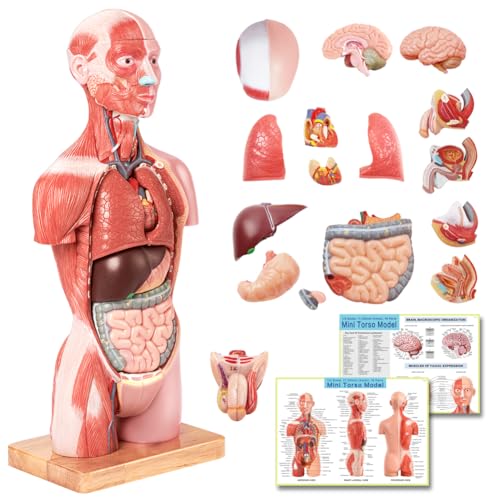
For students who want more presence than an 11-inch desktop torso, this 17-inch model strikes a useful middle ground. Its 16-part construction includes a trunk, skull cap, two-part brain, two-part heart, two lungs, stomach, liver, intestines with pancreas, caecum cover, and male and female anatomical components. Pulling out the organs turns a dense diagram into a tangible packing puzzle.
The hand-painted PVC body rests on an oak wooden base, giving it a polished look for a study room or teaching office. Secure-fitting parts matter during repeated review because students can remove and replace organs without having the entire arrangement tumble loose. A colorful educational brochure accompanies the model, which is handy when working through an unfamiliar cavity before checking a detailed atlas.
Pros
- Larger 17-inch format offers clearer viewing than compact torsos
- Includes 16 removable components for active study
- Represents major thoracic and abdominal organs
- Includes male and female anatomical parts
- Hand-painted PVC construction sits on an oak wooden base
Cons
- Still too compact for studying very small surface landmarks in depth
- Small removable pieces require organized storage between sessions
This is the strongest torso choice for students who expect to use the model regularly and want a larger, more display-worthy format. It is especially useful for learning relative organ position and rehearsing the sequence of removal and replacement. Buyers needing a lightweight backup for occasional revision can spend less on an 11-inch torso, while skeletal courses call for a different model entirely.
To buy this product, click here.
4. 55-Number Labeled Life-Size Skull Anatomy Model | Best for Cranial Landmarks

Cranial anatomy becomes a maze around the skull base, where canals and foramina crowd into a relatively small area. This life-size model tackles that problem with 55 numbered landmarks, including features at the skull base. The numbers give study partners a simple quizzing system: call out a structure, locate its marker, then trace the relevant pathway in an atlas or course guide.
The skull separates into the calvaria, skull base, and mandible. Strong magnetic connections secure the removable cap, while the movable jaw and detailed dentition support study of articulation and dental relationships. High-density PVC is intended for repeated academic handling, and downloadable PDF materials provide a reference for the numbered markings when paper notes have vanished beneath a mountain of flash cards.
Pros
- Displays 55 numbered cranial landmarks
- Includes markings around the detail-rich skull base
- Three-part construction opens the endocranial cavity for viewing
- Movable mandible supports jaw and dentition study
- Magnetic connections hold the removable skull cap in place
Cons
- Numbering may visually clutter the surface for students wanting a plain bone-colored replica
- Three-piece design does not separate individual cranial and facial bones
Medical and dental students drilling foramina, skull-base orientation, or cranial bone landmarks are the clearest audience. Numbered surfaces make solo recall practice much easier, especially when paired with the supplied digital material. Students concentrating on assembling individual cranial bones should choose the exploded model below, while those seeking general organ anatomy will gain little from such a specialized purchase.
To buy this product, click here.
5. 15-Part Color Exploded Skull Model | Best for Individual Skull Bones
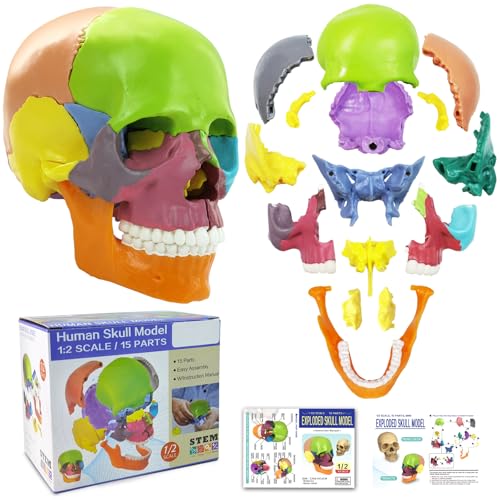
Learning the names of facial bones is one task. Understanding how the lacrimal, palatine, nasal, and turbinate bones fit into the orbit and nasal cavity is a much trickier feat. This palm-size exploded skull separates into 15 pieces, including paired and unpaired bones, so students can dismantle the structure and rebuild those relationships one connection at a time.
Color coding helps adjacent bones stand apart at a glance, a welcome visual cue during a rapid-fire revision session. The model also depicts sockets, canals, teeth, sutures, the internal nasal cavity, and the endocranial cavity. Stable connectors follow simplified sutures, while the accompanying illustrated guide provides general information and study questions to help users reassemble the puzzle rather than stare at a colorful pile of bones.
Pros
- Separates into 15 components for bone-by-bone study
- Color coding makes neighboring bones easier to distinguish
- Shows internal spaces that are difficult to understand from exterior views
- Compact size is easy to carry and store
- Includes an illustrated reassembly guide and questions
Cons
- Palm-size construction limits the visibility of very fine cranial landmarks
- Repeated disassembly involves more setup than a conventional three-part skull
This model suits students who learn by assembling, rotating, and handling each bone. It can be particularly helpful for craniofacial anatomy, dental foundations, and art reference, where boundaries between neighboring bones matter. Choose the numbered life-size skull instead if foramina and realistic overall scale dominate the syllabus, since portability and separability are the priorities here.
To buy this product, click here.
6. Merinden 11-Inch 15-Part Human Body Model | Best Compact Torso

Desk space disappears fast once a laptop, atlas, notebook, and coffee mug enter the scene. At 11 inches, the Merinden torso keeps its footprint manageable while offering 15 detachable components. These include a two-part brain, heart, esophagus and aorta, four-part lungs, skull, and torso structures, allowing students to examine several major systems without hauling a large teaching mannequin home.
The model’s strongest use is basic positional anatomy. Removing the lungs to see deeper structures, then rebuilding the cavity, gives spatial context to terms that can feel slippery on a flat screen. A stable base keeps the torso upright during demonstrations, and the colorful educational manual helps students identify the removable pieces and connect each structure with its function.
Pros
- Compact 11-inch height works well on crowded desks
- Fifteen detachable components encourage active recall
- Includes multi-part brain and lung structures
- Stable base supports upright display and study
- Colorful manual provides identification and function guidance
Cons
- Compact organs provide less room for subtle surface detail
- Coverage centers on major structures rather than advanced regional anatomy
Students seeking a neat, portable torso with a guided learning component should put this model high on the list. It works well for introductory anatomy, nursing foundations, and review of organ relationships between lectures. Those wanting a larger display or broader reproductive anatomy may prefer the 17-inch deluxe torso, while budget-focused buyers can compare it with the simpler 11-inch option below.
To buy this product, click here.
7. 11-Inch Human Torso Anatomy Model With 15 Removable Parts | Best Budget Torso

This 11-inch torso focuses on the hands-on essentials without claiming the space of a large classroom model. Its 15 removable parts include a two-part brain, heart, esophagus and trachea with aorta, four-part lungs, skull cap, stomach, diaphragm, liver, pancreas with spleen, and intestines. That selection provides a practical tour through thoracic and abdominal placement for foundational coursework.
Contrasting colors help separate neighboring structures when the model is sitting under a bright desk lamp, and lightweight PVC makes it easy to carry between a bedroom desk and a study group. The stable base keeps the body upright while pieces are identified or replaced. Surfaces can be wiped clean, an ordinary but useful detail when several classmates are passing organs around during revision.
Pros
- Fifteen removable parts cover several major organ systems
- Compact format is easy to carry and store
- Contrasting colors make major structures easy to distinguish
- Stable display base supports desktop review
- Wipe-clean PVC suits repeated educational handling
Cons
- Smaller scale is less effective for close study of fine anatomical features
- Listing information does not specify the same breadth of reference material as some alternatives
This model is a sensible entry point for students who want tactile organ review without committing to a larger premium torso. It performs best as a companion to lectures, labeled diagrams, and an atlas rather than as a standalone source. Advanced students demanding intricate landmarks or extensive guidance should invest in a larger, more specialized model.
To buy this product, click here.
8. 17.72-Inch Mini Skeleton Anatomy Model | Best Portable Skeleton

Full-size skeletons command attention, yet they are a comically awkward fit beside a dorm-room laundry basket. This 17.72-inch model condenses the full body into a desktop format, retaining visible proportions and textures across the skull, spine, ribs, and joints. Movable arms and legs allow students to change poses and inspect basic relationships from different viewing angles.
The joints use moderate resistance to hold positions, which makes the model useful for simple demonstrations of standing, bending, or limb orientation. Hard PVC construction is intended to resist drops, cracks, fading, and yellowing, while assembly and disassembly are described as straightforward. It can remain on a shelf between study sessions without turning the room into a miniature laboratory storeroom.
Pros
- Compact full-body format fits desks and shelves
- Movable arms and legs support basic positional demonstrations
- Pose-holding joints make different orientations easier to inspect
- Shows major skeletal regions in one portable model
- Hard PVC construction is intended for repeated handling
Cons
- Miniature scale cannot show small foramina and subtle bone landmarks clearly
- Articulation is simpler than the movement study possible with a life-size skeleton
This is a convenient choice for students who need whole-skeleton orientation at arm’s reach. It can help with broad bone identification, drawing reference, and visualizing how regions connect before a practical. Students preparing for detailed osteology examinations should favor the NLShan life-size model or institutional specimens, since compactness inevitably sacrifices fine detail.
To buy this product, click here.
9. Human Anatomy Study Cube | Best Pocket Revision Aid

This folding cube takes a different route from rigid anatomical replicas. Measuring 7 × 7 × 7 centimeters, it opens and refolds to reveal information on the eye, ear, heart, lungs, brain, skin, digestive system, muscles and bones, and circulatory system. The tactile folding action turns a few spare minutes before class into a compact recall session.
Its appeal is convenience rather than three-dimensional realism. Slip it into a backpack, unfold a topic while waiting for a lecture, then quiz a friend over lunch without unpacking a torso full of tiny organs. Detailed text and illustrations cover nine body areas in a small format, giving visual learners a playful alternative to another stack of cards.
Pros
- Covers nine major anatomy topics in one compact aid
- Pocket-size format travels easily between classes
- Folding design encourages short, repeatable review sessions
- Combines diagrams with written anatomical information
- Works well as a supplemental revision or gifting option
Cons
- Does not reproduce realistic spatial relationships like a rigid 3D model
- Small printed format is less suitable for detailed landmark study
Students who enjoy fidgeting while reviewing may find this cube surprisingly sticky as a learning habit. It is best used for quick reinforcement during commutes, breaks, or group quizzes. Anyone purchasing a single primary anatomy model should start with the EVOTECH set, a torso, or a skeleton, since the cube functions as a portable supplement rather than a substitute for dimensional anatomy.
To buy this product, click here.
How to Choose an Anatomy Model for Medical School
Match the Model to the Course Block
Start with the anatomy being taught rather than the most dramatic-looking model. A full skeleton is useful during musculoskeletal blocks, but it offers little help with thoracic organ packing. A removable torso clarifies the lungs, heart, diaphragm, liver, and intestines, while a specialist skull reveals cranial relationships that a small whole-body model can barely suggest.
Think about the questions that repeatedly stall your recall. Students mixing up facial bones may benefit from an exploded skull, while anyone struggling to visualize organ depth may learn more from removing and replacing torso pieces. Broad first-year study favors a multi-model bundle; focused examination preparation often rewards a specialist design.
Balance Scale Against Available Space
Life-size models make landmarks easier to see and allow several students to gather around them. They also demand storage. A 70.8-inch skeleton needs floor space and benefits from a wheeled stand, whereas a 17-inch skeleton can perch beside a stack of lecture notes. Measure the intended location before ordering, especially in dorm rooms or shared apartments.
Compact models are easier to carry, but shrinking anatomy has consequences. Tiny foramina, sutures, processes, and vessel grooves can blur together or disappear. Use smaller models for orientation and relationships, then consult life-size laboratory materials, detailed atlases, or institutional resources for delicate structures.
Look Closely at Removable and Articulated Parts
Removable organs promote active recall because reassembly forces the student to reason through position, depth, and sequence. Check the listed part count and identify what those pieces actually are. Two models with 15 parts may divide organs differently, which can change their usefulness for a particular module.
Articulation matters most for skeletal study. Movable shoulders, hips, limbs, and jaws let students examine orientation and basic movement, while a removable calvarium exposes the cranial cavity. Poseable does not automatically mean biomechanically complete, so treat articulation as a visualization feature rather than a perfect simulation of living movement.
Choose Labels and Colors With a Study Method in Mind
Numbered landmarks simplify self-quizzing. Cover the key, locate a number, name the structure, and explain what passes through it. Color coding is especially helpful on exploded skulls and multi-part organs because boundaries jump into view. These aids can make a foggy evening study session feel much more manageable.
Plain models have their own advantage. Their uncluttered surfaces resemble many practical-exam stations more closely and require students to identify anatomy without colorful prompts. A productive method is to learn with labels first, then test recall using an atlas image or unmarked laboratory specimen.
Assess the Stand, Storage, and Cleaning Needs
A stable stand prevents a torso from toppling while its organs are removed, and a rolling base makes a life-size skeleton far easier to reposition. Check whether the model can remain assembled in its storage location. Carrying cases are valuable for bundles, particularly when several small parts and study guides need to stay together.
Models handled by multiple classmates should have wipe-clean surfaces. Removable parts also need a tray, pouch, or dedicated container, since a tiny organ can vanish beneath notebooks with impressive speed. Good storage habits protect the model and shorten setup time before each review session.
Use Models as One Layer of Anatomy Study
Physical models excel at scale, orientation, and structural relationships, but simplified replicas cannot contain every variation or microscopic detail. Pair them with course-approved atlases, dissection or prosection sessions, imaging, lectures, and digital resources. The click of a torso organ settling into place can cement a relationship, while the atlas supplies the terminology and detail around it.
A practical routine is to identify structures on the model, explain their relationships aloud, sketch the arrangement from memory, and verify the result against course material. That sequence moves beyond passive viewing and turns the model into a genuine retrieval tool.
Best Anatomy Models for Medical Students FAQ
Which Type of Anatomy Model Is Most Useful for a First-Year Medical Student?
A broad multi-system set or removable torso usually provides the widest early value. It helps with organ position, body cavities, and basic structural relationships across several blocks. Students whose first curriculum segment centers heavily on osteology may prefer a full-size skeleton instead.
Is a Life-Size Skeleton Better Than a Mini Skeleton?
Life-size skeletons show proportions and smaller landmarks more clearly, making them better for detailed osteology and group demonstrations. Mini skeletons are easier to store and transport, so they work well for regional orientation and personal desktop review. Available space and expected detail should settle the choice.
Are Color-Coded Anatomy Models Helpful for Exam Preparation?
Color coding can accelerate early recognition by separating neighboring bones, organs, or regions. For stronger recall, gradually remove that support by testing yourself with uncolored atlas images or laboratory materials. Colors are learning cues, not replacements for understanding boundaries and relationships.
How Many Removable Parts Should a Torso Model Have?
There is no universal ideal count. Focus on whether the removable pieces match your syllabus, such as a divided brain, multi-part heart, lungs, liver, stomach, intestines, or reproductive structures. A thoughtfully divided 15-part model may be more useful than a higher-count model containing irrelevant pieces.
Can an Anatomy Model Replace an Atlas or Lab Session?
No. Models simplify structures and may omit small landmarks, tissue layers, anatomical variation, and clinical context. They are most effective beside a detailed atlas, course materials, imaging, and supervised laboratory instruction, where each resource fills gaps left by the others.
Should Medical Students Buy a Numbered Skull or an Exploded Skull?
Choose a numbered life-size skull for landmarks, foramina, and rapid self-quizzing. Pick an exploded skull for learning individual cranial and facial bones and understanding how they interlock. Students facing a cranial-heavy module may find both formats useful, but the syllabus should guide the first purchase.
How Should Removable Anatomy Models Be Stored?
Reassemble the model after study when practical, and keep loose pieces in a labeled tray, pouch, or case. Store it away from excessive heat and direct sunlight, then follow the seller’s cleaning guidance. A quick inventory after group study prevents small components from wandering off with someone’s notes.
Final Verdict
Among these nine picks, the EVOTECH anatomical body, skeleton, heart, skull, brain, and cube set is the strongest overall option. Its mix of portable models covers more study territory than any single torso or skull, while the case and reference guides keep the collection manageable. It is a particularly sensible choice for students who want to visualize several systems without devoting a whole room to life-size teaching equipment.
Specialized needs point elsewhere. The NLShan 70.8-inch skeleton offers the clearest full-body option for osteology and group demonstrations, while the 55-number labeled life-size skull is better suited to cranial landmarks and foramina. Budget-conscious students seeking organ-placement practice should consider the 11-inch 15-part torso. Before purchasing, check the current course block, identify the structures causing trouble, and measure the available study space. The right model should make a specific anatomical relationship easier to retrieve, rotate, and explain rather than simply look impressive on a shelf.
