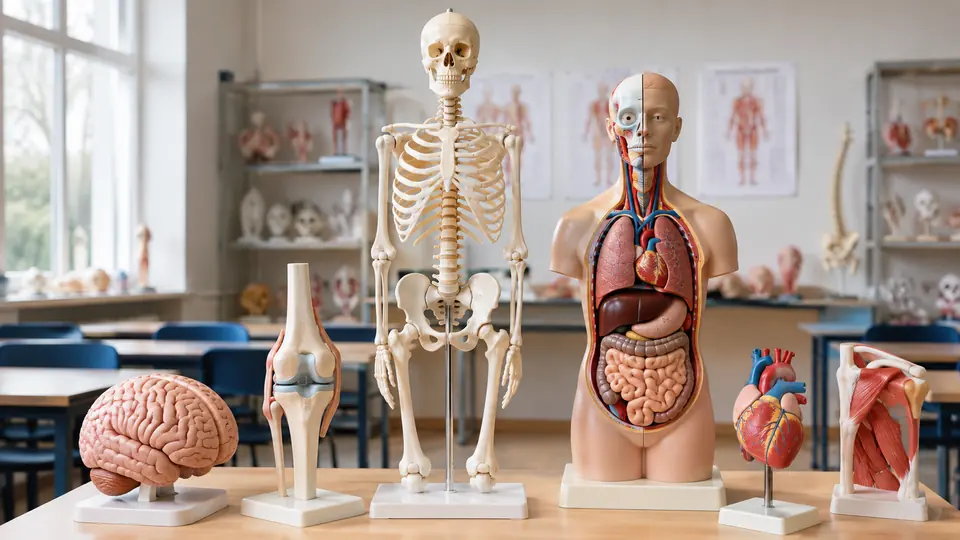
Pass a removable heart around a biology class and the room changes. Students can trace the vessels with a fingertip, peer between the valves, and see why a flat page sometimes leaves spatial relationships feeling fuzzy. Classroom anatomy models range from compact desktop torsos to rolling life-size skeletons, so the right choice depends on what students need to see, move, remove, and reassemble.
Common buying mistakes include picking a model that is too small for room-wide demonstrations, paying for a full-size skeleton when students mainly need organ placement, or overlooking how easily tiny removable pieces can disappear into a crowded lab drawer. Scale, anatomical detail, articulation, removable components, stability, storage, and student age matter more than flashy color alone. Different classrooms will prioritize different features, but the Learning Resources Anatomy Models Bundle Set offers the strongest overall mix of body systems and hands-on learning for a broad audience.
For a fast shortlist, the recommendations and comparison table below highlight the most useful distinctions before the full reviews.
Quick Answer
Best overall: The Learning Resources Anatomy Models Bundle Set covers the heart, brain, torso, and skeleton in one classroom-friendly package. Teachers needing a large demonstration model should look at the Axis Scientific Life Size Skeleton, while the 11 Inch Human Torso Anatomy Model is the standout value for small-group organ lessons. For classrooms focused specifically on cardiovascular anatomy, the Life Size Human Heart Model provides a simple, focused teaching aid.
Best Anatomy Models for Classrooms Comparison Table
| Product | Best For | Size or Format | Key Classroom Feature |
|---|---|---|---|
| Learning Resources Anatomy Models Bundle Set | Broad classroom use | Four-model set | Heart, brain, body, and skeleton models |
| Axis Scientific Life Size Skeleton | Advanced skeletal instruction | About 5 feet 6 inches | Articulated joints, rolling stand, and study guides |
| Human Body, Skeleton, Heart, and Skull Models | Portable anatomy stations | Four-model bundle | Multiple systems plus carrying case |
| NLShan Life Size Human Skeleton | Room-wide demonstrations | 70.8 inches | Articulated skeleton with five-wheel stand |
| Merinden Human Body Model | Guided organ study | 11-inch, 15-part torso | Removable structures and educational manual |
| 11 Inch Human Torso Anatomy Model | Budget-friendly organ lessons | 11-inch, 15-part torso | Removable organs on a stable base |
| Life Size Human Heart Model | Cardiovascular lessons | Life-size, two-part model | Magnetic separation reveals internal anatomy |
| breesky Human Skeleton Model | Desktop skeletal basics | 17.7 inches | Movable limbs and removable skull cap |
| 17.72 Inch Mini Skeleton Anatomy Model | Joint-position demonstrations | 17.72 inches | Poseable arms and legs with firm joints |
The detailed reviews below explain where each model fits into a real lesson plan, from rotating lab stations to demonstrations at the front of the room.
1. Learning Resources Anatomy Models Bundle Set: Best Overall
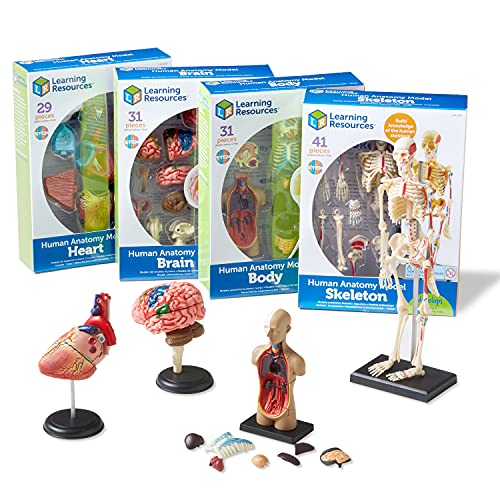
Four distinct models give this set an immediate classroom advantage. Instead of clustering a whole group around one torso, a teacher can create stations for the heart, brain, body, and skeleton. That format suits a lesson where students rotate every few minutes, sketching a structure or answering prompts before the timer chirps and everyone shifts to the next table.
The pieces assemble and disassemble, turning observation into a tactile exercise rather than a look-but-do-not-touch display. The skeleton has movable joints, while the heart includes hinged sections that expose internal features. Sturdy stands keep the assembled models visible between lessons, and the set is intended for learners ages eight and older. Its approachable format makes complex structures feel less intimidating, especially when a student can lift a section and inspect what lies beneath.
Pros
- Includes separate heart, brain, body, and skeleton models
- Supports several simultaneous learning stations
- Assembly and disassembly encourage active participation
- Movable and hinged sections clarify spatial relationships
- Sturdy display stands suit repeated classroom use
Cons
- Individual models are less suitable than life-size options for demonstrations across a large room
- Multiple pieces require organized storage and careful inventory after group activities
This bundle makes the most sense for elementary science rooms, middle-school biology classes, homeschool groups, and teachers building a flexible anatomy unit from scratch. A college-level course requiring fine landmarks may prefer a specialized model with greater detail, but few options here cover as many foundational topics in one package. The ability to divide the set among groups is its real magic during a lively lab period.
To buy this product, click here.
2. Axis Scientific Life Size Skeleton Model: Best Premium Skeleton

Standing approximately 5 feet 6 inches tall, this Axis Scientific model has the presence needed for a lecture hall, anatomy laboratory, or physical education classroom. Students seated several rows back can follow a demonstration of the shoulder or knee without squinting at a desktop figure. Its 206-bone format and articulated major joints support instruction involving flexion, extension, and abduction.
The teaching materials separate it from simpler full-size skeletons. The package includes a product manual, a 27-page skeletal terminology guide, a numbering guide, and 189 stickers for self-labeling activities. A teacher could number selected landmarks before class, then invite students to identify them in teams. The pelvis-mounted rolling stand provides a practical center of support, while casters make it easier to wheel the skeleton from a storage corner to the front bench. A dust cover and corrosion-resistant hardware help protect a model expected to remain in service across many semesters.
Pros
- Life-size format remains visible during room-wide instruction
- Articulated joints demonstrate major anatomical movements
- Includes extensive study guides and 189 numbering stickers
- Pelvis-mounted rolling stand supports easy repositioning
- Includes a dust cover and a three-year warranty
Cons
- Requires considerably more storage space than a desktop skeleton
- Premium construction may exceed the needs of an occasional elementary anatomy unit
This is the strongest choice for educators who teach the skeletal system repeatedly and need a substantial long-term classroom fixture. Nursing programs, high-school anatomy courses, therapy education settings, and college laboratories can make good use of the movable joints and labeling resources. A teacher who carries supplies between rooms will find it cumbersome compared with a miniature model, but for a dedicated lab, its visibility and instructional support justify the larger footprint.
To buy this product, click here.
3. Human Body, Skeleton, Heart, and Skull With Brain Models: Best Portable Bundle

This varied bundle is built for an instructor who wants several anatomical perspectives without dedicating a cabinet to full-size models. It combines a roughly 17.7-inch skeleton, an 11-inch torso, a heart measuring about 8 inches including its base, and a half-size skull with brain. Lay the set across a lab table and students can move from bones to organs to cranial anatomy while comparing how the systems occupy the same body.
A carrying case makes the collection especially useful for tutors, outreach educators, and teachers who move between classrooms. Supporting references include a human body and systems brochure, a skeleton chart, and manuals for the heart and skull models. The hand-painted components and varied bases give the pieces a polished, display-ready look. Still, the chief appeal is educational range. One compact collection can anchor a multiweek unit rather than sitting idle after a single lesson.
Pros
- Covers skeletal, torso, cardiac, skull, and brain anatomy
- Includes a carrying case for transport and storage
- Multiple guides and charts support lesson preparation
- Portable sizes work well for table groups and tutoring
- Hand-painted models can remain on display between classes
Cons
- Different scales prevent direct size comparisons among every included structure
- Smaller models have less room for displaying fine landmarks than full-size teaching pieces
Choose this bundle for a portable anatomy station, homeschool co-op, science club, or classroom that needs broad coverage with tidy storage. It is particularly handy when a teacher arrives with one case and needs to set up several visual aids before the bell rings. Programs concentrating heavily on one system may get more depth from a specialized heart or skeleton, but this collection wins on variety and mobility.
To buy this product, click here.
4. NLShan Life Size Human Skeleton Model: Best for Large Demonstrations

At 70.8 inches tall, the NLShan skeleton is large enough to command attention at the front of a classroom. The listing specifies 206 articulated bones, giving teachers a whole-body reference for discussing the axial and appendicular skeletons. During a posture lesson, an instructor can point from the skull down through the vertebral column and pelvis in one continuous visual sweep, something a mini skeleton cannot communicate as dramatically.
The skull detaches and has a removable calvarium, allowing closer inspection around the cranial cavity. Articulated joints support movement demonstrations, and a five-wheel rolling stand lets the model travel between lab benches without being carried. Three posters add flat-reference material that students can consult while examining the three-dimensional structure. The washable surface can be wiped when dust, pencil smudges, or the general grime of an active science room begins to collect.
Pros
- 70.8-inch height provides excellent classroom visibility
- Features 206 articulated bones for whole-body study
- Detachable skull includes a removable skull cap
- Five-wheel stand supports movement around the room
- Includes three posters for supplementary reference
Cons
- Large dimensions demand dedicated floor and storage space
- Included references are less extensive than the Axis Scientific study package
This NLShan model suits schools seeking full-size visibility at a lower tier than a more elaborate premium system. It works well for a teacher moving between a demonstration area and student lab stations, since the rolling base takes much of the awkwardness out of repositioning. Classrooms needing detailed self-labeling resources may favor the Axis model, while compact spaces should stay with a desktop skeleton that can slip onto a shelf.
To buy this product, click here.
5. Merinden Human Body Model: Best for Guided Organ Study

The Merinden torso turns organ placement into a compact puzzle. Its 15 components include a two-part brain, heart, esophagus and aorta, four-part lungs, and skull structures. Students can remove components, inspect their shapes, and work out how everything returns to the 11-inch body. That click-and-fit process can expose misunderstandings quickly, particularly when someone tries to place an organ in the wrong orientation.
An included color educational manual gives learners a reference while they explore, which is valuable during independent stations where a teacher cannot hover over every desk. The compact scale fits neatly beside worksheets, tablets, and the usual scatter of classroom pencils. A stable base keeps the assembled torso upright for display. Fine structures will naturally be smaller than those on a life-size organ model, but the model’s broad system coverage makes it useful for respiratory, circulatory, and nervous-system introductions.
Pros
- Fifteen-part design supports hands-on assembly activities
- Represents several major organs and body systems
- Included color manual assists guided and independent study
- 11-inch size fits crowded desks and compact storage areas
- Stable base keeps the torso ready for display
Cons
- Compact anatomy is harder to see during demonstrations for an entire class
- Numerous small components require careful counting and storage
This model belongs in a classroom where pairs or small groups can handle it at close range. It is a strong match for middle-school biology, introductory health science, tutoring, or independent review. Teachers seeking a dramatic front-of-room prop should select a larger model, but educators who value a manual-guided disassembly exercise will appreciate how much anatomy fits into its modest footprint.
To buy this product, click here.
6. 11 Inch Human Torso Anatomy Model: Best Value Torso

For teachers prioritizing hands-on organ placement on a modest budget, this 11-inch torso covers the essentials with 15 removable parts. The set includes a two-part brain, heart, stomach, diaphragm, liver, intestines, four-part lungs, skull cap, and connected structures such as the trachea and aorta. Contrasting colors help students separate neighboring forms when the interior looks like a tightly packed three-dimensional puzzle.
The lightweight PVC construction and stable display base make it practical for a desk, science cart, or homeschool table. Picture a pair of students taking turns removing the liver and stomach, then consulting a diagram before rebuilding the cavity. That simple activity adds memory cues a worksheet cannot provide. Its wipe-clean surface is another welcome detail in a shared learning environment, where models tend to gather fingerprints within minutes.
Pros
- Fifteen removable parts cover several major organ systems
- Compact size is easy to carry between classrooms
- Contrasting colors help distinguish adjacent structures
- Stable base supports upright desktop display
- Wipe-clean PVC suits repeated student handling
Cons
- Small structures are less legible from the back of a classroom
- Does not include the educational manual supplied with the Merinden torso
This is the practical pick for purchasing several torsos for group stations rather than relying on one large demonstration piece. It fits introductory biology, nursing basics, homeschool study, and review sessions where locating major organs matters more than identifying tiny anatomical landmarks. Keep a labeled storage container nearby for the removable pieces, and the model can become a recurring activity rather than a shelf decoration.
To buy this product, click here.
7. Life Size Human Heart Model: Best for Cardiovascular Lessons

A focused organ model can be more useful than a crowded torso during a lesson on blood flow. This life-size heart separates into two pieces, revealing internal vessels, valves, and tissue structures. Hidden magnets guide the halves back together, so an instructor can open the model during an explanation and close it again without wrestling with visible clips or loose fasteners.
The model is made from PVC and is described as resistant to drops, deformation, and fading. Those qualities matter when the heart travels from hand to hand through a curious class. Clear exterior texture supports discussion of surface anatomy, while the interior lets students trace a pathway through chambers and valves. Compared with a small heart tucked inside an 11-inch torso, the dedicated format provides more visual breathing room and keeps attention fixed on cardiovascular relationships.
Pros
- Life-size proportions suit focused cardiac instruction
- Two-part construction exposes internal structures
- Hidden magnets simplify opening and reassembly
- Shows vessels, valves, and exterior anatomical texture
- Durable PVC supports repeated classroom handling
Cons
- Specialized design does not cover other organs or body systems
- Two-part format offers less disassembly depth than multi-section heart models
Biology teachers, nursing instructors, and cardiovascular units will get the clearest value from this model. It can sit beside a blood-flow diagram while students alternate between tracing arrows on paper and following structures in three dimensions. Schools seeking one purchase for a complete anatomy curriculum should start with a bundle, but a classroom that repeatedly teaches cardiac anatomy will appreciate this model’s larger, uncluttered focus.
To buy this product, click here.
8. breesky Human Skeleton Model: Best Entry-Level Skeleton

The breesky skeleton keeps things deliberately simple. Measuring 17.7 inches tall on a 4.75-by-4.75-inch base, it fits on a bookshelf, teacher’s desk, or small laboratory station without looming over the room. Movable arms and legs allow basic posture adjustments, while the jaw moves and the skull cap can be removed for a closer look.
Its basic treatment of the spine, ribs, and skull makes the model approachable for younger learners and introductory activities. A student sketching bone proportions can rotate the figure instead of guessing how the rib cage looks from the side. Portability is another strength. Carrying this mini skeleton between rooms is far easier than steering a rolling life-size model through a busy hallway, especially for educators who share science equipment across grade levels.
Pros
- 17.7-inch height fits small desks and shelves
- Movable arms and legs support basic positioning
- Removable skull cap adds an interactive detail
- Compact base requires little display space
- Portable format works well for shared classrooms
Cons
- Basic anatomical detail is less suitable for advanced landmark study
- Miniature size limits visibility during whole-class demonstrations
This model is best for an introductory skeletal unit, art reference, tutoring desk, or small classroom with limited storage. It gives students a whole-body view without consuming floor space or demanding a large equipment budget. Advanced anatomy programs should choose a full-size articulated skeleton, but teachers who need a straightforward visual reference may find the simpler format refreshingly easy to manage.
To buy this product, click here.
9. 17.72 Inch Mini Skeleton Anatomy Model: Best for Pose Demonstrations

This miniature skeleton earns its place through poseability. Its arms and legs move, and the joints are described as having moderate damping so they can hold positions without immediately flopping back. That makes the model useful for a quick demonstration of standing, bending, or limb orientation. An art student can set a pose beside a sketchbook, while a science class can compare the model’s joint position with a movement performed by a volunteer.
At 17.72 inches, the model remains portable enough for a classroom cart or desktop display. Hard PVC construction is described as resistant to cracking, fading, and yellowing, a sensible match for repeated handling. Visible forms of the skull, spine, ribs, and joints cover basic skeletal reference. It still cannot reproduce the classroom impact or detailed scale of a five-foot skeleton, but the smaller figure is far easier to store after the final bell.
Pros
- Movable arms and legs support varied demonstrations
- Damped joints are intended to hold selected poses
- Compact height suits desks, carts, and shelves
- Hard PVC construction supports repeated handling
- Useful for both anatomy instruction and figure drawing
Cons
- Small scale restricts study of fine skeletal landmarks
- Provides no listed study guides or labeling materials
Pick this model where pose retention matters more than extensive reference material. Art rooms, introductory anatomy classes, and small-group movement lessons can all use its adjustable limbs. The breesky model offers a similarly compact whole skeleton with a removable skull cap, while this option places greater emphasis on firm, adjustable positioning. For room-wide lectures, either miniature will feel tiny beside a life-size alternative.
To buy this product, click here.
How to Choose an Anatomy Model for a Classroom
Match the Model to the Lesson
Start with the curriculum rather than the most dramatic object in the catalog. A cardiovascular unit benefits from a heart that opens to reveal internal anatomy, while a skeletal movement lesson calls for articulated joints. General biology classes often gain more from a torso or multi-model bundle because students can connect several systems during one unit. Picture the actual assignment: will learners identify parts, assemble organs, demonstrate motion, or observe from their seats?
Choose a Scale Students Can See
Scale affects both visibility and storage. A life-size skeleton can stand beside an instructor while the class follows a shoulder movement from across the room. A 17-inch figure works better when two students lean over it at a lab table. Compact torsos are excellent for rotating stations, yet their smaller landmarks can vanish from view during a lecture. Measure the available shelf, cabinet, and floor space before committing to a large rolling model.
Look at Removable Parts and Articulation
Removable organs turn anatomy into a spatial exercise. Students learn where a structure sits, what surrounds it, and which direction it faces as they rebuild a torso. Articulation serves a different purpose, showing how bones relate through movement. More moving pieces create richer activities, but they also create more opportunities for a tiny component to migrate under a cabinet. A labeled storage tray and end-of-class piece count can prevent that familiar lab-room headache.
Evaluate Detail at the Right Academic Level
Younger students often need clear shapes, bold color separation, and manageable complexity. Advanced learners may need subtle landmarks, accurate joint relationships, and reference labels. A basic miniature skeleton can explain the overall arrangement of the ribs and spine, but it is a poor substitute for a life-size model during close study of smaller structures. Buy for the most demanding lesson the model will regularly support, rather than an imagined use that may happen once.
Consider Guides, Labels, and Numbering Systems
A model becomes easier to integrate when it includes a manual, chart, stickers, or numbered reference. These materials can form the backbone of station cards and quizzes, saving a teacher from creating every label from scratch. Unlabeled models still have value, particularly for recall practice, but they require a separate atlas or teacher-prepared key. Removable labels can be especially handy for turning a display into a fast pretest on Monday morning.
Plan for Stability, Mobility, and Cleaning
Desktop models need a broad enough base to survive a bumped table. Full-size skeletons benefit from rolling stands, since lifting an awkward articulated figure through a crowded room invites trouble. Wipe-clean materials are practical for shared models that collect fingerprints and dust. For multi-part sets, storage matters as much as the model itself. A fitted case, divided bin, or clearly labeled drawer makes the next lesson begin with anatomy rather than a frantic search for a missing lung.
Balance Breadth Against Specialization
Bundles provide broad curriculum coverage and can supply several group stations at once. Specialized models devote more space to a heart, skeleton, or torso, usually making the target structures easier to discuss. A school purchasing its first set may prefer breadth, while an established laboratory can fill a specific gap with a dedicated organ model. The useful question is simple: which object will students handle often enough to earn its place in the cabinet?
Best Anatomy Models for Classrooms FAQ
What Type of Anatomy Model Is Most Useful for a General Biology Class?
A multi-model bundle or removable-organ torso usually offers the greatest flexibility. These options introduce several systems and support identification, assembly, and comparison activities. A specialized heart or skeleton becomes more useful when the curriculum devotes substantial time to that particular system.
Are Life-Size Models Better Than Desktop Models?
Life-size models are better for whole-class visibility and realistic scale relationships. Desktop models are easier to store, transport, and distribute among small groups. Many classrooms benefit from one large demonstration model plus several compact models for close inspection, provided the equipment budget and storage space allow that combination.
What Age Group Can Use Removable Anatomy Models?
Age suitability varies by product and by the size of its components. The Learning Resources bundle is intended for ages eight and older. Models with numerous small removable organs require supervision, organized handling, and a lesson matched to the students’ ability. Product-specific age guidance should take priority.
How Should Classroom Anatomy Models Be Stored?
Return removable pieces to the model or place them in a divided, labeled container. Keep full-size skeletons upright on their stands and use a dust cover where one is provided. Avoid crushing articulated limbs against other supplies. A quick parts inventory after each lab prevents small components from disappearing into backpacks or desk drawers.
Do Students Learn More From Labeled or Unlabeled Models?
Each format supports a different activity. Labeled or numbered structures help beginners connect names with locations, while unlabeled models support retrieval practice and quizzes. Teachers can add removable numbered stickers to create a flexible model that shifts from guided learning to assessment.
Are Mini Skeletons Detailed Enough for College Anatomy?
Mini skeletons can reinforce overall bone arrangement, posture, and basic joint relationships. Their reduced scale limits visibility around small landmarks, so they are better used as supplementary references in advanced courses. A life-size articulated skeleton is generally more suitable for detailed college-level demonstrations.
How Many Models Does a Classroom Need?
The answer depends on the teaching format. One large model can support a front-of-room explanation, while station work benefits from enough models to keep groups small and actively involved. A four-model bundle can serve several tables, and compact torsos may be practical to purchase in multiples. Plan around group size, storage, and how often the unit appears in the curriculum.
Can Anatomy Models Replace Textbooks or Digital Resources?
No single model covers every label, function, or perspective. Three-dimensional models are strongest for spatial relationships and hands-on identification, while books and digital resources provide terminology, physiological context, and multiple views. Pairing the formats gives students a physical reference alongside the detailed information needed for formal study.
Final Verdict
The Learning Resources Anatomy Models Bundle Set is the strongest overall classroom choice among these nine products. Its heart, brain, body, and skeleton create multiple teaching opportunities, and the separate models can spread across lab stations rather than forcing every student to crowd around one display. For elementary through introductory secondary instruction, that balance of tactile learning, broad coverage, and classroom-friendly construction is hard to beat.
More specialized settings should follow the lesson plan. The Axis Scientific Life Size Skeleton Model is the premium pick for repeated skeletal instruction, with articulated joints, a rolling stand, labeling stickers, and substantial study materials. The 11 Inch Human Torso Anatomy Model offers compelling value for hands-on organ placement, while the magnetic Life Size Human Heart Model keeps cardiovascular demonstrations clear and focused. Before ordering, check viewing distance, storage space, student age, and whether the class needs movement, removable parts, or broad system coverage. The model that comes off the shelf every semester is the one that truly earns its place.
