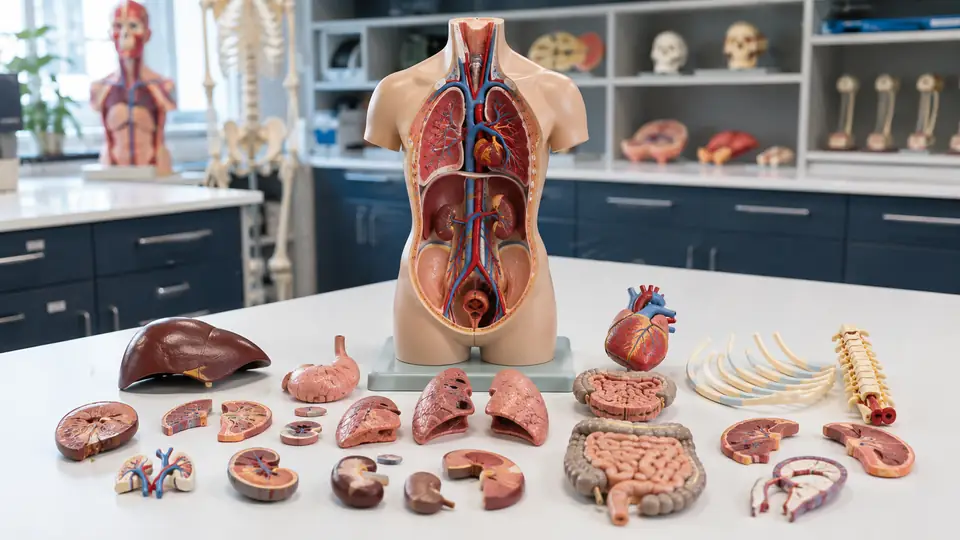
When a torso model is labeled “11-part,” “18-part,” or “24-part,” the number usually refers to the model’s separate physical components, especially the pieces that can be removed for closer study. It does not mean the human torso contains only that many anatomical structures, and it does not automatically indicate the model’s size, accuracy, or educational quality.
That small specification can still be surprisingly confusing. One manufacturer may count a lung as one part, while another counts the right and left lungs separately. A removable heart might be included in the total, but a permanently molded stomach may not. These differences are worth keeping in mind when comparing life-size torso models, since two models with similar-looking anatomy can advertise very different part counts. The safest interpretation is simple: part count describes how the model is divided for assembly, removal, or examination, but the exact counting method depends on the manufacturer’s product description.
What “Part Count” Usually Means
On a torso model, a “part” is generally a distinct piece that is manufactured separately or designed to come away from the main body. Common examples include the heart, lungs, liver, stomach, intestines, kidneys, or sections of the reproductive system. Some models also count the torso shell, head, or a removable spinal segment if those pieces are separate.
For example, a student studying the thoracic cavity may lift out a heart and lungs, set them beside the model, and inspect how the organs sit behind the ribs. In another classroom, an instructor may remove the digestive organs one at a time while explaining the path from the esophagus to the intestines. The part count helps describe how many such physical pieces are included, not how many labels appear in the accompanying diagram.
The phrase can also include small components that are easy to overlook. A removable eye, half of a brain, a section of the spinal cord, or a detachable genital insert may count as its own piece. Even a base or support is sometimes included in a manufacturer’s total, although this is not consistent across brands.
Why Part Counts Differ Between Torso Models
There is no single universal counting standard for anatomy models. Two torso models may show nearly the same organs yet advertise different part counts because their designers divide the components differently.
| Counting Situation | How It May Affect the Listed Number |
|---|---|
| Paired organs | Two lungs or two kidneys may count as two parts, or as one paired set. |
| Organ halves | A heart or brain supplied in two removable halves may add two separate pieces. |
| Removable body sections | A head, chest wall, or reproductive insert may be counted individually. |
| Support components | A base, stand, or mounting element may or may not be included. |
| Built-in structures | Organs molded permanently into the torso are often not counted as removable parts. |
Imagine comparing two classroom lists. One says “heart and lungs” as two learning components, while another lists “right lung, left lung, and heart” as three. Nothing anatomical has changed. The difference is simply the way the manufacturer counts pieces, much like a furniture kit may describe one bookcase as five panels while another calls it one unit with five panels.
That is why the number should be read alongside the product’s component list. A higher count can mean more removable anatomy, but it can also reflect smaller divisions rather than a dramatically more detailed model.
Part Count Is Not the Same as Structure Count
A torso model may display dozens of structures even when only a handful are removable. Blood vessels, nerves, muscles, bones, and organ surfaces can be painted, molded, or printed directly onto the model. Those features may appear in a labeling guide without adding to the advertised part count.
Consider a torso with a molded rib cage and painted blood vessels. The ribs and vessels are visible and teachable, but they may be fixed permanently to the model. A removable liver, by contrast, may be listed as one part because it can be lifted out. The model therefore has more visible anatomy than its part count suggests.
This distinction matters when a learner expects every labeled structure to come loose. A 12-part torso is not necessarily limited to 12 anatomical features. It may show the diaphragm, major vessels, ribs, vertebral column, and several muscles while offering only 12 detachable components for deeper inspection.
What a Higher Part Count Usually Adds
More parts often create more opportunities to examine anatomical relationships layer by layer. A torso with removable superficial muscles may reveal deeper organs. A model with separate lungs may allow the learner to compare the right and left sides. A design with a detachable digestive tract may show how organs occupy the abdominal cavity rather than appearing as a flat painted diagram.
That extra separation can be useful during a study session. A learner might first identify the heart in place, remove it, and then name the structures behind it. Later, the same person can replace the organ without looking at the label key. The slight click of a component returning to its recess turns orientation into a physical problem, which can be useful for practicing spatial relationships.
In a teaching setting, separate parts also support demonstrations. An instructor can pass a removable kidney around a small group, point out its position, and return it to the model before moving to the opposite side. However, a high count does not automatically mean every piece is large, durable, or easy to remove. Tiny components may require careful handling and may be less useful for a crowded classroom.
What Part Count Does Not Tell You
Part count alone does not tell you the model’s scale. A life-size torso and an enlarged torso can have the same number of removable components, while a smaller model may divide its organs into more pieces.
It also does not guarantee anatomical completeness. A model with 20 parts may focus heavily on removable organs, while another with 10 parts may include a more detailed skeletal framework or muscular covering. Part count is therefore only one factor to consider when judging how accurately an anatomy model represents the human body. One model may emphasize general anatomy, while another may include male and female reproductive inserts. The number is a construction detail, not a complete description of what the model teaches.
Nor does part count reveal how securely pieces fit, whether they are labeled, or whether they are suitable for frequent classroom handling. A product description should be checked for details such as removable components, included structures, labeling, articulation, dimensions, and care instructions rather than treating the largest number as the most important feature.
How to Read a Torso Model Specification Correctly
When a listing gives only a number, look for a separate “parts included” or “components” section. That list may clarify whether the count includes paired organs, the head, the torso shell, a stand, or reproductive inserts.
- Find the component breakdown. Look for names such as heart, lungs, liver, stomach, intestines, kidneys, brain, eye, or genital insert.
- Check whether the pieces are removable. “Shown” or “represented” does not necessarily mean “detachable.”
- Look for paired structures. Determine whether two lungs or kidneys are counted separately.
- Check for alternate versions. Some torso models include interchangeable male and female parts, which may affect the advertised total.
- Confirm what is included in the package. A stand, guidebook, or storage tray may be listed separately from the anatomical components.
Suppose a specification says “15-part torso” but names only 13 anatomical pieces. The remaining two may be a stand and a removable torso cover, or the manufacturer may be using a different counting convention. That is a reason to consult the detailed manual or manufacturer documentation, not a reason to assume the listing is wrong.
How Part Count Affects Study and Demonstration
For individual study, removable components can support a simple recall routine. First identify an organ in its normal position. Next remove nearby pieces and name what lies underneath or behind them. Finally, replace everything without checking the guide. This works especially well for regions where depth matters, such as the thorax and abdominal cavity.
A learner reviewing the digestive system might remove the liver and stomach, trace the esophagus into the stomach, and then locate the intestines in relation to the abdominal wall. Another learner may use the same method with the heart, lungs, and diaphragm. The value comes from examining relationships, not from chasing a particular number of parts.
In classroom demonstrations, fewer large parts may be easier for students to see and handle. A model with many small pieces may offer finer separation but require more time for setup, labeling, and storage. If several pieces look similar, a component tray or labeled storage box can prevent a kidney from wandering into the wrong compartment after the lesson.
Part count is also less important when the teaching goal is surface anatomy. A model with fixed muscles and clear labels may be more useful for a quick orientation lesson than a highly disassembled model whose organs must be removed and replaced. The appropriate design depends on what learners need to observe.
Common Misunderstandings About Torso Model Parts
“A 20-Part Model Shows Only 20 Structures”
Usually, it does not. The torso may display many fixed structures in addition to its detachable pieces. The number generally describes physical construction rather than the full number of anatomical features shown.
“A Higher Number Always Means Better Detail”
Not necessarily. A higher count may reflect separate left and right organs, divided organ halves, or included accessories. Compare the actual component list and the visual detail of the structures instead of relying on the headline number.
“Every Manufacturer Counts Parts the Same Way”
They do not always use the same convention. One company may count paired organs individually, while another may treat them as a single set. This is the most important reason to read the specification carefully.
“The Part Count Includes Every Piece in the Box”
Not always. Stands, labels, manuals, and storage accessories may be excluded, included, or listed separately. The product documentation should clarify what the number represents.
Does Part Count Matter When Studying Anatomy?
Yes, but only as one piece of information. The count is useful for estimating how much of the model can be disassembled and how easily a learner might examine internal relationships. It becomes much more meaningful when paired with the component list, model scale, labeling system, and intended educational use.
For a student who wants to practice organ identification, a few clearly removable organs may be enough. For an instructor explaining layers of the thorax or abdomen, a model with more separately removable components may provide additional teaching flexibility. Someone focused on muscles or surface landmarks may care more about molded detail than the total number of detachable pieces.
The practical takeaway is straightforward: treat part count as a description of the model’s physical breakdown, not as a score. To understand what a torso model actually offers, ask which parts are removable, how they are counted, and what anatomical relationships those pieces allow the learner to explore.
