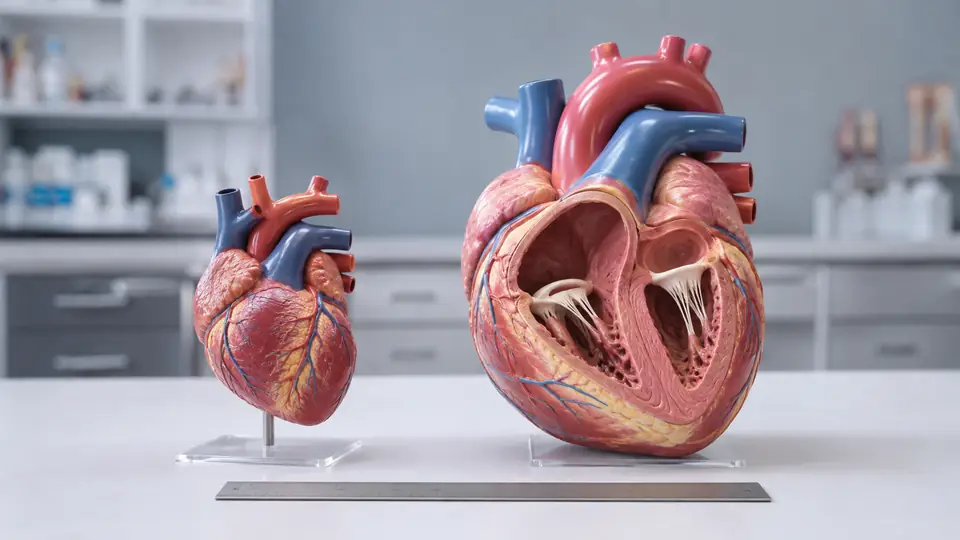
The phrase “2X life size” or “3X life size” on a heart model describes scale. It means the model is intended to be approximately two or three times larger than the anatomical reference used for an adult human heart, usually measured across its main linear dimensions. It does not mean the model represents a heart with twice or three times the biological function, capacity, or number of chambers.
That extra size is mainly about visibility. A natural-sized heart model may fit comfortably in one hand, while an enlarged version gives the coronary vessels, valves, chambers, and wall structures more room to see and discuss. The difference becomes especially noticeable when a student is trying to trace blood flow or when an instructor is pointing to a small opening from several feet away.
What “Life Size” Means on a Heart Model
Life size means the model is built to approximate the size of the anatomical structure it represents. For a heart model, that reference is generally an adult human heart, although actual heart size varies with factors such as body size, age, sex, and individual anatomy. As a result, “life size” should be treated as an educational scale description rather than a promise that every model matches one exact heart measurement.
Imagine comparing a textbook illustration with a physical model during study. The illustration may show the left ventricle in crisp color, but the model lets the learner see its position relative to the right ventricle, atria, valves, and major vessels. At life size, those relationships are represented at roughly anatomical scale. On a larger model, they are expanded so the eye and finger can follow them more easily.
Manufacturers may use slightly different reference dimensions or construction methods, so the product’s listed measurements are more precise than the scale label alone. A model described as life size may therefore not have exactly the same height, width, and depth as another life-size heart model.
How 2X and 3X Scale Work
When a heart model is labeled 2X life size, its corresponding linear dimensions are intended to be about twice the reference size. A 3X life-size model aims for dimensions about three times the reference size. If a feature measures a certain distance on the reference anatomy, the matching feature on a correctly proportioned 2X model would be approximately twice that distance, while the 3X version would be approximately three times as large.
| Label | General Meaning | Typical Visual Effect |
|---|---|---|
| Life size | Approximately the size of the anatomical reference | Useful for overall anatomical orientation |
| 2X life size | Approximately twice the reference dimensions | Small structures become easier to see and label |
| 3X life size | Approximately three times the reference dimensions | Greater visibility for classroom demonstration and detailed inspection |
There is an important mathematical detail here. Scale usually refers to length, width, and height, not total volume. If every dimension were enlarged exactly, a 2X model would occupy about eight times the volume of a life-size model, because 2 × 2 × 2 equals 8. A 3X model would occupy about 27 times the volume. Real anatomy models may not follow perfect geometric scaling, however, because manufacturers sometimes enlarge delicate structures selectively or adjust the shape for strength and visibility.
What Becomes Easier to See on an Enlarged Heart
The heart contains several structures that are difficult to distinguish on a small model. Enlarging the model can create more visual space around the atria, ventricles, septum, valves, and major blood vessels. The openings of the pulmonary trunk and aorta, for example, may be easier to locate when they are not crowded into a palm-sized object.
A student studying the four chambers may use a 2X model to compare the thicker wall of the left ventricle with the thinner wall of the right ventricle. Another learner may use a 3X model to trace the route from the venae cavae into the right atrium, through the right ventricle, and toward the lungs. The enlarged surfaces do not change the anatomy being represented, but they give the learner more room to observe the relationships.
Coronary vessels and surface grooves can also benefit from enlargement, particularly when they are raised, colored, or molded into the model. On a small heart, a vessel may look like a thin painted line. On a larger teaching model, it may be easier to follow its direction across the surface and relate it to the chambers beneath it, although the exact level of detail depends on the model’s design.
What the Scale Does Not Mean
A 2X or 3X heart model does not represent a diseased, stronger, or unusually powerful heart simply because it is large. The enlargement is a visual teaching feature. The model still represents the same basic anatomical arrangement unless it is specifically labeled as a pathology, surgical, or specialized clinical model.
Scale also does not automatically indicate the amount of detail. A 3X model may be easier to see, but it may not include removable chambers, cutaway sections, coronary arteries, conduction-system features, or fine internal markings. A smaller model might include more structures, while a larger one might emphasize broad chamber relationships. Size and detail are separate specifications.
The same caution applies to labeling. A large heart model may have printed labels, numbered markers, or a separate key, but “3X” by itself says nothing about whether labels are included. If a particular structure matters for study, check the model’s stated features rather than assuming enlargement guarantees it.
Why Enlarged Models Are Useful for Teaching
Scale matters most when several people need to look at the heart at once. In a classroom, an instructor standing beside a 3X model can point to a valve or vessel without every student crowding around a tiny object. In a small study group, a 2X model may offer enough enlargement for discussion while remaining manageable on a desk or lab table.
An enlarged model is also useful for verbal explanation. A learner can point to the tricuspid valve, move to the right ventricle, and describe the direction of blood flow while keeping the neighboring structures in view. Another student can rotate the model to examine the posterior surface and compare what is visible from different angles. That physical orientation is difficult to reproduce with a flat diagram alone, though diagrams and digital tools can still provide useful labels and cross-sectional views.
Large models are not automatically ideal for every situation. A 3X heart can take up considerable shelf or table space, and its size may make transport less convenient. A life-size model may be easier to hold, rotate, or compare directly with a textbook illustration. The most useful scale depends on whether the goal is individual inspection, close-up demonstration, or group instruction.
How to Read the Scale Specification Correctly
When reviewing a heart model’s description, treat the scale label as one part of the specification. Look for the model’s actual height, width, and depth, because those measurements reveal how large it will be in practice. A model labeled 2X by one manufacturer may not have identical dimensions to a model labeled 2X by another if their reference anatomy or proportions differ.
- Check the stated dimensions: Scale labels are approximate, while measurements show the physical footprint.
- Look for the reference: Confirm whether the manufacturer describes the model as adult, pediatric, or based on a particular anatomical specimen.
- Review the included structures: See whether chambers, valves, vessels, coronary arteries, or cutaway sections are represented.
- Separate scale from construction: A larger model may be solid, sectional, removable, mounted, or fully closed. The scale label does not identify the construction.
- Consider viewing distance: A classroom demonstration may benefit from 3X scale, while close individual study may not require as much enlargement.
For example, someone planning to place the model beside a laptop should measure the available desk space before relying on the phrase “2X.” Someone preparing a lecture should also consider whether the rear of the model, labels, and internal features will remain visible to students seated farther away.
2X Versus 3X: Is One More Accurate?
Neither scale is automatically more anatomically accurate. Accuracy depends on the model’s proportions, structures, surface detail, and construction, not simply on whether it is larger. A well-made 2X model can represent anatomy more faithfully than a poorly proportioned 3X model, just as a detailed life-size model can be more useful for certain comparisons than a larger simplified one.
The practical difference is visibility. A 3X model generally provides more room for large labels, raised features, and group viewing. A 2X model offers noticeable enlargement without becoming as dominant on a desk or demonstration table. Consider a student tracing the coronary arteries with a fingertip. The 3X version may provide more visual breathing room, while the 2X version may be easier to rotate and store after the lesson.
It is also worth remembering that neither model shows every microscopic feature of a real heart. Enlarging an anatomical model does not turn it into a histology specimen or a complete surgical simulator. The model remains a simplified educational representation, and it works best alongside labeled diagrams, atlases, lectures, or digital views when deeper detail is needed.
Frequently Asked Questions
Does 2X life size mean the heart is twice as heavy?
No. The label generally refers to linear dimensions, not weight. Materials, wall thickness, hollow sections, internal supports, and mounting hardware all affect how heavy a model is.
Does 3X mean every heart structure is exactly three times larger?
Not necessarily. The term usually communicates approximate overall scale. Small vessels and delicate features may be adjusted for durability, visibility, or manufacturing, so check the stated dimensions and construction details.
Is a 2X heart model suitable for individual study?
It often can be. A 2X model provides extra visibility for chambers, vessels, and valves while remaining more compact than many 3X models. Its usefulness still depends on the features it includes and the learner’s study goals.
Why do manufacturers use life-size labels instead of only giving dimensions?
“Life size,” “2X,” and “3X” provide a quick visual reference. Dimensions are still necessary for precise planning, but the scale label immediately communicates whether the model is approximately anatomical size or enlarged for teaching.
The Practical Meaning of 2X or 3X Life Size
On a heart model, 2X or 3X life size means approximate enlargement of the heart’s physical dimensions for clearer observation. The larger scale can make chambers, valves, vessels, grooves, and surface landmarks easier to identify, especially during demonstrations. It does not indicate a different kind of heart, a change in biological function, or a guaranteed increase in anatomical detail.
Use the scale label to understand the model’s viewing purpose, then confirm the actual dimensions and listed features. Life-size models support close orientation, 2X models add useful visibility, and 3X models are especially suited to group demonstrations where small anatomical landmarks might otherwise disappear in the crowd.
