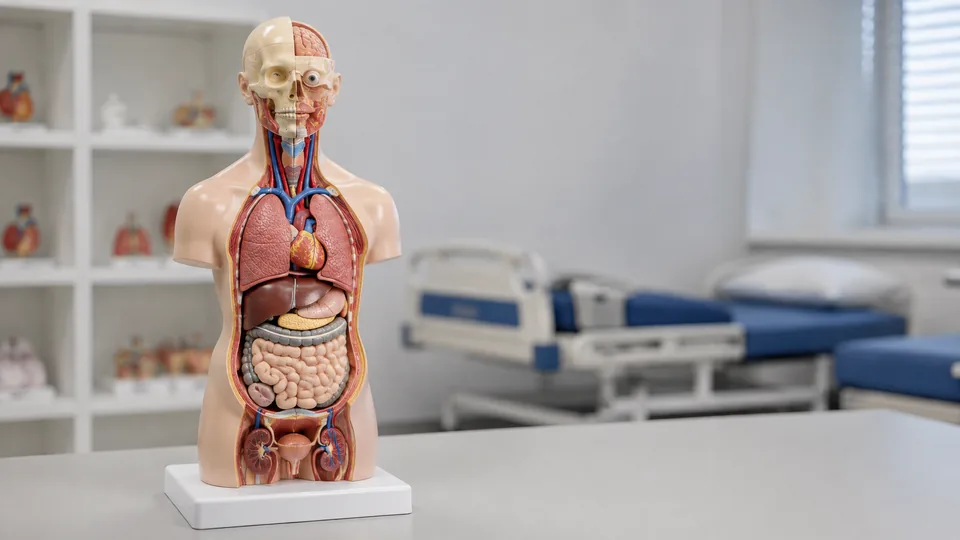
The moment a nursing student tries to trace the path from the trachea to the lungs on a crowded textbook page, anatomy can start to feel like a maze of colored arrows. Three-dimensional models make those relationships easier to see. Organs occupy real space, joints bend, and structures can be viewed from angles that a flat diagram cannot show. The right model depends on the course, though. A removable torso helps with organ placement, while a skeleton, brain replica, or reproductive model serves a narrower but deeper purpose.
Scale, removable components, anatomical detail, stability, and portability matter more than flashy packaging. One common mistake is buying a tiny model for detailed landmark identification, then discovering that its structures are too compressed for the assignment. Another is choosing a large display piece that becomes a clunky burden between class, the library, and home. Among these nine options, the EVOTECH SCIENTIFIC model bundle is the strongest overall choice because it combines torso, skeletal, cardiac, and cranial references in one portable set.
For a faster look at the leading choices, use the table below and select any product name to jump to its full review.
Quick Answer
Best overall: The EVOTECH SCIENTIFIC Human Body Model Bundle offers the broadest coverage, with separate models for the torso, skeleton, heart, and skull with brain. Students who mainly need to understand organ position may prefer the EVOTECH SCIENTIFIC 15-Piece Human Torso, while the 11-Inch Human Torso Anatomy Model provides a simpler, more affordable route into removable-organ study.
For specialized coursework, the QWORK Uterus and Ovary Model gives female reproductive anatomy far more focus than a general torso can provide. The 32-Piece Human Brain Model is the more engaging choice for neuroanatomy review, although its many small sections demand a patient hand and an organized desk.
Best Anatomy Models for Nursing Students Comparison Table
| Product | Best For | Size or Scope | Hands-On Feature |
|---|---|---|---|
| EVOTECH SCIENTIFIC Model Bundle | Best overall | Four-model set | Separate torso, skeleton, heart, and skull models |
| EVOTECH SCIENTIFIC 15-Piece Torso | Organ relationships | 11-inch torso | 15 detachable components |
| QWORK Uterus and Ovary Model | Reproductive anatomy | Life-size organ display | Sectional view with reference chart |
| 32-Piece Human Brain Model | Neuroanatomy | Approximately 4.3 inches | 32 detachable sections |
| 11-Inch Human Torso Anatomy Model | Value and portability | 11-inch torso | 15 removable parts |
| NEW HORIZON 15-Piece Torso | Introductory study | 10.5-inch torso | Removable organs and installation manual |
| Ruiishunyy Mini Skeleton | Skeletal study with a poster | 17.7 inches | Movable joints and removable skull cap |
| 17.72-Inch Poseable Skeleton | Posture demonstrations | 17.72 inches | Positionable arms and legs |
| breesky Human Skeleton | Basic desktop reference | 17.7 inches | Movable limbs, jaw, and skull cap |
The detailed reviews below explain where each model fits into a nursing student’s study routine and which limitations matter before buying.
1. EVOTECH SCIENTIFIC Human Body Model Bundle — Best Overall

This bundle earns the top spot by covering several major areas of anatomy without requiring four separate shopping decisions. It includes an approximately 17.7-inch skeleton, an 11-inch torso, an 8-inch heart including its base, and a compact skull with a brain. Picture a study group moving from bone identification to thoracic organs and then tracing chambers in the heart. Separate models make that shift quick and satisfyingly tactile.
The package also includes a carrying case and several printed references, including a body-systems brochure, skeleton chart, heart manual, and skull-and-brain manual. Those resources help students connect a physical structure with its formal name rather than staring at an unfamiliar groove or organ and guessing. The hand-painted appearance and individual bases also make the set suitable for a permanent study corner where every piece remains visible between review sessions.
Pros
- Covers skeletal, torso, cardiac, cranial, and brain anatomy in one set
- Individual models allow focused study without dismantling one large display
- Includes several illustrated guides and manuals
- Carrying case improves storage and transport between study locations
- Compact dimensions suit desks and smaller rooms better than full-size models
Cons
- Requires more storage space than a single torso or specialty-organ model
- Miniature scale limits close study of very small anatomical landmarks
This set makes the most sense for a student building an anatomy collection from scratch or sharing resources with a study partner. Its breadth is the attraction. A learner preparing for a highly detailed bone practical may still need a larger laboratory skeleton, and advanced neuroanatomy deserves a more specialized brain model. For broad A&P review, however, the bundle gives students several useful perspectives without filling the room with life-size equipment.
To buy this product, click here.
2. EVOTECH SCIENTIFIC 15-Piece Human Torso Model — Best for Organ Relationships

Few study moments are as revealing as removing a model’s intestines and seeing precisely where the stomach, liver, pancreas, and diaphragm sit in relation to one another. This 11-inch EVOTECH SCIENTIFIC torso is built around that spatial lesson. Its 15 pieces include a two-part brain, heart, esophagus and aorta, four lung components, skull cap, stomach, diaphragm, liver, pancreas with spleen, intestines, and the torso itself.
The pieces are made from PVC, painted in contrasting colors, and mounted on an oak base. A brochure accompanies the model, which helps during self-directed review when an instructor is not standing nearby. Its compact height allows it to live beside a laptop without swallowing the whole desk, yet it remains substantial enough for a student to remove and reinstall organs. That assembly process can turn a sleepy late-night reading session into active recall with a clear physical sequence.
Pros
- Fifteen components illustrate the placement of major internal organs
- Removable pieces support active, hands-on review
- Compact 11-inch form is easier to transport than a life-size torso
- PVC surfaces can be wiped clean after repeated handling
- Oak base provides an attractive and stable desktop presentation
Cons
- Small removable components require careful storage and handling
- Compact scale provides less room for fine detail than a larger laboratory torso
Nursing students focused on general anatomy and physiology will get more practical mileage from this model than learners seeking an exhaustive skeletal reference. It excels at showing the crowded arrangement of thoracic and abdominal organs, where flat illustrations often blur depth and position. Students should keep the brochure and small pieces together in a container, especially if the model travels in a backpack, because one missing component can interrupt the entire reassembly exercise.
To buy this product, click here.
3. QWORK Human Uterus and Ovary Anatomical Model — Best for Reproductive Anatomy

General torso models can leave female reproductive structures looking tiny and crowded near the bottom of the display. The QWORK model gives the uterus, ovaries, uterine tubes, vessels, and sectional anatomy the visual space they deserve. Its life-size presentation is mounted upright, creating a clear desktop reference for nursing coursework, classroom demonstrations, and educational discussions.
A labeled reference chart accompanies the model, so students can move between terminology and three-dimensional structure without constantly opening another book. The layered cross section is particularly useful when a frontal external view cannot explain how structures relate internally. During a review session, one student can point to the model while another follows the chart, a simple setup that makes reproductive anatomy feel less abstract and far easier to discuss aloud.
Pros
- Life-size presentation focuses attention on female reproductive anatomy
- Sectional design reveals internal relationships more clearly than an exterior-only model
- Includes a labeled reference chart with diagrams and terminology
- Mounted base keeps the model upright during study or demonstration
- Realistic coloring helps distinguish adjacent structures and vessels
Cons
- Narrower subject coverage than a general torso or multi-model set
- Detailed fixed structures should be handled carefully during transport
This is a strong supplement for maternal-newborn coursework, reproductive-system review, or patient-education practice in an academic setting. It will not replace a broad torso during a full A&P survey, but that specialization is precisely why it is useful. Students who repeatedly struggle to interpret small reproductive structures in diagrams may appreciate the larger, uncluttered view, while those seeking one model for every body system should begin with the overall bundle or a removable torso.
To buy this product, click here.
4. 32-Piece Human Brain Anatomy Model — Best for Neuroanatomy

This compact brain replica takes a puzzle-like approach to adult anatomy study. Its 32 detachable sections can be removed, inspected, and assembled, while color-coded areas and molded surface details help separate neighboring regions. At approximately 4.3 inches tall, the model fits on a crowded desk where notebooks, drug cards, and a half-finished cup of coffee have already claimed most of the space.
The high part count makes this model more interactive than a simple two-piece brain, but it also raises the difficulty. Assembly asks the learner to recognize where sections belong, turning passive observation into a spatial challenge. That can be valuable for college biology, nursing, and healthcare education, especially when a student is trying to connect external surface anatomy with the brain’s overall form. A display stand keeps the assembled model visible between sessions.
Pros
- Thirty-two detachable sections create an active assembly exercise
- Color-coded regions help visually separate anatomical areas
- Molded surface detail supports examination of external brain structure
- Compact footprint fits easily on desks and laboratory workstations
- Included stand provides convenient storage and display
Cons
- Numerous small sections can be challenging to organize and reassemble
- Compact size is less effective for demonstrations to a large classroom
Patient, tactile learners are the clearest audience for this model. Someone who enjoys taking a structure apart and reconstructing it may find the 32-piece format memorable and oddly satisfying. Students seeking a quick glance at gross brain anatomy could find the assembly process fiddly, particularly during a rushed pre-exam review. Keep every section in a dedicated tray or container, and pair the model with course diagrams for formal labels that may receive more emphasis in class.
To buy this product, click here.
5. 11-Inch Human Torso Anatomy Model — Best Value Torso

For students who want removable organs without committing to a larger classroom model, this 11-inch torso covers the essentials in a backpack-friendly shape. Its 15 components include a two-part brain, heart, esophagus and trachea with aorta, four-part lungs, skull cap, stomach, diaphragm, liver, pancreas with spleen, intestines, and torso. The contrasting colors make the packed abdominal cavity easier to parse at a glance.
The lightweight PVC construction and upright base suit repeated desk study. A learner can remove the organs, spread them across a table, and then rebuild the torso from memory, checking the position of the diaphragm or the relationship between the liver and stomach along the way. The surface can also be wiped clean, a practical detail for a model passed around during group review rather than left untouched on a shelf.
Pros
- Fifteen parts provide broad coverage of major torso structures
- Removable organs support assembly-based learning and recall
- Eleven-inch height balances portability with useful visibility
- Contrasting colors help distinguish adjacent organs
- Stable base keeps the torso upright during hands-free review
Cons
- Small scale limits the visibility of subtle landmarks and fine vessels
- Lightweight pieces demand careful packing when carried to class
This model suits first-year nursing students, commuters, and anyone whose study area is a corner of the kitchen table rather than a dedicated laboratory. It offers the core interaction people expect from a removable torso with fewer storage headaches than a larger model. Advanced students who need extensive labeling or minute anatomical features should look toward institutional models, but for practicing basic placement and body-cavity relationships, this compact torso hits a sensible middle ground.
To buy this product, click here.
6. NEW HORIZON 15-Piece Human Anatomy Torso — Best for Introductory Study

The NEW HORIZON torso keeps its focus on approachable organ placement rather than overwhelming the learner with a forest of tiny labels. At 10.5 inches, it is compact enough for a dorm shelf or a small classroom table. Fifteen removable pieces let students see how major organs fit inside the torso, and the bright coloring creates distinct visual boundaries during a quick review.
An installation manual accompanies the model, which is especially useful after the pieces have been laid out in a colorful jumble. The PVC body sits on a flat base, and the listing describes an oak-wood base as part of its construction. That stable presentation works well for a student explaining organ relationships to a classmate or practicing an educational demonstration without holding the model in one hand.
Pros
- Fifteen removable pieces encourage hands-on organ-placement practice
- Compact 10.5-inch form fits smaller desks and shelves
- Installation manual supports independent assembly
- Bright colors make major structures easy to distinguish
- Flat mounted base provides stable upright display
Cons
- Introductory level of detail may be limited for advanced landmark identification
- Compact removable pieces can be easy to misplace during travel
Beginners who feel intimidated by dense anatomical plates may prefer this clear, straightforward presentation. It is also useful for practicing simple explanations, such as showing where the lungs sit relative to the heart or how abdominal organs stack beneath the diaphragm. Students already comfortable with gross organ placement may gain more from a specialized reproductive or brain model, since this torso prioritizes broad orientation over deeper regional detail.
To buy this product, click here.
7. Ruiishunyy 17.7-Inch Mini Human Skeleton — Best Skeleton With a Study Poster

This Ruiishunyy skeleton combines a movable desktop model with an anatomy poster, giving students a physical reference and a flat visual guide in the same package. The 17.7-inch skeleton shows the skull, spine, rib cage, pelvis, and limbs without demanding the floor space of a life-size model. Its shoulders, elbows, wrists, hips, knees, and ankles can be repositioned for basic joint and posture demonstrations.
The skull cap is removable, while the spring-connected jaw opens and closes. Those small interactive features add welcome texture to study sessions. Instead of memorizing the skeleton as a stiff front-facing image, a learner can adjust the limbs, view the pelvis from the side, and compare the result with the included poster. A metal support rod and 4.75-by-4.75-inch base hold the model upright for hands-free observation.
Pros
- Articulated major joints allow basic movement and posture demonstrations
- Removable skull cap provides another view of cranial structure
- Movable jaw adds useful interaction around the skull
- Included anatomy poster complements the three-dimensional reference
- Compact base and desktop height reduce storage demands
Cons
- Miniature bones provide less detail than a full-size laboratory skeleton
- Small model is harder to see during demonstrations across a large room
This is the most versatile skeleton pick here for a student who wants supporting reference material in the box. It works well for reviewing major bones, joint locations, and broad skeletal relationships, particularly at arm’s length. It is less suitable for practical exams centered on subtle foramina, ridges, or other fine landmarks. For that level of work, the student should use laboratory specimens or larger models supplied by the program alongside this portable home reference.
To buy this product, click here.
8. 17.72-Inch Poseable Mini Skeleton Anatomy Model — Best for Posture Demonstrations

The standout feature of this 17.72-inch skeleton is its emphasis on pose adjustment. Movable arms and legs let the model shift from a straight standing position into bent postures, which can make the relationship between bones and joints easier to visualize. The listing describes moderate damping at the joints, intended to help the skeleton retain a pose rather than immediately drooping back into place.
Its hard PVC construction shows the broad textures and forms of the skull, spine, ribs, and joints. For a student trying to picture flexion at a limb or compare standing and bent positions, manipulating a model can be more intuitive than flipping between several drawings. The skeleton can also be assembled and disassembled, making it suitable for desktop instruction, basic anatomical reference, or a study shelf where a posed figure remains visible.
Pros
- Movable arms and legs support basic posture demonstrations
- Positionable joints are intended to hold bent or standing poses
- Full-body format shows relationships from skull through lower limbs
- Hard PVC construction is intended for repeated handling
- Compact height suits desktop study and smaller rooms
Cons
- Mini scale compresses fine skeletal landmarks
- Generalized articulation cannot reproduce the full biomechanics of human joints
Visual learners studying broad movement concepts may enjoy this model more than a rigid skeleton. It helps answer simple spatial questions, such as how limb position changes the silhouette of a joint or how the spine, pelvis, and legs align during a pose. It should remain an educational reference rather than a substitute for detailed biomechanics resources. Students primarily memorizing bone names may prefer the Ruiishunyy option because its included poster provides an immediate companion guide.
To buy this product, click here.
9. breesky Human Skeleton Model — Best Basic Desktop Skeleton

The breesky skeleton is a simple, no-frills option for students who want a full skeletal silhouette on the desk without the looming presence of a full-size lab model. It stands approximately 17.7 inches tall on a 4.75-by-4.75-inch base, so the footprint is manageable beside a tablet or open anatomy workbook. Movable arms and legs allow the model to be repositioned during basic study.
A removable skull cap offers access to the cranial interior, and the jaw moves while remaining attached to the model. The listing is refreshingly direct about the level of complexity, describing basic anatomical detail in the spine, ribs, and skull. That makes the intended role clear. This is a portable orientation tool for broad structures, not a high-resolution replica for identifying every tiny opening and projection before a difficult bone practical.
Pros
- Compact footprint fits desks, shelves, and small study areas
- Movable arms and legs add basic hands-on interaction
- Removable skull cap allows closer inspection of the cranial area
- Moving jaw supports simple skull demonstrations
- Full-body format provides a quick reference for overall skeletal alignment
Cons
- Basic detail is less suitable for advanced bone-landmark study
- Smaller proportions reduce visibility in group teaching settings
This model fits students who want a straightforward skeletal reference at home and already have access to detailed lab specimens on campus. It can help anchor vocabulary by showing where a named bone sits within the full body, especially during quick self-quizzing. Learners expecting numbered structures, extensive markings, or highly refined joint anatomy should choose a more advanced model outside the miniature desktop category. Simplicity is the appeal here, and it should be purchased with that limit clearly in mind.
To buy this product, click here.
How to Choose an Anatomy Model for Nursing School
Match the Model to the Course
Start with the syllabus rather than the most impressive-looking product photo. A general anatomy and physiology course often emphasizes organ systems and spatial relationships, making a removable torso or multi-model bundle a sensible first purchase. Reproductive, neurological, or musculoskeletal units may justify a specialized model that gives one region more room and detail.
Think about the task waiting at the end of the week. A student preparing to explain abdominal organ placement needs a different tool from someone identifying major bones or reconstructing brain sections. One broad model can support many lessons, but a focused replica usually reveals more within its chosen region.
Scale and Anatomical Detail
Miniature models are easier to carry, cheaper to store, and friendly to cramped desks. The trade-off appears when tiny landmarks blur together. A 17-inch skeleton can show the overall positions of the ribs, pelvis, spine, and limbs, yet it is less useful for identifying subtle features that are already small on a human-size bone.
Larger models generally provide more visual room, but size alone does not guarantee accuracy or depth. Check which structures the listing specifically identifies, whether the course requires those structures, and whether labels or a manual are included. For high-detail practical exams, campus laboratory materials should remain part of the study plan.
Removable Parts Versus Fixed Displays
Removable organs turn review into an active sequence. Taking apart a torso and rebuilding it from memory can expose a weak spot quickly, especially when the liver somehow ends up where the stomach belongs. Detachable brain sections offer the same challenge at a finer scale, although dozens of pieces can become tedious during a rushed session.
Fixed models are faster to consult and harder to scatter across the floor. They work well for demonstrations, pointing exercises, and repeated visual reference. Students who travel frequently should ask whether small components can be stored securely, because portability means little if a crucial organ disappears into the bottom of a backpack.
Articulation and Movement
Movable skeletons help illustrate broad posture, limb position, and skeletal alignment. Look for the joints that actually articulate rather than assuming every connection moves. A positionable desktop skeleton remains a simplified representation, so its range and mechanics should not be treated as a complete account of living human movement.
For memorizing major bones, basic articulation is often enough. Coursework involving detailed joint structure, ligaments, or biomechanics may require specialized joint models or institutional teaching specimens. Buy for the stated learning objective, not for the sheer novelty of bending every plastic limb into a dramatic pose.
Color Coding, Labels, and Printed References
Contrasting colors make crowded structures easier to separate, especially inside a compact torso. Labels and numbered keys can speed up self-quizzing, while a poster or manual helps identify a structure when no instructor is nearby. Products in this roundup vary in the amount of printed guidance they provide, so students who study independently should weigh that difference carefully.
Color should serve as a navigation aid rather than an anatomical claim. Real tissues do not match the bright palette of many teaching models. Use the colors to locate and distinguish structures, then connect those structures to the terminology and descriptions used in class.
Stability, Portability, and Storage
A wobbly base becomes irritating during repeated pointing or assembly. Desktop models should stand securely while leaving enough room for notes, and removable parts need a dedicated box or pouch. A carrying case, such as the one included with the overall model bundle, is particularly useful for students moving between home and campus.
Measure the intended shelf or desk before ordering. An 11-inch torso sounds compact, but its depth and removable pieces still require working space. Models with delicate contours are better carried in protective packaging than tossed beside heavy textbooks, where thin structures can catch or bend.
Best Anatomy Models for Nursing Students FAQ
Are Anatomy Models Worth Buying for Nursing School?
They can be valuable for students who struggle to translate two-dimensional diagrams into spatial relationships. Removable torsos are especially useful for organ placement, while skeletons and specialty models support targeted review. A model works best as a supplement to lectures, laboratory resources, assigned texts, and instructor guidance.
Should a Nursing Student Buy a Torso or Skeleton First?
A torso is often the more versatile first choice for general A&P because it demonstrates the positions of major thoracic and abdominal organs. A skeleton may be the better starting point during a strongly musculoskeletal unit. Check the course schedule and practical-exam format before deciding.
Is a Miniature Skeleton Detailed Enough for College Anatomy?
It is useful for major bones, overall alignment, and basic joint locations. Miniature skeletons are less effective for small foramina, ridges, processes, and subtle surface landmarks. Students tested on fine details should pair a desktop model with full-size laboratory specimens or detailed course imagery.
How Many Removable Parts Should a Torso Model Have?
There is no ideal number for every learner. A 15-piece torso can demonstrate major organ placement without creating an exhausting assembly puzzle. More pieces may expose additional structures, but they also increase setup time and the chance of losing a component. The listed organs matter more than the headline count.
Do Anatomy Models Need Labels?
Labels are convenient but not mandatory. An unlabeled model can actually support active recall when the student points to each structure and names it without a prompt. Still, a numbered key, chart, or manual makes independent checking much easier and reduces uncertainty during early study sessions.
Can a Model Replace Anatomy Lab Materials?
No. Consumer anatomy models simplify structures to varying degrees, particularly at compact scales. They are useful for visualization, repetition, and educational demonstrations, but they do not replace course-approved laboratory materials, formal instruction, or the detailed resources required by a nursing program.
How Should Removable Anatomy Models Be Stored?
Keep the assembled model away from direct heat and crowded shelf edges. Place loose organs or brain sections in a labeled container whenever the model travels. Printed guides should stay with the pieces, and the surfaces can be cleaned according to the seller’s material guidance rather than with harsh chemicals chosen at random.
Which Model Type Works Best for Visual Learners?
A removable, color-coded torso offers a strong blend of spatial depth and clear visual separation. Tactile learners may prefer a multi-piece brain or articulated skeleton because assembly and movement add another memory cue. The most useful choice is the one that mirrors the structures emphasized in the student’s current course.
Final Verdict
The EVOTECH SCIENTIFIC Human Body Model Bundle is the strongest overall recommendation among these nine picks. Its combination of a skeleton, torso, heart, and skull with brain gives nursing students several distinct ways to study, while the carrying case and printed references help keep the collection organized. It is particularly appealing for a learner starting from scratch who wants broad coverage rather than one narrowly focused display.
Students concentrating on organ position should look closely at the EVOTECH SCIENTIFIC 15-Piece Human Torso, while the 11-Inch Human Torso Anatomy Model is a practical value choice for smaller desks and frequent travel. Specialized needs call for specialized tools. The QWORK model gives reproductive anatomy a clearer stage, and the 32-piece brain model rewards learners who enjoy assembly-based study. Before purchasing, compare the model’s verified structures with the course syllabus, measure the available storage space, and decide whether portability or fine detail will matter most during the next exam block.
