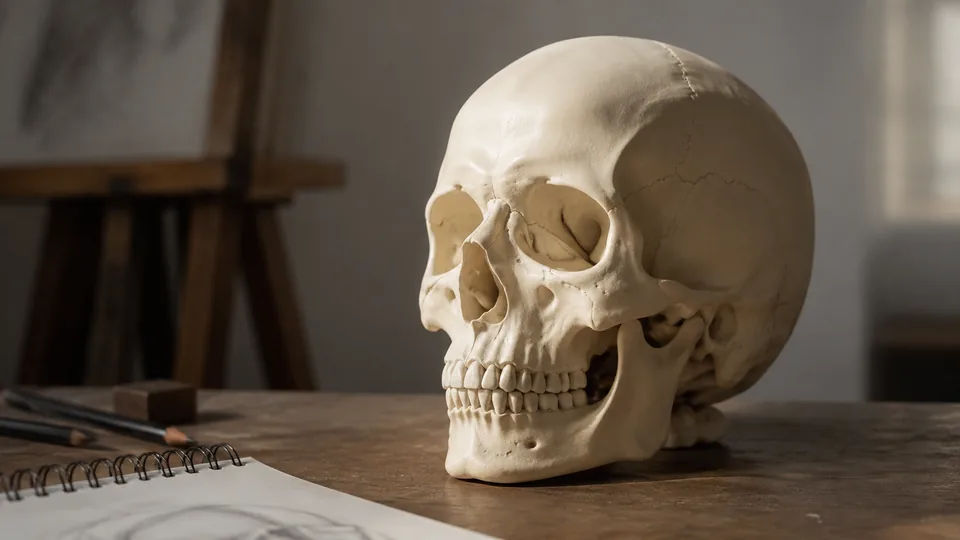
A skull can look deceptively simple until you try to draw one from a three-quarter angle. Suddenly the cheekbone disappears too soon, the jaw hangs like a loose hinge, and the eye sockets flatten into cartoon ovals. A physical model solves a problem that photographs cannot: you can rotate it beneath a lamp, lower your viewpoint, and watch the planes shift in real time. The best skull models for artists preserve useful proportions, sutures, cavities, and jaw relationships without becoming awkward studio clutter.
Choosing one means balancing anatomical detail against visual clarity. A life-size, unmarked skull works beautifully for observational drawing, while numbered landmarks or bright sutures can interrupt a finished still life but help during anatomy study. Compact models travel easily, removable parts expose hidden structures, and muscle or planar heads connect the bones to portrait construction. Priorities vary between portrait painters, sculptors, classroom instructors, and sketchbook artists, but the Axis Scientific Human Skull Model offers the strongest overall blend of adult scale, clear structure, and practical reference material.
For a fast decision, the quick recommendations and comparison table highlight the most useful differences before the full reviews.
Quick Answer
Best overall: The Axis Scientific Human Skull Model combines life-size proportions, an articulating jaw, removable calvarium, labeled structures, and a model-specific manual. Artists who prefer an uninterrupted bone-colored surface should look at the Unnumbered Life-Size Human Skull Model, while the Artists Mannequin Four-Head Set is the standout choice for connecting skull anatomy with muscles, facial mass, and simplified planes.
For a small desk or travel bag, the Medarchitect Mini Human Skull offers a palm-sized, three-part reference. Students seeking a more analytical study tool may prefer the Human Skull Model With 55 Numbered Landmarks or the color-coded, 15-part breesky Exploded Skull Model.
Best Skull Models for Artists Comparison Table
| Product | Best For | Scale or Size | Key Reference Features |
|---|---|---|---|
| Axis Scientific Human Skull Model | Overall studio reference | Life-size | Three parts, articulating jaw, labeled structures |
| Artists Mannequin Four-Head Set | Portrait construction | Approximately human proportions | Skull, muscle, planar, and original heads |
| Unnumbered Life-Size Human Skull Model | Observational drawing | 7.5 by 5.5 by 6.5 inches | Clean surface, removable cap and mandible |
| Small Muscle and Bone Head Model | Facial anatomy | 4.33 inches | Half-muscle, half-bone resin bust |
| Human Skull Model With 55 Numbered Landmarks | Structured anatomy study | Life-size | Numbered landmarks and red sutures |
| Anatomy Lab Human Skull Model | Value-minded beginners | Life-size | Three-part construction and movable jaw |
| Laser-Etched Numbered Skull Model | Durable labeling | Life-size | Permanently etched reference markings |
| breesky 15-Part Exploded Skull Model | Understanding individual bones | Palm-sized | Fifteen detachable, color-coded parts |
| Medarchitect Mini Human Skull | Portable sketching | Palm-sized | Three removable parts and spring-mounted jaw |
The detailed reviews below show how each model behaves as a drawing, painting, sculpting, or anatomy-study reference.
1. Axis Scientific Human Skull Model: Best Overall

The Axis Scientific model earns the top position because it covers the fundamentals an artist needs without drifting into an overly specialized display piece. Its life-size proportions let you compare brow width, orbital depth, cheekbone projection, and mandible placement at a believable adult scale. Place it beside an easel under a single desk lamp, and those deep cavities throw crisp shadows that make planar changes much easier to read.
This three-part design has a removable skull cap and articulating mandible, so the pose is less static than that of a fixed cast. Opening the jaw reveals how the lower facial mass changes, which is handy for character art or studies of open-mouth expressions. Labeled internal and external structures support deeper anatomy work, while the full-color manual uses photographs of the actual model. That direct visual correspondence can save a lot of page-flipping when an unfamiliar opening or ridge catches your eye.
Pros
- Life-size adult proportions support accurate observational drawing
- Removable calvarium exposes internal cranial structure
- Articulating jaw permits varied mouth and mandible studies
- Labeled external and internal features aid anatomy learning
- Includes a photo-based manual and a three-year warranty
Cons
- Visible labels may distract artists seeking a completely clean still-life subject
- Life-size construction requires more desk and storage space than a mini model
This is the most balanced pick for an art student who wants one skull for studio assignments, personal anatomy study, and long-term shelf reference. The labels are useful during structured learning, though painters focused purely on light and form may favor the unnumbered model ranked third. For mixed use, the Axis model offers a convincing combination of scale, movable construction, and supporting information.
To buy this product, click here.
2. Artists Mannequin Four-Head Set: Best for Portrait Construction

A skull explains the foundation of a face, but portrait artists still need to bridge the gap between bone and skin. This four-piece set tackles that transition with skull, muscle, planar, and original head models. Arranging them side by side lets you trace the same brow, cheek, mouth, and jaw regions through different layers. That is a powerful exercise after a portrait keeps looking oddly soft despite careful measurement.
The heads are made from resin and sit on stable bases, allowing artists to turn them toward a window or lamp and study changing angles. The planar head is especially useful for value grouping because broad surfaces make light direction obvious, while the muscle head shows how soft tissue wraps over the cranial framework. Compared with a detachable medical skull, this set sacrifices access to the cranial cavity but delivers a much broader portrait curriculum on one desktop.
Pros
- Includes four complementary references for layered portrait study
- Connects skull structure with muscles, planes, and surface appearance
- Stable bases support rotation and desktop positioning
- Resin construction suits repeated studio or classroom handling
- Useful for drawing, painting, character design, and sculpture
Cons
- The skull component does not provide removable cranial parts
- Four separate heads demand more storage space than a single compact bust
Choose this set if your real goal is drawing believable faces rather than memorizing foramina or internal skull anatomy. A beginner can sketch the skull first, add muscular masses in a second pass, and simplify everything into planes for a final lighting study. Medical students and artists seeking a detailed three-part cranium will get more from the Axis model, but portrait specialists gain a richer progression here.
To buy this product, click here.
3. Unnumbered Life-Size Human Skull Model: Best for Observational Drawing

Black numbers and colored sutures are useful in anatomy class, yet they can become visual noise during a charcoal drawing. This unnumbered model keeps the surface clean, leaving artists to concentrate on silhouette, proportion, cavities, and shadow edges. At 7.5 by 5.5 by 6.5 inches, it supplies a realistic adult reference that can sit beside a portrait bust without looking like a tiny desk ornament.
The magnetic-and-pin cranial cap lifts away, and the spring-connected mandible can open, move, or detach. Those features allow separate jaw studies and views into the cranial base, though most painters will appreciate them simply as posing options. Imagine turning the skull toward a low lamp and cracking the jaw slightly. The dark wedge between the teeth and mandible immediately creates a more dramatic composition than a permanently closed cast could provide.
Pros
- Unnumbered bone-colored surface stays visually clean for drawing and painting
- Life-size dimensions provide realistic facial and cranial proportions
- Magnetic skull cap permits convenient access to the interior
- Removable, movable mandible supports varied studies
- Includes a paper manual and online learning access
Cons
- Lack of printed landmarks makes rapid structure identification less convenient
- Spring-supported jaw should be handled gently during frequent repositioning
This model suits painters, atelier students, illustrators, and sculptors who want the skull itself to remain the visual focus. It also encourages active recall because there are no printed answers scattered across the surface. Beginners who need guided labeling may feel more comfortable with the Axis or numbered-landmark models, but experienced artists will likely prefer this cleaner presentation beneath strong studio lighting.
To buy this product, click here.
4. Small Muscle and Bone Head Model: Best Compact Facial Anatomy Model

This little resin bust takes a clever split-face approach. One side displays skull structure, while the other shows facial musculature, placing two layers of anatomy in a single 4.33-inch reference. For an illustrator trying to understand why the cheek rounds outward or how tissue sits around the eye socket, that immediate left-to-right comparison feels wonderfully direct.
Its compact footprint fits beside a tablet, sketchbook, or lump of modeling clay without swallowing the work surface. Rotate the head as you rough out a profile, then compare the bone side with the muscle side before adding surface forms. The small scale naturally limits fine landmark visibility, but it also makes the model easy to carry between a classroom, café sketch session, and home studio. That portability can matter more than removable parts for artists who draw wherever they find space.
Pros
- Half-bone and half-muscle design links skeletal and soft-tissue anatomy
- Compact 4.33-inch height fits crowded desks and portable kits
- Resin construction provides a sturdy studio reference
- Multi-angle form supports portrait and character studies
- Useful for drawing, sculpture, illustration, and facial design
Cons
- Small scale makes subtle cranial landmarks harder to inspect
- Fixed bust cannot expose internal structures or reposition the mandible
This is a focused tool rather than a comprehensive skull replica. Character artists and portrait students will appreciate the visual bridge between bone and muscle, especially during quick construction studies. Choose a life-size three-part skull for detailed cranial anatomy, but pick this bust when portability and facial structure matter more than calvarium access or jaw articulation.
To buy this product, click here.
5. Human Skull Model With 55 Numbered Landmarks: Best for Structured Anatomy Study

Artists who enjoy a systematic anatomy lesson may find a blank skull frustrating at first. This model places 55 numbered landmarks across a life-size PVC skull and paints the sutures red, turning an intimidating mass of bone into a mapped study object. A printed study card, online PDF guide, and guided videos accompany the model, so the numbers have an organized reference rather than floating without context.
The model measures approximately 7.5 by 5.5 by 6.5 inches and weighs about two pounds. Its magnetic cap separates from the base, while the spring-supported mandible can move for jaw and tooth-placement studies. Picture an art student spending ten minutes identifying landmarks, then covering the study card and drawing the same skull from memory. That blend of active recall and direct observation can build a stronger mental model than copying a flat diagram repeatedly.
Pros
- Fifty-five numbered landmarks support organized self-study
- Red sutures clearly separate major cranial boundaries
- Life-size proportions suit detailed drawing and demonstration
- Three-part construction reveals the skull base and cranial cavity
- Includes printed and online educational resources
Cons
- Bright markings can distract from tonal still-life studies
- Greater educational detail may be unnecessary for casual sketching
This model makes sense for art students taking anatomy seriously, particularly those who like quizzes, labels, and repeatable exercises. It can serve double duty in an anatomy classroom, dental drawing session, or sculpture course. Artists who mainly need a neutral object under dramatic light should choose the unnumbered model, while learners who want a guided path through cranial landmarks will find this option far more approachable.
To buy this product, click here.
6. Anatomy Lab Human Skull Model: Best Value for Beginners

The Anatomy Lab model keeps its pitch refreshingly straightforward: a life-size, anatomically oriented skull with the key movable components artists tend to use. Its calvarium lifts away, the mandible articulates, and the base remains available for studying forms hidden in ordinary frontal photographs. For a beginner assembling a first home studio, that covers much of the useful ground without adding an elaborate color system.
Its full-size form is particularly helpful during sight-size exercises. Set the model at eye level, step back from the easel, and compare the height-to-width relationship before chasing tiny details. Turning it gradually also reveals how the zygomatic region leads toward the ear and how quickly the far eye socket narrows in perspective. The model is intended as a basic educational replica, making it better suited to foundational observation than highly specialized osteology work.
Pros
- Life-size format supports realistic proportion studies
- Removable skull cap reveals internal anatomy
- Articulating mandible allows open- and closed-jaw references
- Clean, basic presentation works for students and artists
- Backed by US-based customer support from Anatomy Warehouse
Cons
- Fewer guided study features than numbered or color-coded models
- Basic design offers less specialized instruction for advanced anatomy study
New art students, hobby painters, and classroom instructors seeking a simple life-size reference should place this model high on the list. It provides the movable features that make skull studies more flexible while avoiding the busy appearance of heavily marked teaching models. Advanced learners who want identified internal landmarks and model-specific documentation may prefer the Axis pick, but this remains a sensible entry point.
To buy this product, click here.
7. Laser-Etched Numbered Skull Model: Best for Durable Labels

Shared classroom references get touched, cleaned, rotated, and pointed at constantly. This life-size model addresses that reality with laser-etched fonts and numbers rather than handwritten surface markings. The engraving is intended to resist smudging or wiping away, which gives instructors and diligent anatomy students a more durable labeling system for repeated lessons.
Like several full-size picks here, it separates into the calvaria, skull base, and mandible. That three-part arrangement allows artists to sketch the jaw independently or inspect interior structure while working through anatomical terminology on the included instruction sheet. The markings make navigation easier during a class critique. Still, they remain visible under studio lights, so a finished graphite study will require the artist to ignore or omit those tiny visual interruptions.
Pros
- Laser-etched numbers and fonts resist ordinary smudging
- Life-size form provides useful adult-scale proportions
- Three detachable parts support interior and mandible study
- Uniform markings are easier to follow than irregular handwritten labels
- Non-toxic PVC surface can be cleaned carefully
Cons
- Etched labels remain visible during pure observational drawing
- Included instruction sheet is less extensive than a full photographic manual
This model is a practical choice for art-anatomy instructors, shared studios, and students who expect to handle their reference frequently. Its core advantage is the permanence of its identifying marks, rather than a special pose or compact shape. Artists seeking a pristine display surface should skip the etched design, while anyone tired of fading classroom labels may consider that trade-off entirely worthwhile.
To buy this product, click here.
8. breesky 15-Part Exploded Skull Model: Best for Understanding Individual Bones

A conventional bone-white skull can make separate structures blend together, especially for a newcomer. The breesky model uses different colors and 15 detachable components to clarify where individual bones meet. Pulling apart the temporal, sphenoid, and other modeled regions turns the skull from a mysterious shell into an assembly of interlocking forms, which can spark a genuine “ah, now I see it” moment.
Magnets support repeated disassembly and reassembly, while the palm-sized format keeps the full set manageable on a desk. Artists can separate one component, draw its shape, then replace it and study how it affects the outer contour. The trade-off is visual naturalism. Bright colors simplify identification, but they alter the value and color relationships that a painter would see on an unmarked skull under neutral light.
Pros
- Fifteen detachable parts reveal how skull bones interconnect
- Color coding makes structural boundaries easy to distinguish
- Magnetic assembly supports repeated study sessions
- Palm-sized format is convenient for desks and storage
- Included study manual supports guided identification
Cons
- Colored surfaces are less suitable for realistic bone-value painting
- Miniature scale limits room-wide demonstrations and fine-detail observation
This is the strongest pick for visual learners who want to understand construction before tackling surface appearance. It also lends itself to memorable exercises, such as drawing each bone separately and then rebuilding the whole cranium from memory. Choose a neutral life-size skull for classical still-life work, but keep this model nearby if cranial boundaries always seem to dissolve into one pale mass.
To buy this product, click here.
9. Medarchitect Mini Human Skull: Best for Portable Sketching

The Medarchitect Mini Skull is built for artists whose workspace disappears beneath pencils, brushes, cables, and coffee cups. Despite its palm-sized dimensions, the model displays bone texture, sutures, foramina, and fossae. It offers a genuine three-dimensional reference that can slip into a backpack, then emerge for quick perspective studies during a lunch break or figure-drawing warmup.
It separates into three parts: calvaria, skull base, and mandible. The spring-mounted jaw demonstrates movement and creates a few useful pose variations, an unusual level of flexibility for such a small object. The compact scale works best at close range. Across a classroom, the fine structures will vanish, and artists with limited eyesight may find a full-size skull considerably more comfortable for prolonged observation.
Pros
- Palm-sized construction is easy to carry and store
- Three-part design provides access to the skull base
- Spring-mounted mandible adds useful jaw movement
- Visible sutures, foramina, and fossae support close study
- PVC construction is lightweight and easy to place on a small desk
Cons
- Small details are harder to observe than on a life-size model
- Limited visibility makes it unsuitable for large classroom demonstrations
Urban sketchers, traveling students, and artists working in dorm rooms can get plenty of mileage from this miniature. It will not replace a life-size reference for careful academic drawing, but it is far more likely to accompany you outside the studio. If portability determines whether the model actually gets used, this tiny three-part skull has a persuasive practical edge.
To buy this product, click here.
Buying Guide for the Best Skull Models for Artists
Choose a Scale That Fits Your Drawing Method
Life-size skulls make comparative measurement more intuitive. An atelier student can stand several feet from the setup, hold up a pencil, and judge the cranium against the jaw without translating from a tiny object. Larger cavities also cast clearer shadows, helping painters separate hard bony edges from softer turning planes. The price is physical space, since a full-size model can dominate a narrow desk or crowded shelf.
Miniatures suit close-range sketching and portable kits. They are handy for learning perspective, major masses, and silhouette, but tiny foramina and thin sutures become harder to inspect. Think about your usual working distance. A palm-sized skull beside a small sketchbook makes sense, while a classroom easel across the room calls for life-size proportions.
Decide Between a Clean Surface and Educational Markings
An unnumbered, bone-colored model is usually the easiest subject for tonal drawing. There are no red seams or black digits to compete with the natural light pattern, so the artist can squint and see broad masses clearly. This clean presentation also photographs well when creating a personal library of reference images from several angles.
Numbered, labeled, or color-coded models provide a different advantage. They let students identify sutures and landmarks quickly, then connect names with forms. The 55-landmark model suits structured study, while the breesky exploded skull makes individual bones instantly distinct. Choose markings if anatomy identification is the goal. Choose a neutral finish if direct observation and realistic lighting lead the lesson.
Look Closely at the Mandible
The lower jaw changes the entire gesture of the head. A fixed mandible is adequate for closed-mouth studies, but an articulating or spring-mounted jaw supports more dramatic references. Opening it changes the negative space between the teeth, lengthens the facial silhouette, and demonstrates how the mandible relates to the cranial base.
Removability also helps sculptors isolate the jaw before rebuilding the complete head. Springs and connectors should be repositioned gently, particularly in a busy classroom where students may tug at movable pieces. If expressive characters or dental relationships are central to your work, jaw articulation deserves more weight than decorative finish.
Consider Removable Cranial Components
A detachable calvarium exposes the internal cranial cavity and base, areas hidden on a fixed display skull. Illustrators drawing cutaway views and students studying three-dimensional anatomy will appreciate that access. Magnetic-and-pin systems can make removal straightforward while helping the cap return to its intended position.
Most portrait artists will spend more time studying the exterior, so removable pieces should not automatically outrank accurate scale or a readable silhouette. A 15-part model goes further by separating individual bones, which is excellent for analytical study but slower to manage during a casual sketch session. Match the part count to what you genuinely plan to draw.
Connect Bone Structure to the Finished Face
A skull alone explains the hard framework, yet facial likeness also depends on muscle, fat, skin, and simplified surface planes. Artists who struggle to carry anatomical knowledge into portraits should consider a muscle-and-bone bust or a multi-head set. Seeing the skull beside a planar head can clarify why the forehead catches light broadly while the eye sockets drop into shadow.
Sculptors may find this transition especially valuable. Start with the cranial mass, establish the jaw and cheekbones, then compare the muscle reference before laying in facial volume. A medical-style skull provides deeper osteological detail, while an artist-oriented head set gives a clearer route toward the visible face.
Account for the Learning Environment
A private studio favors whatever model best serves the artist’s process, whether that is a clean skull under a spotlight or a tiny reference next to a tablet. Shared classrooms place more pressure on durability, readable labels, and uncomplicated assembly. Laser-etched markings can be helpful where many hands repeatedly point to the same landmark.
For demonstrations, size and visual contrast matter. A palm-sized object may look crisp from the front row and disappear for everyone else. Individual students can use mini models effectively at their desks, while instructors generally benefit from a life-size form that remains legible at a distance. The best choice is the model people can actually see, position, and understand in the room where it will live.
Best Skull Models for Artists FAQ
Is a Life-Size Skull Better for Drawing?
A life-size skull is generally easier for prolonged observational drawing because major proportions and small landmarks remain visible from a comfortable distance. It also creates stronger, more readable shadows under studio lighting. Mini skulls still work well for quick perspective exercises, compact desks, and travel sketching.
Should Artists Buy a Numbered or Unnumbered Skull?
Choose an unnumbered skull for clean tonal studies, still-life painting, and reference photography. Choose a numbered model if identifying structures and building anatomical vocabulary are central goals. Artists who need both can study the numbered model first, then omit the markings from drawings.
Why Does an Art Skull Need a Movable Jaw?
A movable jaw provides additional poses and shows how the mandible relates to the rest of the cranium. Opening it changes the silhouette, exposes dental relationships, and creates new negative spaces. This is particularly useful for character design, sculpture, and studies of expressive open-mouth poses.
Are Color-Coded Skull Models Useful for Artists?
Yes, especially during early anatomy study. Separate colors make bone boundaries easier to understand and remember. Those colors can interfere with realistic value or color studies, however, so painters may prefer a neutral skull after learning the underlying structures.
Can a Mini Skull Provide Enough Anatomical Detail?
A well-formed mini skull can show major sutures, cavities, and cranial masses, making it useful for close-range study. Its reduced scale limits the visibility of delicate landmarks and makes it unsuitable for demonstrations across a large room. It works best as a portable supplement or compact personal reference.
Is a Removable Skull Cap Important for Portrait Artists?
It is helpful but rarely essential for ordinary portrait drawing. The removable cap exposes the cranial cavity and internal base, supporting deeper anatomy or cutaway illustration. Portrait artists who work primarily from exterior form may place greater value on realistic scale, clean surfaces, and clear cheekbone and jaw contours.
How Should a Skull Model Be Lit for Drawing?
Start with one lamp positioned above and to one side of the model. A single directional source creates readable shadows inside the eye sockets, nasal cavity, and beneath the cheekbones. Avoid several competing lamps during early studies, since overlapping shadows can muddy the planes you are trying to understand.
Can a Skull Model Replace Live Portrait Practice?
No. A skull model teaches durable structure, proportion, and bony landmarks, while live subjects reveal individual variation, soft tissue, expression, and movement. The strongest practice combines both. Study the skull to understand what supports the face, then apply that knowledge while drawing real people.
Final Verdict
The Axis Scientific Human Skull Model is the strongest overall recommendation among these nine picks. Its life-size scale, three-part construction, articulating jaw, identified structures, and photo-based manual create a versatile reference for drawing and serious anatomy study. It fits the artist who wants one dependable skull beside the easel, then plans to keep learning from it long after the first charcoal exercise is finished.
Different studios call for different tools. The Artists Mannequin Four-Head Set gives portrait and character artists a clearer bridge from bone to muscle and visible facial planes. The Anatomy Lab Human Skull Model offers a straightforward value option for beginners, while the Medarchitect Mini Human Skull serves artists who need a model that can travel inside a small bag. Pick according to working distance, surface markings, movable components, and educational depth. A model that fits your desk and drawing habits will teach far more than an elaborate one left gathering dust on a high shelf.
