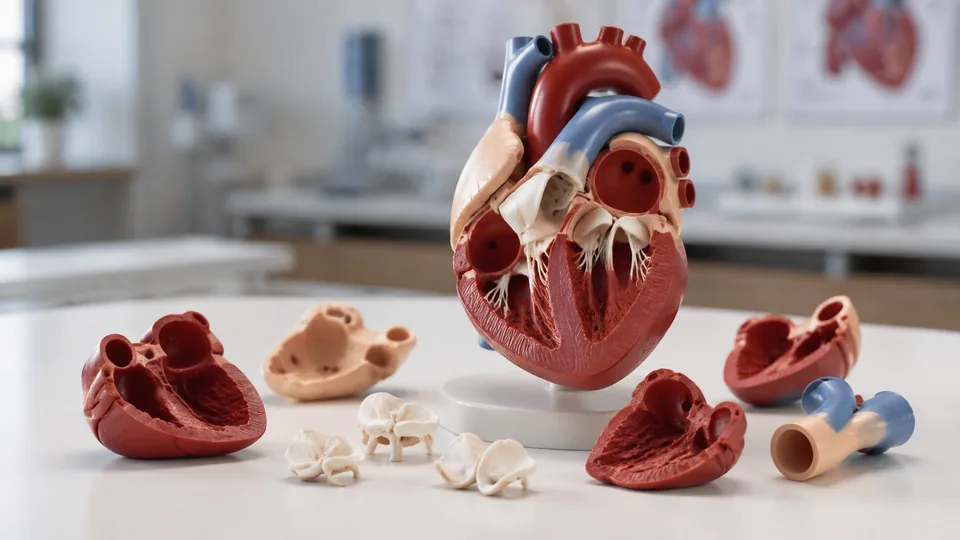
Turn a heart model in your hands and the anatomy suddenly stops looking like a tangle of red and blue lines. Lift away the front wall, trace blood flow through the atria and ventricles, and those crowded textbook labels begin to make spatial sense. That tactile clarity is why students, educators, artists, and healthcare professionals often seek heart models with removable parts.
The models here differ in more than size. Some open through a single magnetic wall, while others separate into four sections for a deeper look at valves, chambers, and major vessels. Numbered structures, reference manuals, stable bases, realistic coloring, and easy reassembly matter during a late-night study session or a lively classroom demonstration. A common mistake is buying the most detailed model available without considering whether it must fit on a desk, travel between classrooms, or remain visible from the back row.
Different buyers need different levels of complexity. The Axis Scientific Life-Size Human Heart Model is the strongest overall choice for its approachable two-part construction, 34 numbered structures, photo-based study manual, and three-year warranty. Larger four-part models make more sense for group teaching, while simpler life-size options offer excellent value for introductory study.
For a fast decision, the quick picks and comparison table highlight the most useful differences before the full reviews.
Quick Answer
Best overall: The Axis Scientific Life-Size Human Heart Model balances clear internal access, manageable size, numbered anatomy, and unusually strong supporting documentation. Best for classroom visibility: The SFXYJ 2X Enlarged Anatomical Heart Model has four removable parts and 49 numbered structures. Best value for two learners: The QWORK Human Heart Model Two-Pack supplies two separate life-size models, a handy arrangement for paired lab work or two teaching locations.
Best Heart Models With Removable Parts Comparison Table
| Product | Best For | Removable Design | Key Learning Feature |
|---|---|---|---|
| Axis Scientific Life-Size Human Heart Model | Best overall | 2 parts, magnetic front wall | 34 numbered structures and photo-based manual |
| SFXYJ 2X Enlarged Heart Model | Classroom teaching | 4 magnetic parts | 49 numbered structures |
| breesky Four-Part Heart Model | Detailed independent study | 4 magnetic parts | 49 numbered regions and labeled chart |
| TYRRDE 2X Life-Size Heart Model | Strong magnetic assembly | 4 magnetic parts | Enlarged dark-red presentation |
| Ruiishunyy 2X Enlarged Heart Model | Group demonstrations | 4 magnetic parts | Large viewing area and reference manual |
| JNMFTD 2X Enlarged Heart Model | All-angle display | 4 magnetic parts | Removable base and color guide |
| QWORK Human Heart Model Two-Pack | Pairs and multiple stations | 2 parts per model | Two life-size, 34-structure models |
| ZENFUN Life-Size Heart Model | Portable study | 2 magnetic parts | 30 hand-numbered areas |
| Life-Size Magnetic Heart Model | Budget-conscious beginners | 2 magnetic parts | Simple access to internal anatomy |
The reviews below explain how each model handles study, teaching, display, and repeated disassembly.
1. Best Overall: Axis Scientific Life-Size Human Heart Model

Axis Scientific earns the top position by getting the everyday details right. Its life-size body opens through a removable front wall held by hidden magnets, giving students direct access to the chambers without scattering several small pieces across a desk. Thirty-four numbered structures cover major features such as the atria, ventricles, valves, coronary vessels, and large veins and arteries. That scope is detailed enough for serious introductory anatomy while remaining approachable during a quick review before class.
The included full-color manual is a particularly useful touch. Its labels correspond to photographs of the physical model rather than unrelated illustrations, so a learner can move from number to name without mentally translating between two different images. Picture a nursing student rotating the model under a desk lamp, booklet open beside a stack of notes. That direct visual match reduces needless friction. The hand-painted finish and secure magnetic closure also suit repeated demonstrations, while the stated three-year warranty gives this pick a reassuring advantage over many similarly sized models.
Pros
- Life-size format is manageable for desk study and close demonstrations
- Magnetic front wall provides quick access to internal chambers
- Thirty-four numbered structures cover the principal cardiac landmarks
- Full-color manual uses photographs of the actual model
- Backed by a stated three-year warranty
Cons
- Two-part construction offers less disassembly than four-part enlarged models
- Life-size anatomy is less visible than enlarged models in a large classroom
This is the sensible choice for medical, nursing, and allied-health students who need a dependable personal reference rather than an oversized lecture prop. It also fits patient education and small-group teaching, where a clean removal motion keeps attention on the anatomy. Educators seeking multiple viewing planes may prefer a four-part model, but the Axis model’s documentation and balanced design make it easier to recommend for broad use.
To buy this product, click here.
2. Best for Classrooms: SFXYJ 2X Enlarged Anatomical Heart Model

Small valves can disappear visually when a teacher holds a life-size model at the front of a crowded room. The SFXYJ model tackles that problem with a twice-enlarged format that makes chambers, vessels, and internal surfaces easier to point out from several seats away. It separates into four parts, and concealed magnets simplify the familiar classroom rhythm of opening the model, showing a feature, and putting everything back together before the next topic.
Forty-nine numbered structures provide more identification points than the simpler two-part picks, supported by a color instruction booklet. Hand-painted PVC distinguishes the surface textures and internal features, while the display base keeps the model upright during a lecture or lab station. Imagine a biology teacher tracing the route from the venae cavae to the right atrium as students follow along. The larger target makes that explanation much easier to see, though it naturally demands more shelf and desk space than a compact life-size heart.
Pros
- Twice-enlarged format improves visibility during group instruction
- Four removable sections expose more anatomy than a single front wall
- Forty-nine numbered structures support structured identification practice
- Hidden magnets allow convenient disassembly and reassembly
- Includes a color booklet and display base
Cons
- Larger footprint is less convenient for backpacks and compact desks
- Additional removable sections require more careful piece management
This SFXYJ model belongs in a science classroom, teaching laboratory, or consultation room where visibility carries real weight. It can also serve a student who finds tiny anatomical landmarks frustrating to inspect. Buyers needing a portable model for daily travel will find the Axis or ZENFUN easier to carry, but stationary educators gain more room to explain relationships among the atria, ventricles, valves, and vessels.
To buy this product, click here.
3. Best Premium Study Option: breesky Four-Part Anatomical Heart Model

For buyers who want a richer dissection-style view, the breesky heart opens into four magnetic components and presents 49 numbered anatomical regions. The listing describes it as a deluxe 1:2 model with an enlarged presentation, making its internal landmarks easier to inspect than those on a typical compact heart. Surface texture, internal chambers, and prominent vessels receive differentiated coloring, creating a more legible map for systematic review.
The model includes a mounted display base, detailed manual, and labeled chart. Those supporting pieces matter during independent study. A student can remove one section, locate its number, check the chart, and replace it with a quiet magnetic snap rather than wrestling with hooks or screws. In an office, the stand keeps the assembled heart ready for a quick visual explanation. Its more substantial format is appealing for close study, although it takes up additional room and may be excessive for an elementary introduction to circulation.
Pros
- Four-part construction provides broad access to internal anatomy
- Forty-nine numbered regions support detailed identification exercises
- Hidden magnets make the sections straightforward to reassemble
- Includes both a detailed manual and labeled chart
- Mounted base supports stable display between study sessions
Cons
- More substantial format is less portable than a basic life-size model
- Level of detail may exceed the needs of younger introductory learners
The breesky is a strong fit for dedicated anatomy students, tutors, and educators who value a generous view of internal structures. Its chart and four-piece design make it better suited to methodical labeling drills than a plain decorative model. A buyer who needs one quick removable wall can spend less space and effort on a two-part option, while those who enjoy taking anatomy apart layer by layer will appreciate this model’s added depth.
To buy this product, click here.
4. Best Magnetic Assembly: TYRRDE 2X Life-Size Anatomical Heart Model
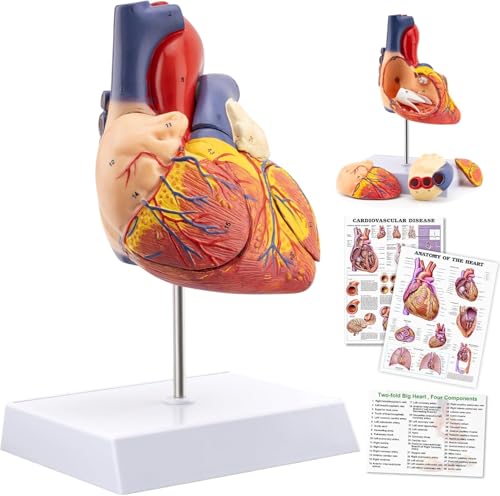
The TYRRDE model emphasizes easy handling through four detachable sections joined by strong concealed magnets. Its listed sections include the left atrium, right atrium, ventricle, and main heart structure, allowing learners to separate major regions and inspect their spatial relationships. At twice life size, the dark-red model gives fine landmarks more visual breathing room, a welcome feature when several people are gathered around one lab bench.
Forty-nine marked structures, handcrafted coloring, and distinct textures support detailed observation. The PVC construction is described as odorless and easy to clean, while the included base provides a steady upright position. Consider a tutor switching rapidly between external vessels and internal valves during an exam review. Magnetic connections remove much of the fiddly interruption associated with mechanical fasteners. The trade-off is familiar among enlarged models: it looks impressive on a shelf, but it is less convenient to tuck into a crowded bag.
Pros
- Strong magnetic connections support frequent assembly and disassembly
- Four sections reveal several internal viewing areas
- Twice-life-size design makes small structures easier to see
- Forty-nine marked structures provide substantial study coverage
- Stable base keeps the model ready for display or instruction
Cons
- Enlarged dimensions require more storage and work-surface space
- Dark-red presentation may be less visually varied than brighter classroom models
Choose the TYRRDE for frequent demonstrations where smooth reassembly matters as much as anatomical detail. It suits study groups, science classrooms, and office displays, particularly when a standard-size model feels cramped. Solo learners working at a narrow desk should check their available space first. For them, the magnetic convenience may still be attractive, but a life-size two-part design will travel more easily.
To buy this product, click here.
5. Best for Group Demonstrations: Ruiishunyy 2X Enlarged Anatomical Heart Model

Room-wide visibility is the Ruiishunyy model’s main appeal. Its enlarged body gives an instructor a broad canvas for identifying chambers, valves, coronary anatomy, and major vessels without asking every learner to crowd within inches of the stand. Four removable magnetic parts open the heart for closer viewing, and the connections help the sections align after a demonstration.
The 49 numbered structures pair with an included reference manual, creating a useful path from guided lecture to self-quizzing. Hand-painted colors separate anatomical regions, and the display base supports hands-free viewing. In a nursing lab, one group might inspect an open section while another checks labels in the manual, then reassemble the model for the next station. The format works smoothly in that shared setting. For an artist seeking a small desktop reference, however, the enlarged body may feel bulky beside sketchbooks and supplies.
Pros
- Enlarged format improves visibility for groups and presentations
- Four removable magnetic parts permit closer internal inspection
- Forty-nine numbered structures cover key cardiac anatomy
- Reference manual supports guided study and label checks
- Hand-painted model sits securely on an included display base
Cons
- Less practical for learners who carry a model between locations daily
- Four sections create more pieces to track than a two-part heart
The Ruiishunyy is aimed squarely at educators, medical and nursing programs, and study groups that need a bold, readable display. Its specifications closely match several other enlarged four-part models here, so the decision may come down to current availability, presentation style, and included reference materials. Buyers whose priority is compact portability should skip the extra scale and select a life-size alternative.
To buy this product, click here.
6. Best for All-Angle Viewing: JNMFTD 2X Enlarged Anatomical Heart Model

Sometimes the posterior surface matters as much as the dramatic open chambers. The JNMFTD enlarged model can be removed from its base, letting a learner rotate the heart and inspect it from different angles rather than treating it as a fixed frontal display. Four magnetic parts reveal external and internal anatomy, while the larger format makes the vessels, valves, atria, and ventricles easier to distinguish.
Its 49 coded structures correspond to a colorful instruction guide, useful for learners practicing recognition without permanent text printed across every surface. The PVC model is hand-painted with realistic colors and texture cues. Picture an art student turning the model beside an easel to understand how the vessels wrap around the back, then returning it to the base for the next sketch. That removable mounting adds flexibility, though the heart still occupies more room than a compact personal-study model.
Pros
- Heart lifts from the base for observation from multiple angles
- Four removable magnetic parts expose external and internal structures
- Forty-nine coded landmarks support systematic anatomy review
- Color instruction guide helps identify the numbered regions
- Enlarged, hand-painted presentation is easy to examine closely
Cons
- Large size is less convenient for limited shelving or frequent travel
- Coded labels require consulting the guide rather than reading names directly
This model suits visual learners, artists, tutors, and instructors who regularly rotate a specimen to explain orientation. The removable base is a small but meaningful distinction, especially during one-on-one demonstrations. Learners who prefer printed anatomical names directly on a model may find the numbered system less immediate, while students happy to quiz themselves from a guide gain a cleaner visual surface.
To buy this product, click here.
7. Best Value for Pairs: QWORK Human Heart Model Two-Pack

One model passing through twelve pairs of hands can turn a lab exercise into a waiting game. QWORK solves that practical snag by supplying two life-size heart models, each with a removable front section held by hidden magnets. Both models show 34 anatomical structures, opening access to the chambers, valves, and principal vessels without requiring a complex four-piece disassembly.
The PVC bodies are hand-painted, washable, and removable from their bases for closer examination of every side. Two models create several useful arrangements: partners can study together, a tutor can keep one open and one assembled, or an educator can place them at separate stations. The design is simpler than the enlarged 49-structure options, so advanced learners seeking finer detail may reach its limits sooner. Still, the pair format delivers unusual practical value where participation matters more than maximum scale.
Pros
- Package includes two separate life-size heart models
- Each model has a magnetic removable front wall
- Thirty-four structures support core cardiac anatomy study
- Models lift from their bases for closer all-around inspection
- Washable PVC suits repeated educational handling
Cons
- Two-part design exposes fewer separate planes than four-part models
- Life-size scale is harder to see during room-wide lectures
The QWORK pair makes sense for homeschooling families with two learners, lab partners, tutors, and schools creating multiple stations on a controlled budget. It is also convenient for an educator who works in two rooms and would rather avoid carrying one model back and forth. A single learner seeking the richest possible anatomy may prefer one enlarged four-part heart, but collaborative settings benefit greatly from having two complete models available.
To buy this product, click here.
8. Best Portable Option: ZENFUN Life-Size Human Heart Model

The ZENFUN model keeps the experience compact and uncomplicated. Its life-size heart measures a listed 9.05 by 3.34 by 5.11 inches, with a 4.33-inch-square base. A magnetic front wall pulls away without tools, revealing internal anatomy across 30 hand-numbered areas that include the atria, ventricles, valves, and major vessels.
The heart lifts from the stand, making it easier to pass around a classroom or turn beneath a study lamp. Lead-free PVC is described as odorless, smooth, shock-resistant, and wear-resistant, all welcome characteristics for an object likely to be handled repeatedly. Imagine an instructor moving between two classrooms with the model tucked beside a laptop and lesson notes. The modest footprint makes that realistic. Its 30 numbered areas provide less identification depth than the 49-region enlarged picks, but many beginners will find the reduced visual load easier to absorb.
Pros
- Life-size dimensions support compact storage and transport
- Tool-free magnetic wall opens quickly for demonstrations
- Thirty numbered regions cover central cardiac structures
- Heart lifts off the stable base for close observation
- Lead-free PVC is described as smooth, odorless, and wear-resistant
Cons
- Thirty marked areas offer less detail than 49-structure models
- Compact scale is less effective for viewers seated far away
ZENFUN is a practical match for beginners, mobile tutors, artists, and educators who need an easy-to-carry heart rather than a dominant display piece. Its balance of numbering and simplicity supports core anatomy lessons without crowding the surface. Advanced students preparing for detailed identification work may prefer the Axis manual or a four-part enlarged model, but portability gives ZENFUN a clear niche among these nine choices.
To buy this product, click here.
9. Best Budget Pick: Life-Size Magnetic Human Heart Model

This straightforward life-size model strips the concept back to what many first-time buyers need: a realistic cardiac form, a removable front section, and hidden magnets that make opening and closing painless. Removing the wall exposes internal blood vessels, valves, and tissue structures, helping learners connect external form with the spaces shown in textbook cross-sections.
The PVC construction is described as sturdy, drop-resistant, and resistant to deformation and fading. That makes the model suitable for regular classroom handling, desk display, or an anatomy-themed gift. A high school student can open it during a lesson on circulation, point out the chambers, and reassemble it in seconds. The listing does not provide the extensive numbered landmark system highlighted by several other picks, so structured memorization may require a separate anatomy guide. Its appeal lies in accessible, uncomplicated visualization.
Pros
- Life-size format provides a realistic sense of cardiac scale
- Two-part magnetic design is easy for beginners to handle
- Removable wall exposes valves, vessels, and internal structures
- PVC construction is described as sturdy and resistant to fading
- Simple presentation works for study, teaching, or display
Cons
- Listing provides less detail about numbered structures and study materials
- Two-part construction is less exploratory than a four-part model
This model is best for a curious beginner, school student, or gift buyer seeking a tangible introduction to heart anatomy without the bulk of an enlarged teaching model. Medical and nursing students who need a mapped list of examination landmarks should favor the Axis, breesky, or another clearly numbered option. For basic spatial learning, however, this magnetic heart offers the essential experience at an approachable level.
To buy this product, click here.
How to Choose a Heart Model With Removable Parts
Decide Between Life-Size and Enlarged Anatomy
Life-size models give learners a realistic impression of how much space the human heart occupies. They sit neatly beside a laptop, slip into many teaching bags, and work well when one or two people can inspect them at arm’s length. Think of a student tracing a vessel beneath a desk lamp. At that distance, a well-painted life-size model can be wonderfully clear.
Enlarged models trade portability for visibility. Their broader valves, chambers, and vessel openings are easier to point out during a lecture or photograph for study notes. A teacher standing several feet from the nearest row will usually gain more from the enlarged format. Measure the intended shelf and work surface before ordering, since a handsome teaching centerpiece can become awkward when it competes with microscopes, books, and lab trays.
Compare Two-Part and Four-Part Designs
A two-part heart usually removes the front wall and leaves the main body intact. This arrangement is fast, intuitive, and hard to mix up. It works especially well for introductory circulation lessons, consultations, and repeated short demonstrations. The soft magnetic click also makes reassembly less distracting than clips or pins.
Four-part models reveal more viewing planes and let learners isolate larger regions. That added access helps with spatial relationships around the atria, ventricles, and valves, yet it creates more components to track. In a busy classroom, assigning a tray or marked storage spot prevents a loose section from vanishing beneath notebooks. Complexity should serve the lesson rather than becoming another puzzle to solve.
Look Closely at Numbering and Reference Materials
Numbered landmarks turn a display object into a practical self-testing tool. A learner can cover the answer key, identify each code aloud, and then check the manual. Models with 49 regions offer broader identification coverage than versions with 30 or 34, but a larger number is not automatically better for every course. Beginners may learn faster from a cleaner model centered on major anatomy.
The quality and format of the reference material matter too. Axis Scientific’s use of photographs corresponding to the actual model is particularly helpful because colors and viewing angles remain consistent. A generic chart can still work, but the learner may need extra time to match its illustration to the physical object. For formal study, confirm that the supplied guide covers the structures required by the course syllabus.
Check the Base and Handling Design
A stable base keeps both hands free for pointing, sketching, or consulting notes. Removable mounting adds another advantage because the heart can be lifted, rotated, and examined from behind. An artist studying vessel placement or a tutor explaining posterior anatomy will appreciate that freedom immediately.
Magnetic attachments are generally convenient for repeated access because they eliminate exposed latches and separate fasteners. Still, removable sections deserve thoughtful handling. Lift pieces from their intended edges, keep liquids away from printed manuals, and store every component together. PVC models are often easy to wipe clean, but cleaning should follow the seller’s care information rather than relying on strong solvents that could affect painted details.
Match Detail to the Learning Environment
A model for an elementary science lesson has a different job from one used in a nursing laboratory. Younger learners benefit from clear color separation and simple removable sections. University students may need numbered valves, coronary structures, and precise internal relationships. Artists often care more about overall shape, surface texture, and all-angle access than a long list of codes.
Patient education calls for restraint and clarity. A clinician or educator may use the model to illustrate general location and anatomy, but the object remains an educational aid rather than a diagnostic tool. Select the level of detail that supports the explanation without burying the viewer in a forest of tiny numbers.
Best Heart Models With Removable Parts FAQ
Are Life-Size or Enlarged Heart Models Better for Students?
Life-size models are usually better for personal desk study because they are compact and communicate realistic scale. Enlarged models help learners inspect smaller landmarks and are easier to see in group settings. The right choice depends on viewing distance, available storage, and the anatomical detail required by the course.
How Many Removable Parts Should a Heart Model Have?
Two parts are sufficient for basic study of internal chambers, valves, and major vessels. Four-part models provide more viewing angles and encourage sectional exploration. More pieces create a richer demonstration, but they also require additional storage and careful reassembly.
Do Numbered Heart Models Include the Anatomical Names?
The names are usually supplied in a manual, chart, or booklet that corresponds to numbers on the model. The exact supporting material varies by product. Buyers studying for a specific class should check that the included reference identifies the structures covered by their curriculum.
Are Magnetic Heart Models Suitable for Classroom Handling?
Magnetic models are convenient for classroom use because sections can be removed without tools, pins, or external clips. Educators should still demonstrate the correct removal points and keep all sections together. Larger four-part models are especially useful at supervised lab stations, while two-part designs are simpler for younger groups.
Can a Heart Model Help Explain Blood Flow?
Yes. A three-dimensional model helps learners trace a general path through the venae cavae, right atrium, right ventricle, pulmonary vessels, left atrium, left ventricle, and aorta. Color coding and removable walls make those relationships easier to visualize. The model supports education, but it does not replace formal instruction or authoritative course resources.
What Is the Best Heart Model for an Anatomy Artist?
An artist will often benefit from a model that lifts from its base and rotates freely. The JNMFTD enlarged model offers all-angle viewing, while the smaller ZENFUN is easier to keep beside a sketchbook. Surface form, vessel placement, size, and available studio space should guide the choice.
How Should a Removable Heart Model Be Stored?
Reassemble the model after study or keep its pieces together in a dedicated tray or container. Store it away from prolonged direct sunlight, heavy objects, and extreme heat. Keep the manual nearby, since a beautifully numbered model becomes much less useful when its identification key wanders off.
Are Heart Anatomy Models Appropriate for Medical Education?
They can be valuable supplementary tools for medical, nursing, and allied-health education. Their strongest role is spatial visualization and identification practice. Accuracy requirements vary by program, so learners should compare the model’s listed structures with their syllabus and continue using approved textbooks, atlases, and instructor guidance.
Final Verdict
Among these nine models, the Axis Scientific Life-Size Human Heart Model offers the strongest overall package. Its 34 numbered structures cover essential cardiac anatomy, the magnetic front wall is simple to operate, and the photo-based manual keeps identification work clear. The three-year warranty adds further reassurance for a model likely to move between a desk, lab table, and classroom shelf.
For larger demonstrations, the SFXYJ 2X Enlarged Anatomical Heart Model provides four removable parts and 49 numbered structures in a format that is easier for groups to see. The QWORK Human Heart Model Two-Pack is the more practical value choice for partners or multiple stations, while the simple life-size magnetic model suits beginners who primarily need a clear internal view. Before buying, match the model’s scale, removable design, numbering, manual, and base to the way it will actually be used. The right heart model should make anatomical relationships feel immediate, clear, and far easier to recall when the textbook closes.
