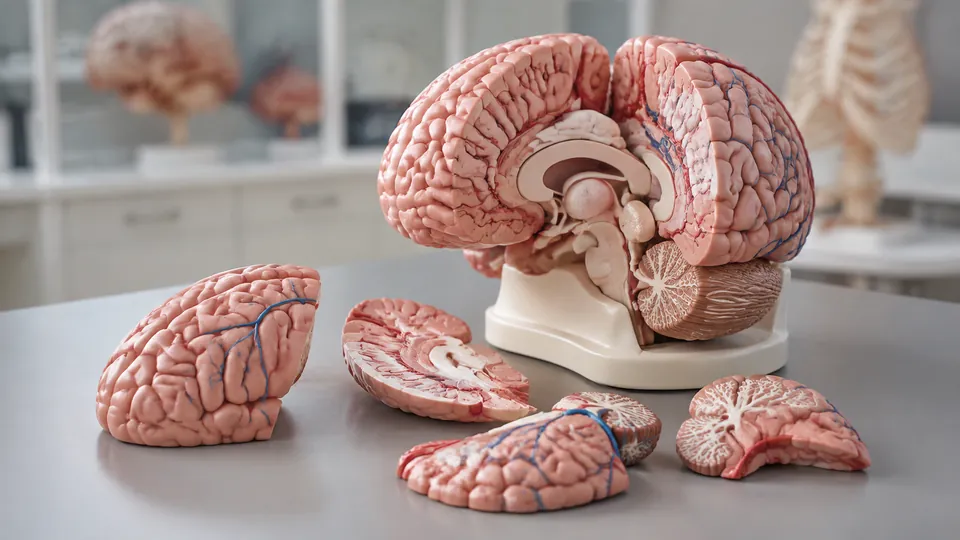
The brain is much easier to understand once its major regions can be separated and viewed from different angles. Removable models let learners lift away the cerebral hemispheres, examine the cerebellum and brainstem, and see how those structures occupy the same three-dimensional space. That hands-on approach makes them useful for anatomy students, psychology learners, educators, homeschool study, and clinical teaching.
The models here differ sharply in scale, labeling, color coding, and anatomical context. A 2X enlarged brain makes small landmarks easier to discuss across a table, while a life-size model better represents natural proportions. Some models focus tightly on neuroanatomy. Others place the brain inside a translucent skull, muscular head, or full torso. Buyers often focus on part count alone, but readable markings, secure connections, a stable stand, and an appropriate level of detail matter far more during repeated study.
For most brain-focused learners, the SKUGWG 2X Human Brain Model offers the strongest balance of enlargement, 131 labels, magnetic construction, and a substantial stand-mounted format. Different priorities may point elsewhere, particularly if you need eight removable pieces, skull context, or a complete human-organ teaching model.
For a quick decision, the recommendations and comparison table below highlight the clearest differences among the nine options.
Quick Answer
Best overall: The SKUGWG 2X Human Brain Model combines a large viewing area, four magnetic sections, 131 labels, functional color coding, and a detailed guide. For a lower-cost life-size format, the 41-Landmark 8-Part Brain Model offers more removable sections in a compact tabletop package. Educators who need to show how the brain sits inside the cranium should look closely at the Axis Scientific Clear Skull with 8-Part Brain.
Best Brain Models With Removable Parts Comparison Table
| Product | Best For | Scale or Format | Removable Parts and Key Feature |
|---|---|---|---|
| SKUGWG 2X Human Brain Model | Best overall | 2X enlarged | 4 magnetic parts, 131 labels |
| 41-Landmark Brain Model | Value and reconstruction practice | Life-size | 8 magnetic parts, 41 numbered landmarks |
| Axis Scientific Clear Skull with Brain | Skull and brain relationships | Life-size skull | 3-part skull, 8-part brain |
| 2X Laser-Engraved Brain Model | Durable labeling | 2X enlarged | 4 parts, 130+ structures, 11 color regions |
| 2X Four-Part Brain Model with Oak Base | Display and guided study | 2X enlarged | 4 parts, 130+ labeled structures |
| 2X Nine-Zone Brain Model | Psychology demonstrations | 2X enlarged | 4 magnetic parts, 9 functional zones |
| HADWYN Head and Neck Model | Head, neck, and brain context | Life-size | 10 parts, 100+ identifiers |
| JNMFTD 17-Inch Torso Model | Compact whole-body study | 17-inch torso | 16-part format, 70+ markers |
| 33.4-Inch Dual-Sex Torso Model | Comprehensive organ education | 33.4-inch torso | 32 removable parts, brain and visceral organs |
The full reviews below explain how each model fits a particular classroom, study desk, or demonstration setting.
1. SKUGWG 2X Human Brain Model: Best Overall

The SKUGWG model earns the top position by making dense neuroanatomy easier to see without turning assembly into a puzzle marathon. Its 2X enlargement gives labels, sulci, functional areas, and internal relationships more breathing room than a natural-size model can provide. The four sections connect magnetically, so a student can open the model, inspect a region, and rebuild it without fiddling with screws or hooks.
Its 131 anatomical labels are especially useful during structured review. Distinct colors identify motor, sensory, and other functional centers, while the included guide connects the markings to named locations. At approximately five pounds, this is a substantial desktop teaching aid rather than a featherlight model tossed casually into a backpack. That heft, combined with the included stand, should suit a tutoring table, clinic office, or college study room where the model will be handled frequently.
Pros
- 2X enlargement makes smaller structures and labels easier to inspect
- Includes 131 anatomical labels and a corresponding guide
- Four magnetic sections support quick disassembly and reconstruction
- Color differentiation helps distinguish functional brain regions
- Durable PVC construction and included stand suit repeated educational use
Cons
- Four large sections provide less granular reconstruction than an eight-part brain
- Approximately five-pound weight is less convenient for frequent transport
This is the strongest fit for neuroscience and psychology students who want more detail than a basic life-size model provides, along with educators who need markings visible from across a small table. Learners focused on memorizing many individual removable pieces may prefer the eight-part options. For readable labels, straightforward magnetic handling, and a generous viewing scale, however, the SKUGWG is the most balanced brain-specific choice in this group.
To buy this product, click here.
2. 41-Landmark 8-Part Human Brain Model: Best Value

For learners who absorb anatomy by taking things apart and rebuilding them, this life-size model has an appealing advantage: eight magnetic sections. The design lets users explore the cerebrum, cerebellum, brainstem, diencephalon, and internal regions from several angles. Reassembling those pieces turns passive reading into retrieval practice, much like closing a textbook and sketching a structure from memory.
The model uses 41 numbered landmarks, an included label card, and online study materials for repeatable identification drills. Color-coded regions and visible red vessel details make orientation quicker, especially for an introductory anatomy and physiology student facing a crowded practical-exam checklist. Measuring approximately 7 by 5.7 by 6.5 inches and weighing about 1.77 pounds, it fits comfortably on a study desk and remains easier to carry than the enlarged five-pound models.
Pros
- Eight magnetic pieces provide detailed assembly practice
- Life-size proportions connect well with standard anatomical references
- Features 41 numbered landmarks for self-quizzing
- Includes a display base, label card, and online study materials
- Compact dimensions and moderate weight support desk use and transport
Cons
- Numbered landmark coverage is less extensive than models with 130 or more labels
- Life-size construction offers less visual enlargement for group demonstrations
This model makes sense for students who value part-by-part spatial learning over a huge catalog of surface labels. Its eight sections can create a more engaging review session than a four-part model, yet the natural scale keeps it manageable in a dorm room or home classroom. Educators addressing a larger room may prefer a 2X model, while independent learners seeking strong functionality at a more accessible price position should place this option near the top of the list.
To buy this product, click here.
3. Axis Scientific Clear Skull With 8-Part Brain: Best Premium Option

The Axis Scientific model answers a question a standalone brain cannot: how does the brain relate to the surrounding skull? Its translucent, three-part life-size skull houses an eight-part removable brain, letting students see cerebral placement while retaining access to the internal pieces. During a cranial anatomy lesson, that clear shell can bridge the gap between studying soft tissue and identifying protective bony landmarks.
The skull replica is cast from real human bones, according to the listing, which helps preserve natural texture and anatomical features. Magnets secure the removable components, and the articulated mandible demonstrates movement at the temporomandibular joint. A full-color guide uses photographs of the model, a practical detail when a student is staring at an unfamiliar ridge and trying to match it to the correct reference image.
Pros
- Combines a three-part translucent skull with an eight-part removable brain
- Clear cranium helps reveal the brain’s position inside the skull
- Skull replica is cast from real human bones for realistic landmarks
- Articulated mandible adds useful jaw-joint context
- Includes a full-color photographic study guide
Cons
- Clear skull bones are not individually color coded
- Broader cranial focus may be excessive for buyers studying brain regions alone
This premium model is best suited to medical students, neurologic education settings, and instructors covering both neuroanatomy and osteology. An introductory psychology learner may get faster results from a brightly labeled 2X brain, since the Axis model devotes considerable attention to the skull. For visualizing containment, orientation, cranial landmarks, and the relationship between hard and soft anatomy, its format is unusually informative.
To buy this product, click here.
4. 2X Laser-Engraved Detachable Brain Model: Best for Durable Labels

Labels are wonderfully helpful until frequent classroom handling turns them faint or ragged. This 2X brain addresses that concern with laser-engraved markings rather than applied stickers. More than 130 anatomical structures appear across the model, and 11 color-coded functional regions help users discuss areas associated with movement, sensation, memory, learning, and emotional processing.
The brain separates into four sections, exposing internal anatomy from multiple viewing angles without creating a pile of tiny pieces beside a lecture podium. Its PVC construction can tolerate routine educational handling, while the display stand keeps the enlarged model positioned for lessons or independent review. Picture a homeschool student rotating the model beside an open workbook, then an instructor pointing to the same colored region during a presentation. The format accommodates both situations neatly.
Pros
- Permanent laser-engraved markings resist the wear associated with stickers
- 2X scale makes labels and anatomical relationships easier to view
- Identifies more than 130 structures
- Eleven color-coded functional regions support psychology and neuroscience lessons
- Includes a sturdy display stand for tabletop demonstrations
Cons
- Four-part construction offers fewer removable sections than eight-part models
- Dense labeling may feel busy for younger or introductory learners
Choose this model for a classroom, tutoring practice, or busy study area where the labels are likely to receive frequent touching and cleaning. The engraved text is its defining advantage over models that rely on surface printing or stickers. Buyers who prefer an uncluttered, natural-looking brain may find the markings visually intense, but learners who repeatedly identify named structures should appreciate having those cues permanently attached.
To buy this product, click here.
5. 2X Four-Part Brain Model With Oak Base: Best for Display
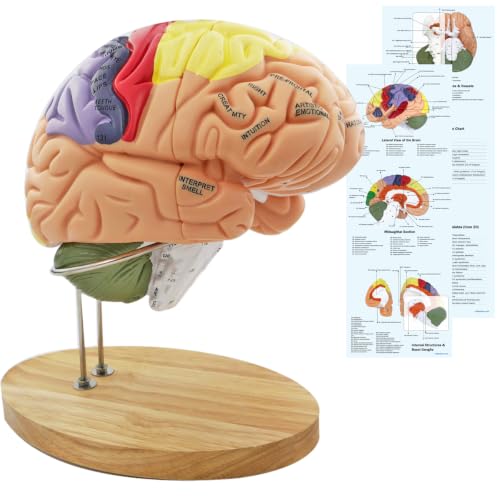
This enlarged four-part model pairs detailed study features with a weighted oak display base, giving it a polished look for an office shelf or teaching table. Its 2X scaling makes lobes, fissures, and functional centers easier to identify than they would be at natural size. The model marks more than 130 structures and uses color coding to separate motor, sensory, and functional areas.
Its detachable arrangement includes access to a midsagittal section, frontal lobe, and brainstem, giving learners a useful mix of outer and inner views. A colorful reference guide accompanies the model, so the markings have immediate context rather than leaving users hunting through a separate atlas. The washable PVC surface also suits environments where several students may handle the same model during a lab or review session.
Pros
- 2X enlargement improves visibility of lobes, fissures, and functional centers
- More than 130 labeled structures support detailed study
- Four detachable sections reveal external and internal anatomy
- Weighted oak base provides a stable, attractive display
- Includes a colorful reference guide
Cons
- Four removable sections provide less assembly depth than eight-part designs
- Enlarged dimensions require more desk or shelf space than a life-size model
This model suits clinicians, educators, and students who want a brain that can remain on display between lessons without looking like loose lab equipment. The oak base gives it a warmer, more finished presence than a basic plastic stand. Someone commuting daily may prefer a lighter life-size unit, but for a permanent desk, therapy room, or classroom station, the combination of scale, labeling, and stable presentation is compelling.
To buy this product, click here.
6. 2X Nine-Zone Magnetic Brain Model: Best for Psychology Learning

Psychology lessons often begin with abstract concepts such as memory, stress, emotion, and learning. This model gives those conversations a physical focal point through nine color zones and more than 130 enlarged structures. At 2X life-size, it has enough visual presence for a small seminar, therapy-education setting, or college study group gathered around a table.
The four sections attach magnetically and provide access to the cerebral hemispheres, brainstem, and cerebellum. Laser-engraved labels resist fading from routine handling, while the washable PVC surface simplifies basic care. A weighted oak stand and full-color guide complete the package. The listing also cautions that the model may have an odor after airtight shipping, so allowing it to air out before placing it in a small office would be sensible.
Pros
- 2X enlargement supports clear tabletop demonstrations
- Nine color zones distinguish functional areas
- More than 130 structures provide substantial anatomical coverage
- Four magnetic sections are quick to separate and rebuild
- Includes laser-engraved labels, a weighted oak stand, and a color guide
Cons
- Four-part format is less granular than models with eight removable sections
- May require airing out after removal from airtight packaging
This option is especially attractive for psychology educators and therapy practices using anatomy as an educational visual aid. The functional colors can make a discussion feel more concrete than pointing at a monochrome chart. Anatomy students who need extensive reconstruction practice may lean toward an eight-part model, while users prioritizing enlarged, durable, easy-to-reference functional regions will find plenty to like here.
To buy this product, click here.
7. HADWYN 10-Part Head and Neck With Brain Model: Best for Head and Neck Context

A brain rarely appears in isolation during a head-and-neck anatomy course, and the HADWYN model embraces that broader view. This life-size, 10-part model depicts superficial and deep muscles, nerves, vessels, the skull, an eye, the falx cerebri, and removable brain components. More than 100 identifiers provide reference points across those connected systems.
The hand-painted PVC construction creates a vivid cross-sectional display that can support medical-student review or clinician-to-patient educational conversations. Both cerebral hemispheres can be studied, and the falx cerebri adds context absent from many standalone models. Once reassembled, the exposed musculature, vessels, and cranial structures form an eye-catching cabinet piece. It is the kind of model that can turn a passing glance into a ten-minute anatomy discussion.
Pros
- Integrates the removable brain with skull, eye, muscles, nerves, and vessels
- Life-size proportions provide realistic head and neck context
- Ten removable components support layered anatomical exploration
- Includes more than 100 identifiers and a detailed manual
- Easy-clean PVC construction suits classrooms and professional offices
Cons
- Brain-specific detail is less concentrated than on dedicated 2X brain models
- Complex head-and-neck presentation may overwhelm beginners seeking basic lobe identification
The HADWYN is a smart choice for advanced students and instructors who need to connect cerebral anatomy with nearby muscles, vessels, nerves, and cranial features. It is less efficient for a learner whose entire checklist covers brain regions alone. For a head-and-neck course, educational office display, or layered demonstration, however, the wider anatomical story makes this model considerably more useful than a standalone brain.
To buy this product, click here.
8. JNMFTD 17-Inch Dual-Sex Torso Model: Best Compact Whole-Body Model

The JNMFTD torso takes a wider route to learning by placing its removable brain within a 17-inch human-body model. Its 16-part format covers the sagittal head, lungs, heart, liver, stomach, pancreas, intestines, and male and female urogenital components. That breadth works well for general biology courses where the brain is one stop in a larger tour of organ systems.
More than 70 numerical markers help users identify structures with the included educational brochure. The PVC torso rests on a sturdy removable base, and its organs are secured through a combination of posts, hooks, and metal fasteners. Reassembly asks the learner to reason through organ placement, which can turn a rainy homeschool afternoon or exam review session into an active spatial exercise rather than another hour of page flipping.
Pros
- Combines a removable brain with major thoracic and abdominal organs
- Compact 17-inch height is manageable for desks and home classrooms
- Dual-sex components broaden the model’s educational coverage
- More than 70 numerical markers support guided identification
- Includes a sturdy base and educational brochure
Cons
- Small brain component cannot match the detail of a dedicated enlarged brain model
- Posts, hooks, and fasteners are less immediately convenient than magnetic brain sections
This torso is best for homeschool families, introductory biology classrooms, and students who need a compact overview of human organ placement. It should not be the first choice for a neuroscience course, since the brain occupies a relatively small part of the model’s educational scope. Buyers seeking a broad anatomy station with removable organs, dual-sex anatomy, and a modest footprint will find its versatility more valuable than extreme cerebral detail.
To buy this product, click here.
9. 33.4-Inch 32-Part Dual-Sex Human Torso Model: Best Comprehensive Organ Model

At 33.4 inches tall with 32 removable parts, this model offers the broadest anatomical canvas in the roundup. The brain joins the heart, visceral organs, muscular layers, bones, and vessels in a body-wide teaching system. Instead of discussing the nervous system as an isolated chapter, an instructor can connect it visually with the structures spread throughout the torso.
Interchangeable male and female components allow one model to cover both anatomical configurations. The PVC construction incorporates flexible components and is intended for repeated classroom or home-study handling. A detailed manual guides identification and assembly, which matters on a model with this many pieces. Imagine a group lab where one student holds the liver, another searches for the brain, and everyone has to rebuild the body before class ends. That lively exercise is where a large multipart torso earns its keep.
Pros
- Thirty-two removable parts provide extensive hands-on anatomy study
- Includes the brain alongside organs, muscles, bones, and vessels
- 33.4-inch format offers stronger visibility than compact torso models
- Interchangeable male and female components expand teaching coverage
- Includes a detailed assembly and identification manual
Cons
- Dedicated brain models provide greater cerebral labeling and internal detail
- Large size and high part count require more storage and setup space
Choose this model for a classroom, science room, or serious home-learning setup where comprehensive anatomy takes priority over portability. A psychology student studying functional regions would be better served by one of the 2X labeled brains. For educators who want learners to remove, identify, and replace structures across the human body, this torso creates the richest whole-system experience among these nine picks.
To buy this product, click here.
How to Choose a Brain Model With Removable Parts
Start With the Learning Goal
A first-year psychology student identifying lobes has different needs from a medical student reviewing cranial relationships. For basic functional anatomy, clear color zones and readable labels can be more useful than a complicated multipart design. For spatial reconstruction, additional removable sections let the learner examine how the cerebrum, cerebellum, brainstem, and internal regions fit together.
Think about an actual study session. Will the model sit beside a flash-card deck during solo review, or will an instructor point to it while six students crowd around a lab bench? That scene quickly reveals whether compactness, enlargement, labeling, or broader anatomical context deserves top priority.
Life-Size Versus Enlarged Models
Life-size brains preserve familiar human proportions and tend to occupy less space. They fit neatly on crowded desks and can travel more easily between a dorm, library, and classroom. Their smaller landmarks may be harder to distinguish from several feet away, especially under ordinary classroom lighting.
A 2X model turns narrow fissures and dense labels into more approachable visual targets. Enlarged models are excellent for demonstrations and detailed tabletop review, although they consume more shelf space and can weigh considerably more. If the model will remain in one room, that trade-off is usually manageable.
Four Parts or Eight Parts?
Part count changes the learning experience. Four-part models open quickly and reduce the chance of a small section wandering under a stack of notebooks. They work well for exposing broad internal structures and keeping a lecture moving without a lengthy reassembly pause.
Eight-part models create more opportunities for reconstruction and spatial recall. A student can remove individual sections, identify each one, and rebuild the brain as an active quiz. More pieces also mean more components to track, so a secure storage spot and reliable magnetic connections become increasingly valuable.
Labels, Numbers, and Color Coding
Direct labels are convenient when a learner wants immediate identification. Numbered models encourage retrieval practice because the user must match each number to a key. Neither approach is universally better. Direct labeling speeds guided lessons, while numbering creates a natural self-test before an anatomy practical.
Color coding should have a clear purpose. Functional zones can help psychology students connect regions with movement, sensation, memory, or emotion, while realistic coloring may suit learners emphasizing structural anatomy. Laser-engraved markings have an advantage in high-use settings because they are less vulnerable to the peeling associated with stickers.
Stand Stability and Durability
A brain model that rocks every time someone removes a hemisphere can become irritating surprisingly fast. A weighted base helps during demonstrations, while a removable compact stand may be easier to pack. Check whether the listing includes the stand rather than assuming it arrives as part of the package.
PVC is common across these models because it supports molded detail and can generally be wiped clean. Washability does not mean every cleaner is appropriate, so follow the manufacturer’s care directions and avoid harsh solvents. Magnetic joints are convenient for frequent assembly, while hooks and posts may make more sense in complex torso models where organs have irregular shapes.
Standalone Brain or Broader Anatomy Model?
A standalone brain gives cerebral structures the most space and attention. It is typically the better choice for neuroscience, psychology, or brain-focused anatomy study. A clear skull model adds cranial relationships, while a muscular head-and-neck model introduces nerves, vessels, eyes, and surrounding tissues.
Torso models serve a broader curriculum. They show where the brain belongs within the entire organism and allow students to explore multiple organ systems, but their smaller brain components cannot deliver the labeling density of a 2X dedicated model. Match the model to the syllabus rather than choosing the product with the greatest number of pieces.
Best Brain Models With Removable Parts FAQ
Are Magnetic Brain Models Better Than Models With Pins or Hooks?
Magnets make repeated removal and reassembly quick, which is helpful during classes and self-quizzing. Pins, posts, and hooks can hold irregular parts securely, particularly in torso models, but they may require more careful alignment. The best connection style depends on how often the model will be disassembled and how many people will handle it.
Is a Life-Size or 2X Brain Model Better for Students?
A life-size model is compact and represents natural proportions. A 2X model provides more room for labels and makes small landmarks easier to see. Students working at a crowded desk may prefer life-size, while educators and detail-focused learners often benefit from the enlarged format.
How Many Removable Parts Should a Brain Model Have?
Four parts are sufficient for broad inspection of cerebral and internal anatomy. Eight parts offer more extensive reconstruction practice and views from additional angles. A higher part count is useful only if the divisions correspond to the structures the learner needs to study.
Do Numbered Brain Models Help With Exam Preparation?
Numbered landmarks can support active recall. Cover the reference key, identify each number aloud or in writing, and then check the answers. This method resembles the identification demands of many anatomy practicals more closely than reading direct labels repeatedly.
Are Color-Coded Functional Regions Anatomically Useful?
Color zones can clarify boundaries and help learners connect anatomical areas with broad functions. They are educational simplifications rather than substitutes for a full anatomy atlas or formal instruction. Choose a model with a guide explaining what each color represents, since color schemes can vary between products.
Can These Models Be Used for Patient Education?
Many of the models can serve as visual aids during general educational explanations in clinics or therapy practices. Enlarged regions and removable pieces can make spatial concepts easier to communicate. They remain teaching aids and should never be treated as diagnostic tools or replacements for individualized guidance from a qualified health professional.
How Should a PVC Brain Model Be Cleaned?
Follow the care instructions supplied with the specific model. A soft, lightly damp cloth is generally a cautious starting point for routine dust and surface marks. Keep the model away from harsh solvents, abrasive scrubbers, and prolonged heat, which may damage paint, markings, or molded PVC components.
Final Verdict
Among these nine models, the SKUGWG 2X Human Brain Model is the strongest overall choice for focused neuroanatomy study. Its 131 labels, four magnetic sections, functional color differentiation, substantial construction, and included guide create a practical balance between detail and straightforward handling. It should fit college study, small-group teaching, and professional educational displays without requiring learners to manage an excessive number of loose pieces.
The 41-Landmark 8-Part Human Brain Model is the better value-oriented alternative for buyers who want life-size proportions and more reconstruction practice. The Axis Scientific Clear Skull With 8-Part Brain is the premium pick for understanding how cerebral structures relate to the cranium and jaw. Before choosing, picture where the model will live, who will handle it, and what must be identified. A compact eight-part brain can shine during solo exam review, while an enlarged labeled model or comprehensive torso may serve a busy classroom far better.
