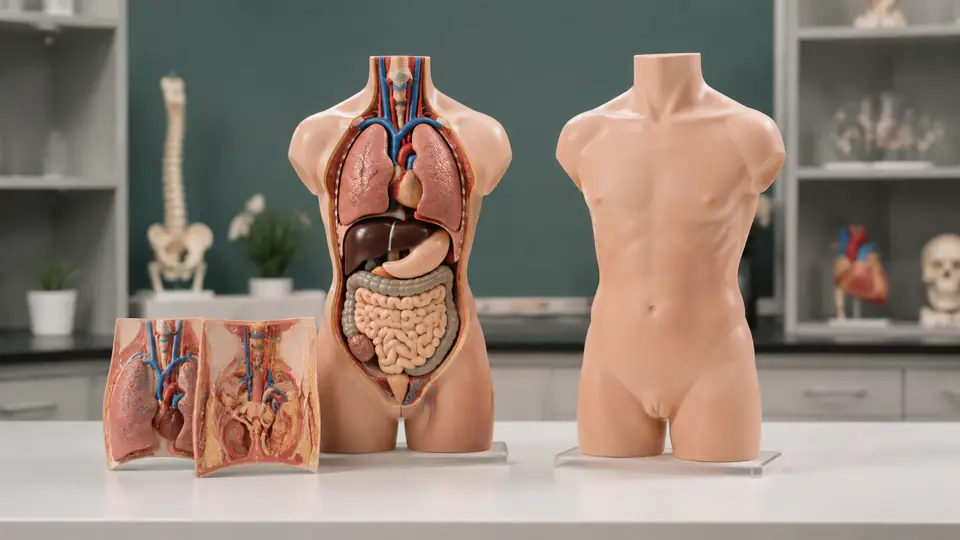
A torso model labeled “dual-sex” may look similar to one labeled “unisex” in a catalog photograph, yet the two terms usually describe different teaching choices. One may include interchangeable male and female reproductive structures, while the other may present a general torso without emphasizing sex-specific anatomy. The wording is not perfectly standardized, so the physical components matter more than the label on the box.
That distinction becomes important when a student studies the lungs, heart, liver, and digestive organs, then reaches the pelvis and reproductive system. A dual-sex model is designed to support both anatomical configurations, whereas a unisex model generally aims to provide a broadly usable torso view without offering two complete reproductive-system options. Understanding that difference helps explain what each model can demonstrate, what it leaves out, and why the same term may appear differently across manufacturers.
What “Dual-Sex” Means on a Torso Model
In anatomy-model terminology, dual-sex usually means that one torso model represents both male and female anatomical features. This may be done with removable or interchangeable reproductive organs, separate pelvic components, or a design that displays sex-specific structures on different sides of the model. The exact arrangement varies, so “dual-sex” should not be treated as a guarantee that every organ is supplied in duplicate.
For example, a classroom may use the same torso to identify the uterus, ovaries, and uterine tubes during one lesson, then replace or reposition those parts to demonstrate the prostate, testes, and related male reproductive structures. That flexibility can reduce the need to store two separate torso models, but it also means learners need to understand which parts are installed at a given time.
The phrase describes the anatomical content of the model, not a statement about gender identity or the full diversity of human bodies. It is a traditional product-category term used for teaching aids, and some manufacturers may use different wording for a similar arrangement. Product diagrams and component lists therefore deserve closer attention than the short label alone.
Common Dual-Sex Configurations
Dual-sex torso models are commonly arranged in a few broad ways:
- Interchangeable reproductive organs: Male and female reproductive structures can be removed and replaced within the pelvic region.
- Split-body presentation: One side may show selected male structures while the other side shows selected female structures, although the precise design differs.
- Separate teaching inserts: A torso may include removable pelvic or reproductive-system assemblies that can be examined outside the main body.
- Layered or sectional presentation: Internal organs are exposed through removable panels, with sex-specific anatomy represented in the lower torso.
These configurations are not interchangeable in a practical sense. An insert that allows a student to hold the uterus and ovaries separately supports a different lesson from a fixed split-body display, especially when the class is tracing relationships among organs and surrounding structures.
What “Unisex” Usually Means
Unisex torso model generally refers to a model intended for broad anatomical instruction without presenting two complete sex-specific reproductive configurations. The model may focus on shared structures such as the heart, lungs, kidneys, liver, stomach, intestines, blood vessels, and major muscles. Some unisex models may include reproductive anatomy, but the term alone does not tell you whether it is male, female, simplified, neutral, or absent.
That ambiguity can create a familiar catalog surprise. A buyer may see “unisex” and assume the model includes both reproductive systems, only to discover that it contains a general torso with no removable reproductive organs. In another case, the model may show one set of reproductive structures while using “unisex” to emphasize that the torso is suitable for a wide audience. The specification sheet has to settle the question.
For many introductory lessons, a unisex torso keeps attention on organ location and body organization. A student learning the path of air from the trachea into the bronchi, for instance, does not necessarily need a dual-sex reproductive assembly installed at the same time. That narrower presentation can be useful when the goal is a clean overview rather than a comparison of pelvic anatomy.
Dual-Sex vs Unisex Torso Models: The Main Differences
| Feature | Dual-Sex Torso Model | Unisex Torso Model |
|---|---|---|
| Primary purpose | Represents shared anatomy plus male and female reproductive features | Provides general torso anatomy, often with limited or unspecified sex-specific content |
| Reproductive anatomy | Usually includes two configurations, interchangeable parts, or a combined display | May be absent, simplified, or limited to one configuration |
| Parts and assembly | Often has more removable components and a more complex pelvic area | Often has fewer specialized parts, though construction varies |
| Teaching use | Useful for comparing reproductive anatomy and shared organ systems in one model | Useful for introductory regional anatomy and general organ identification |
| Terminology reliability | Usually clearer, but the exact arrangement still requires verification | Especially variable between manufacturers and product lines |
| Storage and handling | Loose inserts and small components may require organized storage | May be simpler to assemble, depending on the model’s removable parts |
The table shows the broad distinction, not a universal rule. A highly detailed unisex model may contain more organs and removable sections than a basic dual-sex model, while a compact dual-sex model may simplify structures to fit the available space. The number of parts, the level of enlargement, and the labeling system can matter just as much as the sex-related terminology.
How the Difference Affects Anatomy Lessons
Studying Shared Organ Systems
Both model types can support lessons on the major systems found in the torso. A learner can follow the position of the diaphragm beneath the lungs, observe how the heart sits between the lungs, or examine the relationship between the kidneys and posterior abdominal wall. If the lesson focuses on these regions, the reproductive configuration may remain secondary.
In a study session, a student might first remove the anterior chest wall to locate the heart and lungs, then use the digestive organs to trace the route from the esophagus to the intestines. A teacher may similarly use the same central torso landmarks before discussing differences in the pelvis. That shared foundation is why either model can work well for general regional anatomy, provided the internal organs are clearly represented.
Comparing Reproductive Anatomy
Dual-sex models have a more direct role when the lesson requires comparison of male and female reproductive structures. The learner can examine where the organs sit in relation to the bladder, rectum, pelvic bones, and surrounding tissues. Depending on the model, removable parts may also make it possible to discuss how the reproductive organs occupy a confined anatomical region rather than floating separately from the rest of the body.
That comparison is most useful when the model’s parts are labeled or accompanied by a diagram. A removable uterus, for example, is easier to interpret when the learner can reconnect it to the pelvic cavity and identify neighboring organs. Without that spatial context, a loose component can become little more than a brightly colored puzzle piece.
Demonstrating to a Group
For classroom or laboratory demonstrations, a dual-sex model can let an instructor address different reproductive configurations without changing to another torso. The tradeoff is visual complexity. Small inserts, replacement organs, and extra labels can slow a demonstration if the pieces are not organized before the lesson begins.
A unisex model may be more straightforward when a teacher needs to rotate the torso, expose the thoracic cavity, and identify abdominal organs in quick succession. A student at the back of a room may benefit from a less crowded presentation, while a smaller study group may have enough time to examine every removable part. The teaching setting therefore influences how useful the additional components become.
Why Terminology Can Be Confusing
“Dual-sex” and “unisex” are commercial and educational descriptors, not a complete classification system for anatomical representation. Manufacturers may use terms such as male and female torso, interchangeable torso, or torso with reproductive organs for designs that overlap. Some product descriptions also use “unisex” in a broad social sense, meaning the model is intended for all learners rather than describing its anatomical contents.
The word “dual” can be misleading too. It does not necessarily mean that every organ system is represented twice, nor does it guarantee that the male and female components are equally detailed. One model may provide detailed reproductive inserts but simplified external anatomy, while another may show both configurations with only a few removable pieces.
Before relying on a label, check the manufacturer’s parts diagram, photographs of the opened torso, list of removable organs, and description of the pelvic region. If those details are missing, the safest conclusion is that the terminology is insufficiently specific, not that the model includes features that are merely implied.
Features That Matter More Than the Label
The sex-related configuration is important, but several construction details determine how useful the torso will be during study. Removable organs allow learners to investigate depth and relationships, while fixed organs may provide a clearer overview with less risk of misplaced parts. Neither arrangement is automatically superior, because a quick demonstration and a detailed dissection-style exercise call for different handling.
Scale also affects visibility. A life-size torso may offer realistic proportions, while an enlarged model can make narrow vessels, airways, or pelvic structures easier to see from a short distance. Enlargement does not mean the anatomy is more complete or more accurate in every respect. It simply changes the visual size of the representation.
Labeling deserves equal attention. Printed labels, numbered callouts, color coding, and a separate key each support identification in different ways. A student practicing recall may prefer to cover the key and name structures independently, whereas a first introduction may benefit from labels that remain visible beside the organs.
Finally, inspect how the parts attach. Pegs, magnets, friction fittings, or simple rests can affect assembly and storage, but the exact mechanism varies by model. Small reproductive inserts and delicate labels should be kept in a designated container rather than left loose in a drawer where they can be scratched, bent, or separated from the torso.
Using Either Model for Active Study
A torso becomes more useful when it is treated as a three-dimensional question rather than a display object. Start with the model assembled and identify organs without looking at the key. Then remove one section, such as the chest wall or abdominal organs, and explain what lies behind it, below it, and beside it. This forces the learner to reconstruct relationships instead of memorizing isolated colors.
With a dual-sex model, repeat the same spatial exercise for each reproductive configuration. Identify the bladder and rectum first, then locate the reproductive organs in relation to those landmarks. The comparison should focus on anatomical position and relationships, not on treating one configuration as the default version of the body.
With a unisex model, pair the torso with a labeled atlas, wall chart, or digital anatomy reference when a structure is simplified or missing. A flat illustration may clarify a pathway, while the physical model supplies depth and relative position. Used together, the resources can cover gaps that neither format handles perfectly on its own.
Care, Storage, and Inclusive Use
Care instructions depend on the materials, paint, labels, joints, adhesives, and attachment systems used by the manufacturer. Use the supplied documentation when available, and avoid assuming that a household cleaner is safe for every plastic or printed surface. A soft, dry or lightly damp cloth may be appropriate for routine dust removal, but specific compatibility should be confirmed before applying any cleaning solution.
Store removable parts with the torso’s diagram or in a labeled compartment. This is particularly important for dual-sex models, where several pelvic components may look similar at a glance but serve different teaching purposes. A simple inventory after each lesson can prevent the frustrating moment when the heart is present but a key reproductive insert has vanished beneath a stack of worksheets.
Inclusive teaching also benefits from careful language. Explain that the model represents selected anatomical configurations and that real human bodies vary. “Male” and “female” labels on a teaching model describe the structures depicted in that component set, not every person’s identity, anatomy, or lived experience. That clarification keeps the model useful without asking it to represent more than it was designed to show.
Frequently Asked Questions
Is a dual-sex torso the same as a unisex torso?
No. A dual-sex torso usually includes male and female reproductive configurations, often through removable or interchangeable parts. A unisex torso generally presents shared torso anatomy and may omit, simplify, or show only one reproductive configuration. Because manufacturers use the terms inconsistently, examine the parts list and images.
Does a dual-sex model show every organ twice?
No. “Dual-sex” normally refers to the representation of male and female reproductive anatomy, not duplicate hearts, lungs, digestive organs, or other shared structures. The model may include one set of shared organs and two possible pelvic or reproductive configurations.
Can a unisex torso model include reproductive anatomy?
Yes. “Unisex” does not reliably mean that reproductive anatomy is absent. It may describe a general-purpose torso, a model with one configuration, or a product intended for all learners. The manufacturer’s component list is more informative than the word “unisex” by itself.
Which type is better for studying general anatomy?
Either can support general anatomy study if the model clearly shows the thoracic and abdominal organs, has useful labels, and matches the learner’s level. A dual-sex model adds reproductive comparison, while a simpler unisex model may keep an introductory lesson less crowded. The teaching objective should guide the interpretation.
Can these models represent every human body?
No. Anatomy models simplify bodies for teaching. They may omit normal variation, differences in development, tissue texture, and many structures that would be visible in dissection or advanced clinical imaging. A model is a visual aid, not a complete representation of human anatomical diversity.
Choosing the Right Understanding, Not Just the Right Label
The practical distinction in Dual-Sex vs Unisex Torso Models is simple to state but worth checking carefully. Dual-sex models generally provide male and female reproductive configurations, while unisex models usually emphasize general torso anatomy with more variable reproductive content. The most reliable evidence is the actual parts diagram, pelvic design, labels, scale, and assembly method.
For broad organ-system instruction, either format may be suitable. For comparing reproductive anatomy, a clearly documented dual-sex model offers capabilities that a general unisex torso may not. Once the terminology is treated as a starting point rather than a guarantee, the model’s educational purpose becomes much easier to understand.
