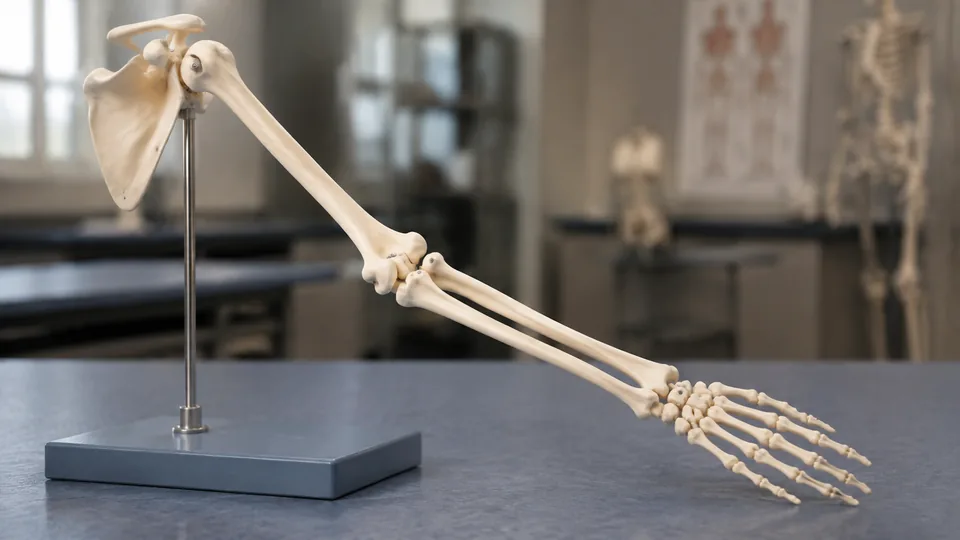
The upper limb looks straightforward on paper until the scapula starts gliding, the radius crosses the ulna, and dozens of small hand bones enter the picture. That spatial puzzle sends students, instructors, artists, and patient educators searching for the best arm skeleton models. Life-size regional models make bony landmarks easier to inspect, while compact full-body skeletons reveal how the arm connects with the shoulder girdle and trunk.
A common buying mistake is treating every articulated skeleton as equally useful for upper-limb study. Some models provide a complete clavicle-to-fingertip assembly, while others offer simplified arms attached to a miniature body. Scale, articulation, anatomical detail, removable parts, mounting, and intended viewing distance matter most. The Merinden Human Upper Limb Skeleton is the strongest all-around choice for focused study, though the Axis Scientific Left Arm offers a more premium regional option and several full-body models suit broader anatomy courses.
For a fast look at the leading choices, start with the recommendations and comparison table below.
Quick Answer
Best overall: The Merinden Human Upper Limb Skeleton combines life-size proportions, a complete shoulder girdle, an articulated hand, and movable upper-limb structures in a focused model. Best premium arm model: The Axis Scientific Human Left Arm Skeleton emphasizes natural bony landmarks and durable construction. Best for broader classroom instruction: The Axis Scientific Life-Size Skeleton places both arms within a complete 206-bone framework and includes extensive study materials.
Best Arm Skeleton Models Comparison Table
| Product | Best For | Scale or Height | Upper-Limb Features |
|---|---|---|---|
| Merinden Human Upper Limb Skeleton | Overall focused study | Life-size arm | Clavicle, scapula, articulated hand, movable shoulder |
| Axis Scientific Human Left Arm Skeleton | Detailed regional study | Life-size left arm | Scapula to fingertips, bungee and wire articulation |
| EVOTECH SCIENTIFIC Upper Limb Skeleton | Value and portability | Life-size arm | Scapula, clavicle, movable elbow, wrist, and fingers |
| Axis Scientific Life-Size Skeleton | Classrooms | Approximately 5 feet 6 inches | Articulated major joints and complete body context |
| Axis Scientific Mini Skeleton | Compact premium study | 31 inches | Removable arms and articulated shoulder, elbow, and wrist |
| EVOTECH SCIENTIFIC 33.5-Inch Skeleton | Students | 33.5 inches | Detachable design and movable upper-limb joints |
| breesky 33.4-Inch Skeleton | Removable limb study | 33.4 inches | Removable arms with articulated shoulder, elbow, and wrist |
| Ruiishunyy Mini Skeleton | Desk study | 17.7 inches | Movable arms and major joints |
| breesky 17-Inch Skeleton | Beginners | 17.7 inches | Movable arms and legs with basic anatomical detail |
The detailed reviews below show where each model fits, from close-up landmark study to room-wide teaching demonstrations.
1. Best Overall: Merinden Human Upper Limb Skeleton Anatomical Model

Merinden keeps the lesson tightly focused from the clavicle and scapula to the articulated fingers. Its life-size format is especially helpful when a small illustration leaves the acromion, glenoid region, or clustered carpal bones looking like a jumble of pale shapes. Students can rotate the assembly, compare anterior and posterior views, and build a clearer mental map before an identification practical.
Movable shoulder and hand joints add useful motion demonstrations, while the listing also specifies forearm rotation. Picture an instructor explaining why the radius changes position during pronation and supination. A physical model makes that relationship far easier to follow than arrows printed beside a diagram. Its durable construction is intended for regular handling in classrooms, medical-school study spaces, and patient-education settings, which gives this regional model broad appeal.
Pros
- Life-size proportions support close inspection of upper-limb bones
- Includes the clavicle, scapula, arm, forearm, and articulated hand
- Movable structures demonstrate shoulder, hand, and forearm movement
- Focused format avoids the bulk of a complete skeleton
- Suitable for classrooms, independent study, and visual explanations
Cons
- Does not provide the whole-body context of a complete skeleton
- No included stand or labeled study guide is specified
This is the sensible pick for buyers who primarily need upper-limb osteology rather than a general skeletal survey. It should fit comfortably into a student study routine or a small teaching room, where someone can pass it around without rolling a full-size skeleton between desks. Buyers needing a specified warranty, study manual, or more extensive brand support may prefer an Axis model.
To buy this product, click here.
2. Best Premium Arm Model: Axis Scientific Human Left Arm Skeleton Model

For buyers who prioritize bony landmarks, the Axis Scientific left arm is the standout regional alternative. The life-size replica runs from the scapula to the fingertips and is cast from real bone, according to the listing. That detail matters during a quiet evening of exam preparation, when the difference between recognizing a smooth shaft and locating a subtle process becomes painfully clear.
Bungee and wire hardware allow articulation and close handling without adding a full-body frame around the specimen. The PVC-based plastic keeps the model portable, so an instructor can carry it from an office to a lab or an artist can turn it beside a drawing board. Because this is specifically a left arm, anatomical orientation remains consistent during demonstrations rather than becoming a vague, side-neutral exercise.
Pros
- Life-size left-arm representation supports realistic spatial study
- Extends from the scapula through the fingertips
- Cast from real bone to reproduce natural anatomical landmarks
- Bungee and wire hardware permits articulated handling
- Durable PVC-based construction suits repeated educational use
Cons
- Regional design cannot demonstrate the arm’s relationship to the spine and pelvis
- May offer more detail than casual learners or basic science classes require
Nursing, medical, therapy, and art students who want a dedicated left upper extremity should place this model high on the list. Its appeal lies in close observation rather than room-wide presentation. A teacher covering the entire skeleton may get more mileage from the Axis life-size model, while a buyer seeking a simpler arm at a more accessible tier may favor Merinden or EVOTECH.
To buy this product, click here.
3. Best Value: EVOTECH SCIENTIFIC Human Upper Limb Skeleton Anatomical Model
EVOTECH SCIENTIFIC offers the key ingredients of a practical regional study model: life-size bones, the scapula and clavicle, and a fully articulated hand. The elbow, wrist, and fingers can demonstrate flexibility, giving learners several opportunities to connect bone names with visible movement. That is handy during a group review session where everyone wants to reposition the wrist and trace the limb from proximal to distal.
The model uses lightweight, washable PVC that the listing describes as corrosion resistant and difficult to break. Those qualities make sense in busy classrooms, where models travel between tables and occasionally collect pencil marks or dusty fingerprints. Its manageable regional format also works for artists studying hand placement and healthcare educators illustrating basic skeletal relationships without wheeling out a towering figure.
Pros
- Life-size upper-limb format provides practical viewing proportions
- Includes the clavicle, scapula, and fully articulated hand
- Movable elbow, wrist, and fingers support motion demonstrations
- Lightweight PVC construction improves portability
- Washable surface is convenient for shared learning environments
Cons
- No stand or mounting system is specified for hands-free display
- Listing does not specify labels, numbering, or an included reference manual
This model suits students and educators who want a functional arm assembly without paying for a complete skeleton or a more specialized premium replica. Its biggest compromise is presentation. Someone teaching with both hands occupied may miss a stand, and learners who depend on printed labels will need a separate atlas. For straightforward handling and repeated joint demonstrations, however, the feature set lands in a sweet spot.
To buy this product, click here.
4. Best Full-Size Option: Axis Scientific Life-Size Skeleton Model

The Axis Scientific life-size skeleton earns its place by showing what an isolated arm cannot: how the shoulder girdle sits against the thorax and how upper-limb posture relates to the rest of the body. Standing approximately 5 feet 6 inches tall, its 206-bone design gives an instructor enough visual presence for a room full of students. Major joints demonstrate movements such as flexion, extension, and abduction.
Its educational package is unusually substantial within this group. Three study resources and 189 numbered stickers let learners turn the model into an active-recall station rather than a silent corner display. Imagine students circling the skeleton before a lab practical, matching numbered markers to terms while the rolling stand moves from one group to the next. A pelvic-mounted base, corrosion-resistant hardware, dust cover, and specified three-year warranty support that classroom role.
Pros
- Life-size 206-bone model provides complete anatomical context
- Articulated major joints support upper-limb movement demonstrations
- Includes three study resources and 189 numbered stickers
- Rolling pelvic-mounted stand helps with classroom repositioning
- Includes a dust cover and a specified three-year warranty
Cons
- Requires considerably more floor and storage space than an isolated arm
- Less convenient for passing around during close tabletop study
Choose this model for a classroom, teaching clinic, or dedicated study room where the arm forms part of a broader anatomy curriculum. It is excessive for a learner who needs to memorize only the humerus, radius, ulna, and hand, yet wonderfully useful when posture and regional relationships are part of the lesson. The rolling base also matters in practice, especially when “just move the skeleton over here” becomes a daily request.
To buy this product, click here.
5. Best Compact Premium Model: Axis Scientific Mini Human Skeleton Model

At 31 inches tall, this Axis Scientific model bridges the awkward gap between tiny desktop figures and room-dominating life-size skeletons. The shoulder, elbow, and wrist move alongside the other major joints, so students can examine arm positioning while retaining full-body context. Better yet, the arms detach cleanly for a closer regional lesson at a desk or lab bench.
The metal stand keeps the skeleton upright, and the included full-color manual uses photographs of the model to identify anatomical landmarks. That pairing is useful when a learner glances from a labeled page to the actual bone instead of mentally translating from a different illustration. Removable limbs and skull cap make the model interactive, while the specified three-year warranty and US-based support add reassurance for schools expecting frequent handling.
Pros
- 31-inch height balances visibility with compact storage
- Articulated shoulder, elbow, and wrist joints demonstrate arm positioning
- Removable arms allow focused upper-limb study
- Metal stand supports stable, hands-free display
- Includes a photo-based study manual and specified three-year warranty
Cons
- Reduced scale limits inspection of very small hand landmarks
- Less visible from the back of a large classroom than a life-size skeleton
This is an appealing compromise for tutors, students with limited space, and instructors who travel between rooms. Detaching an arm for close work, then restoring it to the trunk, creates a useful back-and-forth between regional detail and body context. Buyers preparing for highly detailed hand osteology should still favor a life-size arm, but the Axis Mini is the more versatile compact teaching package.
To buy this product, click here.
6. Best for Students: EVOTECH SCIENTIFIC 33.5-Inch Human Skeleton Model

Study-bedroom floors and crowded dorm desks rarely have room for a life-size skeleton. EVOTECH SCIENTIFIC answers that practical problem with a 33.5-inch model that retains movable shoulder, elbow, and wrist joints. The half-size format is large enough for structured review yet manageable enough to shift from a shelf to a desk when the flash cards come out.
The listing specifies non-toxic, washable PVC, a sturdy base, and a manual. Detachable construction permits closer work with individual regions, which is valuable when learners need to inspect the upper limb without the rib cage blocking a viewing angle. Once the arm is returned, the model can show how the humerus relates to the scapula and how shoulder position affects the silhouette of the complete skeleton.
Pros
- 33.5-inch format fits smaller study spaces
- Movable shoulder, elbow, and wrist joints support basic demonstrations
- Detachable design permits focused regional inspection
- Washable PVC is practical for frequent handling
- Includes a stand and educational manual
Cons
- Half-size hand bones are harder to inspect than life-size equivalents
- Base lacks the rolling mobility of larger classroom models
This model is best suited to students who need one skeleton for several body regions but cannot dedicate much floor space to it. It also makes a useful office reference where a compact standing display is preferable to loose arm bones. For fine landmark identification in the wrist and hand, scale remains the unavoidable compromise, so serious upper-limb study may still call for a full-size regional model.
To buy this product, click here.
7. Best for Removable Limb Study: breesky 33.4-Inch Human Skeleton Model

The breesky 33.4-inch skeleton has a practical classroom trick: its arms and legs are removable. An instructor can begin with a full skeletal overview, detach an arm for a table group, and then reconnect it for a shoulder-girdle demonstration. Articulated shoulder, elbow, and wrist joints help illustrate basic movement, while the metal stand keeps the figure available for hands-free reference.
At roughly half life-size, the model remains far easier to store and transport than a standing adult-size skeleton. The listing describes visible sutures, foramina, and grooves across the model, plus a removable calvarium and movable lower jaw for lessons beyond the arm. A manual is included, and assembly is described as a short process rather than a complicated build full of mystery screws and rattling hardware.
Pros
- Removable arms support focused upper-limb lessons
- Articulated shoulder, elbow, and wrist permit movement demonstrations
- 33.4-inch height offers useful visibility without life-size bulk
- Metal stand provides an upright display platform
- Includes a manual and removable cranial components
Cons
- Small upper-limb bones provide less landmark detail than life-size arm models
- Full-body features may be unnecessary for buyers focused solely on the arm
This breesky model fits teachers and general anatomy students who value detachable limbs more than full-size proportions. It is especially convenient for rotating lab stations, where one group studies the arm while another reviews the axial skeleton. Artists seeking overall pose reference may also appreciate it, but learners concentrating on carpal identification should choose a life-size regional option.
To buy this product, click here.
8. Best for Desk Study: Ruiishunyy 17.7-Inch Mini Human Skeleton Model

Ruiishunyy shrinks a full skeletal overview into a 17.7-inch desktop footprint. Movable shoulders, elbows, wrists, and other major joints allow basic pose changes, making the model useful for introductory demonstrations and visual reference. Set beside a laptop, it can show the broad relationship between the arm, rib cage, spine, and pelvis without swallowing the entire workspace.
A 4.75-inch-square base and metal support rod hold the figure upright, while the removable skull cap and movable jaw broaden its educational scope. The included anatomy poster supplies a second visual reference for students who like switching between 2D labels and a 3D form. Its scale naturally favors broad relationships over tiny landmarks, rather like viewing a city map before walking individual streets.
Pros
- Compact 17.7-inch height works well on desks and shelves
- Movable upper-limb joints allow basic arm positioning
- Stable base and metal rod support hands-free viewing
- Removable skull cap and movable jaw expand study options
- Includes an anatomy poster for complementary reference
Cons
- Miniature wrist and hand structures are unsuitable for detailed landmark study
- Small size limits visibility during group instruction
Buy this model for introductory anatomy, compact display, or basic drawing reference rather than advanced upper-limb osteology. It makes sense for a student who wants a constant visual reminder beside the computer or a teacher conducting a close, small-group lesson. Anyone expecting life-size detail at the fingers and wrist will find the regional Merinden, Axis, or EVOTECH arm models more useful.
To buy this product, click here.
9. Best for Beginners: breesky 17-Inch Human Skeleton Model

Beginners often need orientation before fine detail. This breesky model stands 17.7 inches tall on a 4.75-inch-square base, providing a simple full-body reference with movable arms and legs. It can sit beside an introductory textbook while a learner traces the arm from shoulder to hand, then glances across to compare its length and position with the torso.
The manufacturer openly characterizes this as a basic, entry-level model, which helps set realistic expectations. A removable skull cap and movable jaw add interactive interest, but the spine, ribs, and skull show fundamental rather than advanced anatomical detail. That simplicity can be welcome in a middle-school science setting or an artist’s first skeletal drawing session, where too many tiny markings would create visual noise.
Pros
- Compact 17.7-inch size suits crowded desks and small classrooms
- Movable arms and legs support introductory pose demonstrations
- Base provides a modest footprint for upright display
- Removable skull cap adds hands-on educational value
- Simple detail level is approachable for new anatomy learners
Cons
- Basic anatomical detail is less suitable for advanced coursework
- Small arm and hand bones limit close identification practice
This is a starter model for broad skeletal orientation, casual reference, or younger science learners. It should be skipped by buyers preparing for a demanding upper-limb practical, since compact proportions and simplified details cannot replace a life-size arm. Within its intended role, however, it offers an approachable way to move from a flat page to a standing three-dimensional skeleton.
To buy this product, click here.
How to Choose an Arm Skeleton Model
Decide Between a Regional Arm and a Full Skeleton
A regional upper-limb model concentrates space and detail where students need it most. Life-size arm bones are easier to rotate at a kitchen table, pass around a lab group, and compare with an atlas. Models that include the scapula and clavicle are preferable for studying the complete shoulder girdle. Without those bones, the humerus can feel like an isolated piece rather than part of a connected system.
Full skeletons answer a different question: where does the arm sit relative to the thorax, spine, and pelvis? They work well in general anatomy courses, posture demonstrations, and art studios. A removable arm offers a particularly useful compromise because it can shift between regional inspection and whole-body context as the lesson changes.
Match the Scale to the Lesson
Life-size models provide the clearest view of the humerus, radius, ulna, carpals, metacarpals, and phalanges. Imagine trying to distinguish neighboring wrist bones while they are reduced to tiny ivory bumps. That frustration is why serious upper-limb learners usually benefit from full-scale regional models.
Half-size skeletons around 31 to 34 inches are easier to store while remaining visible at close range. Models near 17 inches work best for basic orientation, desk display, and simple pose reference. They are far less helpful for small landmarks or teaching from across a room, so compactness should serve the learning goal rather than dictate it.
Look Closely at Articulation
“Movable” can cover several levels of function. Check which joints the listing specifically identifies. Shoulder movement helps with broad arm positioning, while elbow and wrist articulation supports flexion demonstrations. Articulated fingers add value for hand study, and forearm rotation is particularly useful for visualizing how the radius and ulna change position.
Movement on an educational skeleton remains a simplified demonstration. It does not reproduce every soft-tissue restraint or the complete mechanics of a living joint. The model should clarify skeletal relationships, while a reputable anatomy text or instructor supplies the deeper biomechanical explanation.
Check the Scapula, Clavicle, and Hand
An arm model intended for comprehensive study should ideally extend beyond the humerus. The scapula and clavicle establish the proximal connection, and an articulated hand reveals the dense arrangement at the distal end. Artists may care most about silhouette and proportion, while medical and nursing students are more likely to prioritize landmarks and orientation.
Listings sometimes emphasize “arm” while providing limited information about the shoulder girdle or fingers. Read the component description carefully and choose verified features. A complete clavicle-to-fingertip assembly generally offers more educational range than a loose humerus, radius, and ulna set.
Consider Mounting, Portability, and Storage
Loose regional models are easy to lift and inspect from every angle, but they may need to lie on a desk between demonstrations. A stand leaves both hands free for pointing and note-taking. For complete life-size skeletons, a rolling base can be a huge convenience when the model travels between a lecture corner and lab stations.
Storage deserves equal attention. Measure the intended shelf, cabinet, or floor area before buying, including the base footprint. A 17-inch model slips into spaces where a 5-foot-plus skeleton simply cannot go, while a dedicated arm often stores more easily than either full-body option.
Use Labels and Guides Strategically
Numbered stickers, manuals, and posters can turn passive viewing into active recall. Cover the answer key, identify each marked structure, then check the result. This simple routine feels much closer to a practical exam than rereading a list of bone names.
Unlabeled models still work well when paired with an atlas or course materials. They may actually be preferable for self-quizzing because the answer is not printed beside the structure. The crucial point is having a reliable reference close by, whether it arrives with the model or comes from the learner’s curriculum.
Best Arm Skeleton Models FAQ
Is a Life-Size Arm Skeleton Better Than a Mini Skeleton?
A life-size arm is generally better for identifying small landmarks, studying the wrist and hand, and inspecting the relationship among the scapula, clavicle, and humerus. A mini full-body skeleton is better for broad skeletal orientation, posture reference, and compact storage. The right scale depends on whether detail or whole-body context matters more.
Should an Arm Skeleton Include the Scapula and Clavicle?
Yes, for comprehensive upper-limb study. The scapula and clavicle form the shoulder girdle and help explain how the free upper limb connects with the axial skeleton. Models without them can still teach individual long bones, but they provide less context at the shoulder.
What Articulation Is Most Useful?
Movable shoulder, elbow, wrist, and finger structures cover the most common demonstrations. Forearm rotation adds particular value for studying the changing relationship between the radius and ulna. Buyers should rely on the joints specifically named in the product listing rather than assuming every visible joint moves naturally.
Are Arm Skeleton Models Useful for Artists?
Yes. A three-dimensional model helps artists study proportions, elbow placement, hand orientation, and how the shoulder girdle shapes the upper torso. Life-size regional arms favor close detail, while articulated full-body skeletons are better for overall poses and limb relationships.
Can These Models Be Used for Patient Education?
Regional and full-body skeletons can support clear visual explanations of basic bone locations and joint relationships. They are educational aids, not diagnostic tools, and they do not replace individualized guidance from a qualified healthcare professional.
Is PVC a Practical Material for Classroom Models?
PVC is common in anatomy models because it can be lightweight, durable, and easy to wipe clean. Construction quality and joint hardware still matter, especially where many students handle the model. Follow the manufacturer’s cleaning instructions and avoid forcing articulated parts beyond their intended movement.
Do I Need a Stand?
A stand is valuable for lectures, drawing sessions, and hands-free desk study. A loose arm can be easier to rotate and pass between learners, so the absence of a stand is not automatically a drawback. Full-size skeletons benefit most from stable bases, and rolling stands are convenient in shared classrooms.
How Detailed Should a Student Model Be?
Introductory learners may need clear proportions and major bones, while advanced students often require life-size landmarks and a well-resolved hand. Match the model to the course assessments. A miniature skeleton is excellent for orientation but may leave tiny wrist structures too small for practical identification.
Final Verdict
The Merinden Human Upper Limb Skeleton Anatomical Model is the strongest overall choice among these nine picks. Its life-size format, complete clavicle and scapula, articulated hand, and specified forearm movement make it well suited to focused study without the storage burden of a full skeleton. For buyers seeking a more premium dedicated replica, the Axis Scientific Human Left Arm Skeleton emphasizes realistic landmarks, durable PVC-based construction, and articulated handling from scapula to fingertips.
Different rooms and lessons call for different bones on the table. The EVOTECH SCIENTIFIC Upper Limb Skeleton is a practical value-oriented regional choice, while the Axis Scientific Life-Size Skeleton brings the arm into full-body context for classrooms. Compact learners can look toward the 31-inch Axis Mini or the half-size EVOTECH and breesky models. Before purchasing, decide whether the next lesson demands fine hand detail, removable limbs, room-wide visibility, or a skeleton that quietly fits beside a laptop. That single decision will narrow these nine options quickly.
