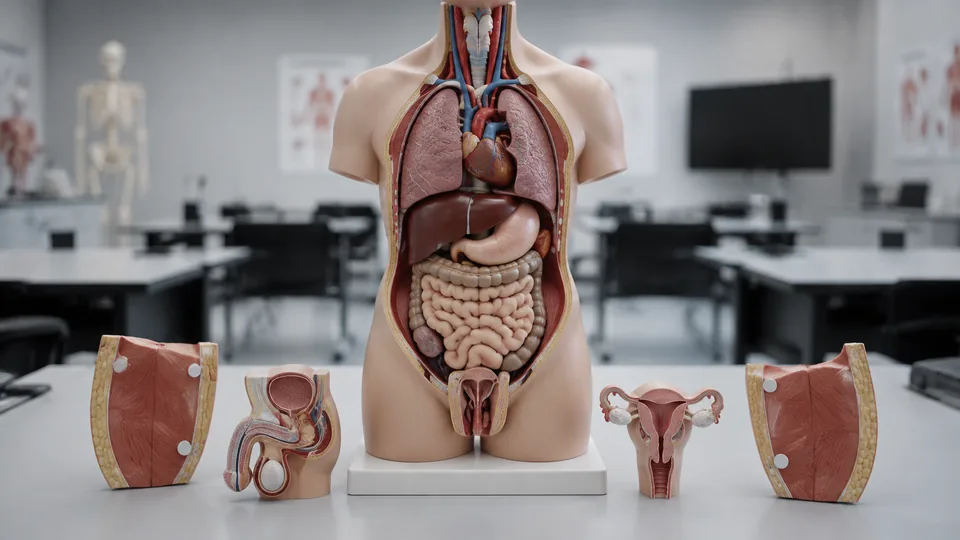
A flat anatomy diagram can make the abdominal cavity look tidy. Lift out a model’s liver, stomach, and intestines, however, and the spatial puzzle suddenly clicks into place. Dual-sex torso models add interchangeable male and female anatomy, making them useful for classrooms, nursing programs, medical study, patient demonstrations, and curious learners who want a tactile view rather than another page of tiny labels.
The models here differ sharply in size, removable-part count, open-back detail, labeling, and build. A compact torso may fit beside a laptop but lose small landmarks, while a larger hand-painted model can command a lecture table and consume a hefty slice of the equipment budget. Common buying mistakes include focusing on part count alone, overlooking the quality of the manual, or choosing a closed-back torso when spinal nerves and muscular layers are part of the curriculum.
The Axis Scientific Deluxe Dual-Sex Human Torso is the strongest overall choice for its 27 removable parts, 225 identified structures, open back, and practical attachment system. Students with limited space may prefer the compact JNMFTD 17-inch model, while institutions seeking a premium digital learning package should examine the 3B Scientific B32.
Short on time? Start with these standout choices, then use the table for a quick side-by-side view.
Quick Answer
- Best overall: Axis Scientific Deluxe, thanks to its deep anatomical coverage, open back, and 27 removable parts.
- Best value: JNMFTD 33.4-inch model, which combines 32 components with more than 200 numbered labels.
- Best compact option: JNMFTD 17-inch model, a manageable choice for home study and small desks.
- Best premium learning system: 3B Scientific B32, with a torso guide, app-based coursework, and warranty-extension eligibility.
Best Dual Sex Torso Models Comparison Table
| Product | Best For | Size or Parts | Key Feature |
|---|---|---|---|
| Axis Scientific Deluxe | Best Overall | 27 removable parts | Open back and 225 structures |
| JNMFTD 33.4-Inch Model | Best Value | 33.4 inches, 32 components | More than 200 numbered labels |
| JNMFTD 17-Inch Model | Compact Study | 17 inches, 16-part title | More than 70 numbered markers |
| 55cm Open-Back Torso | Layered Study | 55cm, 21 parts | Removable spinal-cord section |
| Parco Scientific PB00161 | Classroom Fundamentals | 55cm, 21 parts | Exposed muscles, spine, and nerves |
| 3B Scientific B32 | Premium Learning | 34.3 inches, 20 parts | Guide, digital courses, and warranty option |
| Vision Scientific VAT103 | Open-Back Demonstrations | 22 inches, 22 parts | Dissected neck and removable cord section |
| XLTEAM 85cm Model | Detailed Head and Thorax Study | 85cm, 29 organs | Detailed cranial and thoracic structures |
| Dual-Sex Removable Torso | General Education | Life-size listing, count unspecified | Numbered markings and stable base |
The detailed reviews below explain where each torso shines, where it gives something up, and which learning environment suits it best.
1. Axis Scientific Deluxe Dual-Sex Human Torso Anatomy Model: Best Overall

One reason the Axis Scientific Deluxe rises above the pack is the sheer breadth of material packed into one torso. Its 27 removable parts and 225 identified features support far more than a quick “heart goes here” demonstration. A student can remove the intestines, trace the relationship among the stomach, pancreas, and kidneys, then turn the model around to inspect the vertebral column, muscles, and nerve structures through the open back. That front-to-back continuity is the juicy part for serious study.
The model uses interchangeable male and female genital inserts, so an instructor can cover both anatomical configurations without storing two bulky torsos. Hooks, magnets, and pegs secure the removable pieces, while the two-part heart opens for a closer look at cardiovascular anatomy. Its full-color manual uses photographs of the actual model, a small but meaningful convenience when a lab group is staring at a loose component and wondering exactly where it nests.
Pros
- Includes 27 removable organs and components for layered study
- Identifies 225 anatomical features and structures
- Open back exposes the vertebral column, muscles, and nerves
- Uses interchangeable male and female genital inserts
- Includes a photo-based full-color product manual
Cons
- Premium positioning may exceed the needs of casual learners
- Numerous small removable structures require careful organization
This is the model to choose for a university lab, advanced anatomy course, or clinical teaching room where the torso will support multiple lessons rather than gather dust after one organ-placement exercise. Its detail may be excessive for an elementary classroom, but educators who need open-back anatomy and extensive identification in one unit will find the added depth genuinely useful.
To buy this product, click here.
2. JNMFTD 33.4-Inch 32-Part Human Torso Anatomy Model: Best Value

For buyers who want a substantial component count without stepping into the highest product tier, this 33.4-inch JNMFTD torso hits an appealing middle ground. It provides 32 removable organs and structural components, including the brain, heart, lungs, liver, stomach, kidneys, spleen, intestines, bladder, and an eighth-thoracic-vertebra component. During a study session, learners can work inward layer by layer rather than peer into a crowded plastic cavity and hope the relationships make sense.
More than 200 numbered labels work with the included manual, giving students a direct route from a painted landmark to its name. The model also has interchangeable male and female genital components and a removable base. Its PVC construction includes some flexible PVC pieces, according to the listing, which can make handling feel less rigid than an entirely hard-shell assembly. The large format should remain visible around a lab table without reaching the footprint of a full human figure.
Pros
- Provides 32 removable components for extensive disassembly
- Features more than 200 numbered anatomical labels
- Includes interchangeable male and female components
- Comes with a detailed manual and removable base
- Large 33.4-inch format suits group instruction
Cons
- Takes more storage and desk space than compact torso models
- Lacks the clearly specified open-back emphasis of several competing picks
This JNMFTD model makes sense for nursing students, biology departments, tutoring centers, and medical offices seeking a broad teaching aid at a midrange position. Buyers focused heavily on posterior muscles, spinal nerves, and open-back demonstration may prefer the Axis or one of the 55cm open-back models. For organ placement and label-driven review, however, its combination of size and component count is mighty persuasive.
To buy this product, click here.
3. JNMFTD 17-Inch Dual-Sex Human Torso Model: Best Compact Option

If your study desk already groans beneath a laptop, textbooks, and a cold mug of coffee, a 17-inch torso is far easier to welcome than an 85cm showpiece. This JNMFTD model covers the head in sagittal section, brain, lungs, heart, liver, pancreas, stomach, intestines, and male and female urogenital systems. Its title identifies it as a 16-part model, while the listing details refer to 17 removable parts, so purchasers should confirm the current package contents before ordering.
More than 70 numerical markers connect the physical model to its educational brochure. Metal screws, posts, and hooks help hold components in position, and the PVC surface can be cleaned after repeated handling. Picture a study pair quizzing each other before a practical: one removes the liver, the other identifies what sits behind it, and the entire model still leaves enough room for an open notebook. That compact convenience is its clearest advantage.
Pros
- Compact 17-inch height fits smaller desks and shelves
- Covers major organs plus male and female urogenital anatomy
- Includes more than 70 numbered markers
- Uses screws, posts, and hooks to secure removable components
- Comes with a sturdy removable base and educational brochure
Cons
- Smaller scale provides less room for fine landmarks than larger models
- The listing contains conflicting 16-part and 17-part descriptions
Home learners, tutors, and students moving between dorm rooms will appreciate this model most. It provides tactile organ-placement practice without turning a bedroom desk into a permanent laboratory exhibit. A lecturer addressing a large room should choose a taller option, since small structures can disappear visually beyond the front row.
To buy this product, click here.
4. 55cm 21-Part Open-Back Dual-Sex Human Torso Model: Best for Layered Study

This 55cm model earns its spot by showing anatomy from both directions. The dissected neck reveals muscular, vascular, and glandular structures, while the open back exposes spinal and muscular layers that a front-only torso keeps hidden. For a lesson tracing a nerve pathway or explaining how posterior structures relate to the chest and abdomen, turning the model around can prompt that satisfying “oh, now I see it” moment.
Its 21 removable structures include the skull, a spinal-cord section, and muscular layers. Vivid hand painting separates neighboring tissues, and the stable base keeps the torso upright while components move in and out. The listing specifies high-grade, nontoxic PVC with a cleanable, fade-resistant finish. At 55cm, the model balances visibility and manageability, landing between a little desktop torso and the tall premium units.
Pros
- Open back displays muscles, spine, and deeper structures
- Dissected neck exposes several anatomical systems
- Includes 21 removable organs and structures
- Features a removable spinal-cord section
- Stable base supports repeated classroom demonstrations
Cons
- Offers fewer removable components than the 27-part and 32-part leaders
- Its 55cm format still requires dedicated shelf or cabinet space
Choose this model for advanced high-school biology, undergraduate instruction, or patient education where posterior anatomy matters as much as visceral organs. Students concentrating mainly on detailed organ identification may gain more from the JNMFTD 32-component model. This option wins its niche through layers, visibility, and a satisfyingly versatile open-back layout.
To buy this product, click here.
5. Parco Scientific PB00161 55cm Dual-Sex Human Torso: Best for Classroom Fundamentals

The Parco Scientific PB00161 keeps its educational pitch focused: 21 removable parts, dual-sex anatomy, a dissected neck, and an open back. Those features cover the core needs of many anatomy classrooms without leaning on a huge list of digital extras. An instructor can face the model forward for organ placement, swivel it around for the vertebral column and nerve branches, then remove a spinal-cord section for closer examination.
At 55cm, it should be visible across a lab bench yet manageable enough to move between a prep room and classroom. The exposed neck brings muscular, vascular, and glandular structures into view, giving teachers more discussion material than a basic trunk with removable organs. The supplied product information is relatively concise, though, so shoppers seeking extensive labeling details or a richly documented manual should compare the supporting materials carefully.
Pros
- Combines dual-sex anatomy with 21 removable parts
- Open back exposes muscular layers and the vertebral column
- Displays nerve branches for posterior anatomy lessons
- Dissected neck shows muscular, vascular, and glandular structures
- Includes a removable spinal-cord section
Cons
- Listing information provides limited detail about labels and included guides
- Twenty-one parts offer less dissection depth than higher-count models
The PB00161 is a sensible classroom workhorse for teachers whose lesson plans emphasize spatial relationships, the spine, and major internal structures. Independent learners who rely heavily on numbered keys may prefer a model with a clearly specified label count and photo manual. Its appeal lies in direct, uncomplicated demonstration rather than a mountain of supplementary features.
To buy this product, click here.
6. 3B Scientific B32 Deluxe Dual-Sex Torso: Best Premium Learning System

The 3B Scientific B32 takes a broader approach to anatomy education by pairing a 20-part hand-painted torso with the 3B Torso Guide and digital learning resources. Its listed measurements are 34.3 by 15 by 9.8 inches, a commanding size for a lecture table. Large painted organs make placement easier to demonstrate than on a miniature model, especially when several students crowd around and the person at the back still needs to distinguish the liver from the stomach.
Registration through 3B Smart Anatomy provides eligibility for a warranty extension from three to five years, plus access to specified Complete Anatomy app materials. The listing describes 11 courses with 23 lectures, 117 interactive model views, and 39 quizzes. That physical-and-digital combination suits structured courses where students can handle the torso in class and revisit the same concepts on a screen later that evening.
Pros
- Large 34.3-inch format works well for group visibility
- Includes 20 removable, hand-painted parts
- Comes with the 3B Torso Guide
- Offers app-based courses, lectures, interactive views, and quizzes
- Eligible registration extends the stated warranty from three to five years
Cons
- Premium package may be excessive for occasional home study
- Twenty removable parts trail several less elaborate models in raw part count
Schools, training programs, and instructors building a blended curriculum have the strongest case for choosing the B32. Its value rests less on winning a component-count contest and more on the combination of physical scale, established educational materials, and digital reinforcement. A buyer who wants maximum removable anatomy per dollar should look elsewhere, but a department seeking a cohesive teaching package has a compelling option here.
To buy this product, click here.
7. Vision Scientific VAT103 22-Inch Dual-Sex Human Torso: Best for Open-Back Demonstrations
Vision Scientific’s VAT103 occupies a practical classroom sweet spot with a 22-inch body and 22 removable parts. The open back exposes muscular layers, the vertebral column, and nerve branches, creating a fuller teaching surface than a torso viewed solely from the chest and abdomen. Rotate it during a lesson, and a discussion can move smoothly from visceral organs to the spinal region without hauling out a second model.
The neck is dissected to reveal muscular, vascular, and glandular structures, while a removable spinal-cord section supports closer tabletop inspection. Its size is large enough for a small group to gather around yet shorter than the 33.4-inch and 34.3-inch alternatives. That middle footprint can matter in a classroom where every cabinet shelf and rolling cart is already claimed by microscopes, glassware, and half a dozen skeletal limbs.
Pros
- Includes 22 removable parts in a manageable 22-inch format
- Open back reveals muscular layers and spinal anatomy
- Displays nerve branches alongside the vertebral column
- Features a dissected neck with multiple tissue systems
- Removable spinal-cord section supports close study
Cons
- Supplied specifications do not state a numbered-label count
- Smaller than tall lecture models for room-wide visibility
The VAT103 suits small laboratory groups, community-college courses, and instructors who repeatedly teach the neck, spine, and posterior trunk. Buyers prioritizing an extensive manual or hundreds of indexed landmarks should lean toward the Axis or larger JNMFTD. For a balanced combination of size, removable pieces, and open-back access, Vision Scientific makes a strong practical case.
To buy this product, click here.
8. XLTEAM 85cm Dual-Sex Human Torso Model: Best for Detailed Head and Thorax Study

For buyers drawn to a tall, visually dramatic teaching model, the XLTEAM stands 85cm high and includes 29 removable organs. The right side of the head and neck displays the skull, masseter, and temporal muscles, while the cranial cavity contains the right cerebral hemisphere. A sagittal head-and-neck section opens discussion of structures that smaller torso models can compress into a tight, colorful jumble.
The thorax receives similarly deliberate treatment. Frontal sections of both lungs reveal internal structure, and the dissected heart shows differences between the left and right atrioventricular areas. Numbered organs and structural parts correspond with a manual, while interchangeable male and female anatomy broadens the reproductive-system teaching scope. Set this on a lecture table and it has genuine visual presence, but that height also demands a stable, planned storage location.
Pros
- Large 85cm format provides strong classroom visibility
- Includes 29 removable organs for layered exploration
- Shows detailed skull, facial muscles, eye, and cerebral anatomy
- Sectioned lungs and heart support thoracic study
- Numbered structures work with the included manual
Cons
- Large size is cumbersome for small desks and frequent transport
- Its extensive detail may exceed the needs of introductory learners
This XLTEAM torso fits professional teaching rooms, medical education displays, and courses that spend meaningful time on head, neck, respiratory, and cardiac anatomy. A student living in a compact apartment will find the 17-inch JNMFTD much easier to accommodate. Institutions with the room and curriculum to exploit its 85cm scale gain an eye-catching reference that goes well beyond basic organ placement.
To buy this product, click here.
9. Dual-Sex Removable Human Torso Anatomy Model: Best for General Education

This model focuses on the basic reason people buy a torso in the first place: seeing where major organs sit, removing them, and assembling the cavity again. The listing describes a life-size torso with numbered anatomical markings and multiple detachable components, although it does not specify a total part count or exact dimensions. For a general science demonstration, that straightforward layout may be enough to turn a flat diagram into a memorable three-dimensional lesson.
Painted PVC construction and a stable display base suit repeated classroom or office use. Students can lift out major organs, inspect their shapes, and practice returning them to the correct location. The numbered markings should help with guided identification, but buyers who need a precise inventory for a formal curriculum should request or verify the current manual and component list before purchase. That little bit of homework prevents an unpleasant surprise when lesson plans depend on one particular removable structure.
Pros
- Removable organs support tactile placement exercises
- Numbered markings aid guided anatomical identification
- PVC construction is suited to repeated educational handling
- Stable base keeps the torso upright during demonstrations
- Appropriate for classrooms, laboratories, and patient education
Cons
- Listing does not specify the exact removable-part count
- Less documented detail than the Axis, JNMFTD, and 3B options
This torso is best considered by buyers seeking a general educational display rather than a specification-heavy professional system. It may suit introductory lessons and basic organ-location demonstrations, but demanding programs should favor models with verified dimensions, explicit component lists, and comprehensive guides. Its simplicity has appeal, provided the available documentation matches the intended syllabus.
To buy this product, click here.
Buying Guide for Dual-Sex Torso Models
Match the Scale to the Room
A 17-inch model can sit beside a monitor and travel between tutoring sessions without much fuss. An 85cm torso offers far better visibility when twelve students gather around a lecture table, but it needs sturdy storage and enough clearance for safe handling. Check listed dimensions against the actual shelf, cabinet, or cart rather than trusting broad terms such as “life-size.”
Look Beyond the Removable-Part Count
More parts can support deeper dissection, yet the number alone reveals little about educational usefulness. One model may count a two-piece heart separately, while another emphasizes a removable spinal-cord section or detailed cranial component. Compare the named structures with the course syllabus. A respiratory lesson benefits from sectioned lungs, while posterior anatomy calls for an open back and visible nerve branches.
Choose the Right Dual-Sex Configuration
Most models in this roundup use interchangeable male and female genital or urogenital components. This approach saves room and lets learners compare anatomical configurations using the same torso cavity. Check what “dual-sex” means in the specific listing, since interchangeable inserts may cover different levels of reproductive detail from one product to another.
Open Back Versus Closed Back
An open-back model exposes structures hidden on standard front-facing torsos, often including the vertebral column, muscular layers, nerve branches, or spinal-cord anatomy. Picture an instructor explaining a posterior nerve pathway with a closed plastic back. The lesson quickly returns to charts. Buyers teaching musculoskeletal or nervous-system relationships should place this feature near the top of the checklist.
Labels, Numbers, and Manuals
Numbered landmarks are most useful when paired with a clear key. Photo-based manuals can make reassembly easier because the learner sees the actual colors and shapes rather than interpreting a bare list. For independent study, a model with more than 200 indexed structures offers a different experience from one whose listing simply promises “clear markings.” Confirm that the guide is included and appropriate for the learner’s level.
Attachment Methods and Reassembly
Hooks, magnets, pegs, screws, and posts each influence how the model feels during repeated use. Secure pieces are less likely to tumble onto the floor when someone nudges the table, while tightly nested organs can require patience during reassembly. In shared laboratories, establish a labeled tray or small-part container so an interchangeable insert does not vanish into the same mysterious dimension as missing pens.
Durability and Cleaning
PVC is common because it accepts detailed paint and can generally be wiped clean, but painted structures still deserve gentle handling. Follow the manufacturer’s care instructions and avoid harsh cleaners unless explicitly approved. Models passed among several lab groups benefit from a stable base, secure connections, and a storage area where delicate projections will not rub against cabinet walls.
Educational Level and Budget
An introductory student may learn plenty from a compact torso showing major organs and urogenital anatomy. Advanced programs can justify paying more for open-back detail, extensive labels, dissectible organs, and digital coursework. Spend according to the lessons the model must support. Unused complexity is expensive decoration, while insufficient detail can force an instructor to buy another model later.
Best Dual Sex Torso Models FAQ
What Does Dual-Sex Mean on a Torso Model?
It usually means the torso includes interchangeable male and female genital or urogenital components. The exact structures vary, so review the component list rather than assuming every dual-sex model provides the same reproductive detail.
How Many Removable Parts Should a Good Torso Have?
There is no universal minimum. Models with roughly 16 to 22 parts can cover major organ placement effectively, while models with 27 to 32 components support more layered study. The identity and detail of the removable structures matter more than the headline number.
Is an Open-Back Torso Worth Buying?
Yes, if the curriculum covers the vertebral column, posterior muscles, spinal cord, or nerve branches. A closed-back model can still be excellent for visceral-organ study, but it provides less direct access to posterior relationships.
What Size Is Best for Home Study?
A model around 17 to 22 inches is usually easier to keep on a desk or shelf. Larger 33-inch or 85cm torsos offer stronger group visibility but need dedicated storage and are less convenient to move between rooms.
Are These Models Suitable for Medical Diagnosis?
No. They are educational and demonstrational tools for visualizing anatomy. They do not replace accredited instruction, clinical resources, diagnostic equipment, or guidance from qualified healthcare professionals.
How Should Removable Organs Be Stored?
Keep them assembled in the torso whenever practical. Loose inserts can go in a labeled container lined with soft material. Store the model upright on its base, away from direct heat, strong sunlight, and crowded shelves that could scrape painted surfaces.
Do Numbered Models Require a Manual?
A corresponding key is crucial because bare numbers carry no anatomical meaning by themselves. Confirm that the manual identifies every numbered landmark and, for independent learners, look for clear illustrations or photographs that assist with placement and reassembly.
Which Features Matter Most for Classroom Use?
Prioritize visibility, a stable base, durable attachments, clear color separation, and structures aligned with the curriculum. Large groups benefit from taller models, while rotating lab stations may work better with several compact torsos that students can handle closely.
Final Verdict
The Axis Scientific Deluxe Dual-Sex Human Torso Anatomy Model is the strongest overall pick among these nine models. Its 27 removable parts, 225 structures, dissectible heart, open back, and photo-based manual form a well-rounded package for advanced students and serious teaching environments. It shows the organ cavity in useful depth, then adds posterior muscles, nerves, and vertebral anatomy that many standard torsos leave behind.
For a value-focused alternative, the JNMFTD 33.4-Inch 32-Part Model provides a generous component count and more than 200 numbered labels. The smaller JNMFTD 17-Inch Model is easier to fit into a home-study setup, while the 3B Scientific B32 makes more sense for institutions that will use its guide, digital courses, quizzes, and warranty-extension program. Match the size to the room, verify that the removable structures fit the syllabus, and favor an open back whenever posterior anatomy is a teaching priority.
