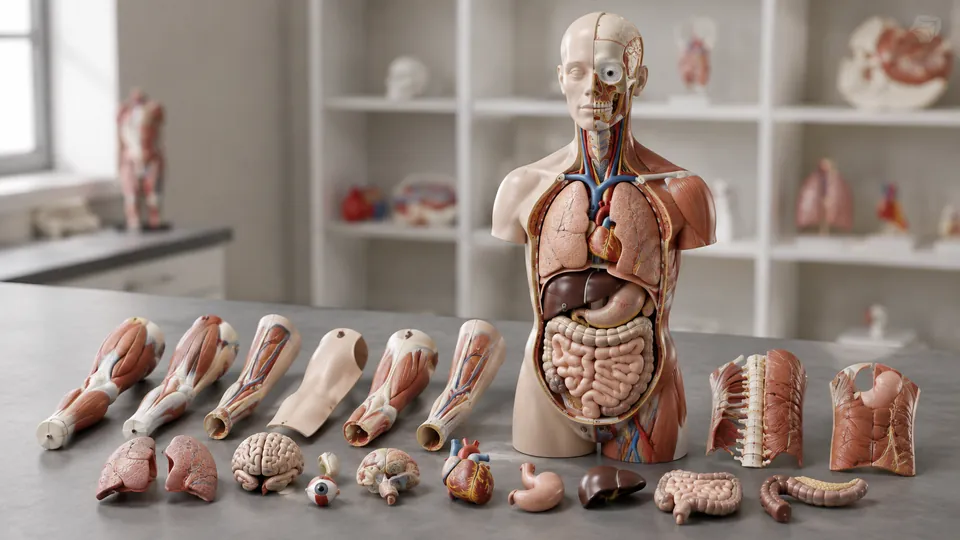
Pulling a heart from a torso model and tracing where it sits between the lungs can make anatomy click in a way that a flat illustration rarely does. Models with removable parts turn memorization into a spatial puzzle, helping students, teachers, and curious learners see how organs, bones, vessels, and muscles relate to one another.
The tricky part is matching the model to the lesson. Compact torsos travel easily but compress small structures, while larger models command a classroom and reveal more detail at the cost of storage space. Buyers also overlook part count, secure mounting, reference materials, and whether the model covers the whole body or one region. For broad instruction, the FriCARE 33.8-inch torso offers the strongest balance of scale, removable organs, and classroom visibility among these nine picks.
Different learners have different priorities. A nursing student may want a portable torso for desk study, an instructor may need life-size proportions, and a specialist may gain more from a focused heart or pelvis model. The right choice is the one that presents the anatomy you actually need at a useful scale.
Quick Answer
Best overall: The FriCARE Human Body Anatomy Torso Model provides a large 33.8-inch format with removable, labeled anatomy for teaching and study. The 11-Inch Human Torso Anatomy Model is the strongest budget-friendly choice for basic organ placement, while the Dual-Sex 32-Part Human Body Model suits buyers seeking a more comprehensive premium torso. For skeletal anatomy, the breesky Life-Size Human Skeleton offers a full-body format on a rolling stand.
Short on reading time? The table provides a fast look at scale, removable components, and the learning environment each model fits best.
Best Anatomy Models With Removable Parts Comparison Table
| Product | Best For | Size | Removable Parts or Key Feature |
|---|---|---|---|
| FriCARE Human Body Anatomy Torso Model | Best overall | 33.8 inches | Removable organs and labeled parts |
| Deluxe Musculature Model | Musculature and dual-sex study | 17 inches | 16 parts, including male and female components |
| EVOTECH SCIENTIFIC Human Body Model | Portable student study | 11 inches | 15 detachable pieces and oak base |
| 11-Inch Human Torso Anatomy Model | Budget-conscious beginners | 11 inches | 15 removable parts and stable base |
| Dual-Sex 32-Part Human Body Model | Detailed torso instruction | 33.4 inches | 32 parts with interchangeable male and female anatomy |
| Axis Scientific Life-Size Human Heart Model | Focused cardiac anatomy | Life-size | Two-part magnetic design with 34 labeled structures |
| Life-Size 3-Part Human Skull Model | Cranial anatomy | Life-size | Removable calvaria and articulated mandible |
| Male Pelvis Model With Removable Organs | Male pelvic anatomy | Life-size | 11 parts with magnetic mounting |
| breesky Life-Size Human Skeleton | Full-body skeletal instruction | 70.8 inches | Detachable head and joints, rolling stand |
The detailed reviews below explain where each model shines and which compromises matter during actual lessons or study sessions.
1. FriCARE Human Body Anatomy Torso Model: Best Overall

The FriCARE model earns the top position through sheer practical visibility. At 33.8 inches, it is large enough for an instructor to point out organ relationships without everyone crowding around a tiny desk model. The life-size proportions also give learners a more intuitive sense of where vital organs sit, which helps during a lesson on the thoracic and abdominal cavities.
Its removable organs turn that large display into an interactive teaching tool. Students can lift components out, inspect their shape, and work through the satisfying puzzle of replacing them in the correct sequence. Labeled parts support identification, while the stated emphasis on durable materials matters in classrooms where a model may pass through dozens of hands. That blend of scale and interaction gives it broader utility than a specialized heart, skull, or pelvis model.
Pros
- Large 33.8-inch format is easy to see during group demonstrations
- Life-size proportions support spatial understanding of organ placement
- Removable organs encourage active, hands-on study
- Labeled components help with identification and review
- Durable construction is intended for frequent educational handling
Cons
- Requires more storage and display space than an 11-inch torso
- Less convenient to carry between classes than compact alternatives
This FriCARE torso makes the most sense for classrooms, tutoring rooms, laboratories, and dedicated home-study spaces where visibility outranks portability. A student commuting by bus may find it cumbersome, but an instructor explaining organ position to a group will appreciate every extra inch. Choose it over the smaller torsos when the model needs to function as a shared visual centerpiece rather than a personal desktop reference.
To buy this product, click here.
2. Deluxe 16-Part Human Body Musculature Model: Best Mid-Size Torso
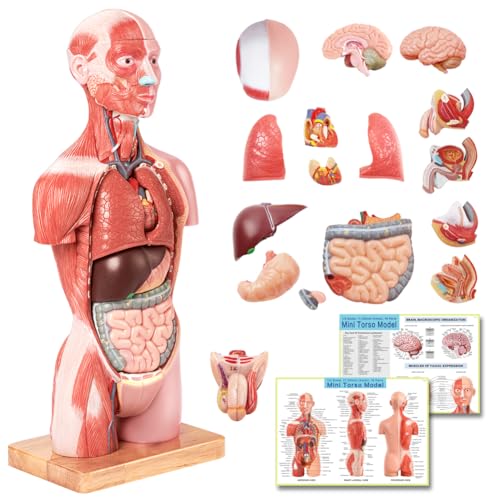
Seventeen inches occupies a handy middle ground. This half-size musculature model remains large enough to display recognizable internal anatomy, yet it can sit on a shelf without taking over the room. Hand-painted PVC gives the components visual separation, and the oak base adds a warmer, more substantial presentation than a basic plastic platform.
The 16-part arrangement includes a two-part brain, two-part heart, lungs, stomach, liver, intestines with pancreas, and interchangeable male and female components. Picture a small study group passing the brain halves around, then reconstructing the torso before an exam. Secure-fitting pieces reduce the frustration of organs slipping loose during that exercise, while the included educational brochure provides a starting reference for learners working independently.
Pros
- Mid-size 17-inch body balances visibility with portability
- Includes 16 detachable components for interactive study
- Interchangeable male and female parts broaden its teaching scope
- Hand-painted PVC is easy to wipe clean
- Oak base creates a stable, display-ready presentation
Cons
- Half-size anatomy cannot show tiny landmarks as clearly as a larger model
- Small detachable components require careful storage around young children
This model suits nursing students, anatomy enthusiasts, homeschool settings, and instructors who move supplies between rooms. Its male and female components give it an advantage over basic 15-part torsos, though the larger dual-sex model below offers a deeper 32-part build. Pick this one when shelf space and transport matter, but an ultra-compact 11-inch model feels too cramped for comfortable group discussion.
To buy this product, click here.
3. EVOTECH SCIENTIFIC 15-Part Human Body Model: Best for Students

A crowded dorm desk leaves little room for a towering torso, which is where this 11-inch EVOTECH SCIENTIFIC model makes sense. It is compact enough to carry to a study session or tuck beside a stack of textbooks. The painted PVC and oak base also allow it to stay assembled as a tidy visual reference between review sessions.
Its 15 detachable pieces cover core torso anatomy, including a two-part brain, heart, four lung components, stomach, diaphragm, liver, pancreas with spleen, and intestines. Removing the lungs to expose deeper structures creates a useful mental map that diagrams struggle to convey. The parts are described as fitting securely, and the colorful brochure can help students identify components while they learn the assembly order.
Pros
- Compact 11-inch body fits easily on a student desk
- Fifteen detachable pieces cover the major torso organs
- Four-part lung structure adds useful sectional detail
- Hand-painted PVC provides clear visual differentiation
- Includes an oak base and educational brochure
Cons
- Small scale limits visibility during room-wide demonstrations
- Fine anatomical structures are harder to distinguish than on life-size models
The EVOTECH SCIENTIFIC torso is aimed squarely at personal study, small tutoring sessions, and portable classroom work. It offers a more polished base and an established 15-piece layout, while the budget torso in the next section covers similar foundational anatomy for buyers prioritizing economy. Medical students needing detailed landmarks should look toward a larger torso or a dedicated regional model, but beginners can get plenty of mileage from repeatedly disassembling this compact body.
To buy this product, click here.
4. 11-Inch Human Torso Anatomy Model: Best Budget Pick

Basic anatomy practice does not always call for a massive laboratory model. This small torso delivers a 15-part removable system in an 11-inch package, making it a sensible entry point for homeschool lessons, introductory biology, and casual self-study. Contrasting colors help major organs stand apart at a glance, while the stable base keeps the body upright during display.
The component list is surprisingly broad for its size. Learners can remove a two-part brain, heart, four-part lungs, stomach, diaphragm, liver, pancreas with spleen, intestines, and the esophagus and trachea with aorta. Imagine a student clearing one corner of the kitchen table, completing a quick organ-placement drill, then packing everything away before dinner. Lightweight, wipe-clean PVC suits that kind of repeated everyday handling.
Pros
- Accessible budget positioning for introductory anatomy study
- Fifteen removable parts create a useful assembly exercise
- Eleven-inch size is portable and easy to store
- Contrasting colors make major structures easier to separate visually
- Stable display base supports desk and shelf use
Cons
- Compact organs may feel fiddly for learners with limited dexterity
- Provides less fine detail and classroom visibility than larger torsos
Families, beginner students, and teachers building several small-group stations should give this model a close look. Its strength lies in showing broad organ location rather than minute anatomy, so it is less appropriate for advanced identification of subtle landmarks. Buyers who need a portable, straightforward body puzzle can save space and keep the lesson tactile without paying for features their curriculum may never use.
To buy this product, click here.
5. Dual-Sex 32-Part Human Body Model: Best Premium Torso

For a lesson that moves from superficial muscular layers to deeper visceral anatomy, this 33.4-inch model brings much more to the table than a basic miniature torso. Its 32-part construction includes the heart, brain, internal organs, muscular layers, bone, and vessels. The larger body creates room for those layers to remain readable, rather than squeezing everything into a palm-sized cavity.
Interchangeable male and female genital components expand its usefulness across anatomy units, avoiding the need for two separate torso models. A detailed manual supports identification and reassembly, which matters once 32 pieces are spread across a lab bench. Durable PVC and flexible components are intended to tolerate regular handling, making this a candidate for serious home study or structured educational environments where learners revisit the model across multiple courses.
Pros
- Thirty-two removable parts provide the broadest torso coverage here
- Large 33.4-inch format improves visibility of layered anatomy
- Interchangeable male and female components support wider instruction
- Includes muscular layers, bones, vessels, and visceral organs
- Detailed manual helps guide identification and assembly
Cons
- Complex 32-part assembly demands more setup and careful organization
- Large format needs dedicated storage and is awkward for routine transport
This is the premium choice for educators and committed students who will use its added layers rather than leave half the components in a drawer. The FriCARE model remains a simpler all-around recommendation, but this dual-sex torso pulls ahead for breadth and detailed assembly work. Casual beginners may find the part count overwhelming, while an advanced learner could turn that same complexity into repeated practical review.
To buy this product, click here.
6. Axis Scientific Life-Size Human Heart Model: Best for Cardiac Anatomy

Sometimes a whole torso becomes visual noise. The Axis Scientific heart narrows the lesson to cardiac anatomy, using a life-size, two-part design with 34 labeled structures. Its removable front wall exposes the atria, ventricles, valves, and internal pathways, giving students a clean view once the exterior is opened.
Hidden magnets make that reveal especially practical. Instead of wrestling with visible clips, a teacher can lift away the wall, discuss internal chambers, then snap it back into position with a neat click. The full-color manual uses photographs of the model, so its references correspond directly to the object in hand. That pairing is useful during solo exam review and patient education demonstrations, where clear orientation matters more than a huge part count.
Pros
- Life-size representation focuses attention on cardiac structures
- Removable front wall reveals internal chambers and valves
- Hidden magnets allow quick, secure reassembly
- Thirty-four labeled structures support guided identification
- Photo-based study manual maps directly to the model
Cons
- Two-part construction offers less disassembly than multi-piece torso models
- Specialized cardiac focus does not cover surrounding organ relationships
Medical and nursing students reviewing the heart, educators teaching circulation, and clinics explaining basic cardiac structures are the clearest audience. It will not replace a torso for understanding how the heart sits between the lungs, but it provides a much cleaner internal view than many general models. Choose it when depth within one organ matters more than breadth across several body systems.
To buy this product, click here.
7. Life-Size 3-Part Human Skull Model: Best for Cranial Anatomy

Cranial sutures, foramina, and fossae become far easier to orient once the skull can be turned in the hands. This life-size PVC model separates into the calvaria, skull base, and mandible, exposing internal surfaces that remain hidden on a fixed replica. A realistic bone texture and clearly presented sutures support visual and tactile study from multiple angles.
The removable calvaria attaches with magnets and small pegs, combining easy access with a secure fit. Meanwhile, the articulated mandible helps demonstrate basic jaw position and movement. During a study session, one learner can call out a landmark from the included color chart while another locates it on the model. That simple exercise turns a dense page of cranial terminology into a more memorable scavenger hunt.
Pros
- Life-size dimensions preserve realistic cranial proportions
- Three-part design exposes the skull base and internal cavity
- Magnetic calvaria is quick to remove and replace
- Articulated mandible adds a movable anatomical feature
- Included color chart supports structure identification
Cons
- Three removable sections provide limited assembly compared with a torso
- Unnumbered landmarks may require frequent reference to the separate chart
This skull is a practical fit for anatomy courses, art reference, dental education, and anyone concentrating on cranial form. Learners seeking brain structures will need a different model because the listing centers on bony anatomy. Its life-size scale and removable cap give it a clear edge over decorative replicas, particularly when access to the cranial cavity is part of the lesson.
To buy this product, click here.
8. Male Pelvis Model With Removable Organs: Best for Pelvic Anatomy

The pelvis packs bones, muscles, vessels, nerves, and organs into a tight three-dimensional space, making it one of those regions that can look baffling on a crowded page. This life-size male pelvis model separates into 11 parts, letting learners examine components and then rebuild their relationships within the pelvic cavity.
Its hand-painted PVC presents multiple tissue types with visual distinction, while magnetic mounting helps hold the removable parts in place. The model includes bones, ligaments, vessels, nerves, pelvic-floor muscles, and external sex organs, along with an educational brochure. In an orthopedics or anatomy lesson, removing layers can reveal why a structure sits where it does, creating a clearer spatial path through a notoriously dense region.
Pros
- Life-size scale supports realistic study of pelvic relationships
- Eleven-part construction allows layered disassembly
- Includes bones, ligaments, vessels, nerves, and pelvic-floor muscles
- Magnetic mounting helps secure removable components
- Hand-painted, wipe-clean PVC suits repeated teaching use
Cons
- Male-specific anatomy limits its coverage of pelvic variation
- Regional specialization makes it less versatile for general anatomy beginners
This model is best reserved for focused male pelvic-floor, surgical, orthopedic, or anatomy instruction. Its regional depth makes it more informative than a general torso in this area, but that specialization carries an obvious boundary. Buyers needing both male and female structures should favor the 32-part dual-sex torso, while those teaching male pelvic relationships can benefit from the larger, layered presentation here.
To buy this product, click here.
9. breesky Life-Size Human Skeleton Model: Best Full-Body Skeleton

At 70.8 inches, this skeleton has the physical presence needed for room-wide demonstrations. Students can compare the height and proportions with their own bodies, then follow skeletal relationships from the skull to the feet. The PVC construction is easy to wipe down, and nervous-system markings add another visual layer to the bony framework.
The head and joints are detachable and movable, allowing closer inspection of selected areas instead of forcing learners to circle the entire stand. A five-wheel rolling base makes moving the skeleton between a classroom corner and the center of a demonstration far easier. Three included posters extend the reference material, which is handy when one group examines a detached component while another follows the full-body view.
Pros
- Life-size 70.8-inch format is highly visible in classrooms
- Full-body skeleton supports study of overall skeletal relationships
- Detachable head and joints permit focused examination
- Five-wheel stand makes the large model easier to reposition
- Includes nervous-system markings and three educational posters
Cons
- Requires substantial floor and storage space
- Removable organ study is outside its skeletal focus
Physical therapy classrooms, chiropractic education spaces, biology labs, and instructors teaching full-body skeletal orientation are the natural audience. A torso offers richer visceral anatomy, while this skeleton excels at scale, posture, joint location, and bone relationships. Apartment-based learners may struggle to house it, but a dedicated teaching room can make excellent use of its rolling, full-height presentation.
To buy this product, click here.
How to Choose an Anatomy Model With Removable Parts
Match the Anatomy to the Lesson
Start with the course objectives rather than the most impressive-looking model. General torso models work well for organ position, body cavities, and broad physiology lessons. A student trying to understand cardiac chambers will see more in the Axis Scientific heart, while someone studying pelvic-floor relationships will gain greater regional depth from the male pelvis model.
Think about the moment the model will be used. During a middle-school demonstration, bright separation between the liver, lungs, stomach, and intestines may be enough to spark understanding. During advanced study, learners may need layered muscles, vessels, ligaments, or internal surfaces that an introductory torso cannot provide.
Scale and Viewing Distance
An 11-inch torso works beautifully across a desk, where one or two people can lean close and handle the organs. Put that same model at the front of a classroom, and the details shrink into colored blobs for learners in the back row. Large torsos and life-size skeletons solve the visibility problem, though they demand considerably more space.
Measure the intended shelf, cabinet, tabletop, or floor area before ordering. Allow extra room for removed pieces, manuals, and safe disassembly. A 32-part torso needs a clear work surface, while a rolling skeleton needs enough clearance to move without clipping desks or door frames.
Part Count and Useful Detail
More parts can create a richer study experience, but part count alone does not determine educational value. Fifteen well-chosen torso pieces may be perfect for learning broad organ placement. Thirty-two components become useful when the curriculum covers muscular layers, sex-specific anatomy, bones, or vessels in greater depth.
Ask what each removable piece reveals. A detachable heart wall exposes chambers, a removable skull cap opens the cranial cavity, and layered pelvic components clarify tightly packed relationships. Those purposeful reveals matter more than pieces that separate without adding a new view.
Mounting and Reassembly
Loose components can turn a smooth classroom demonstration into several awkward minutes of fumbling. Magnets, fitted cavities, pegs, and stable bases help parts return to the proper position. Magnetic models are particularly convenient for quick reveals, though learners should still handle small pegs and delicate structures carefully.
Reassembly difficulty can also be educational. Replacing organs in the correct sequence forces students to think spatially, much like solving a three-dimensional puzzle. For younger learners or short lessons, a simpler 15-part torso usually keeps the activity lively rather than frustrating.
Labels, Manuals, and Color Coding
Numbered structures paired with a model-specific manual reduce guesswork during independent study. The Axis Scientific heart stands out because its guide uses photographs corresponding to the physical model. Separate charts can still help, but students may spend more time moving their eyes between the chart and an unnumbered surface.
Color coding should make structures easy to distinguish without creating confusion about what the colors represent. Most anatomy models use contrasting paint as an educational convention rather than an attempt to reproduce natural tissue color exactly. A clear legend or brochure helps bridge that gap.
Durability and Portability
PVC is common because it can hold molded detail and wipe clean after frequent handling. Durability also depends on the smallest connectors, magnets, pegs, and projecting structures. Store every removable piece in a designated tray or container, especially when the model travels between classrooms.
Portable models make sense for tutoring, dorm study, and instructors without a permanent room. Large models serve fixed labs better. Picture the actual route from storage to teaching space, including stairs, narrow doors, and crowded hallways, before choosing a life-size torso or rolling skeleton.
Best Anatomy Models With Removable Parts FAQ
Are Larger Anatomy Models More Accurate Than Small Models?
Larger scale does not automatically guarantee greater accuracy, but it gives manufacturers more room to represent small landmarks clearly. Compact models are usually better for broad spatial relationships and portability, while life-size models tend to be easier to view during group lessons.
How Many Removable Parts Should a Torso Model Have?
For introductory organ placement, a 15-part torso can provide plenty of useful interaction. Models with 16 to 32 parts offer more layers, divided organs, or sex-specific components. Pick the part count that matches the curriculum, since additional pieces also increase setup time and storage demands.
Are Removable Anatomy Models Suitable for Children?
They can support supervised biology lessons, particularly models with large, colorful organs. Small detachable pieces can present a choking risk and may be easy to lose, so follow the manufacturer’s age guidance and keep disassembled models away from children who put objects in their mouths.
Should an Anatomy Model Have Labels or Numbers?
Labels and numbers are valuable for independent study because they speed up identification. An unnumbered model can still work well with a detailed chart or instructor-led lesson. Model-specific manuals are preferable to generic diagrams because the pictured structures match the object being studied.
What Is the Difference Between a Torso Model and a Full Skeleton?
A torso model emphasizes internal organs and their positions within body cavities. A full skeleton focuses on bones, joints, proportions, and posture. Some skeletons include markings or detachable joints, but they generally do not provide the removable visceral organs found in torso models.
How Should Removable Parts Be Stored?
Reassemble the model when possible and keep any loose components in a labeled, divided container. Avoid piling delicate projections under heavier organs. Store the model away from excessive heat and direct sunlight, and follow the listing or manufacturer’s cleaning instructions for its material.
Can Anatomy Models Be Used for Patient Education?
Clear regional models can help professionals illustrate basic anatomical locations during educational conversations. They are visual references rather than diagnostic tools, and they do not replace individualized explanations from qualified healthcare professionals.
Is a Specialized Model Better Than a General Torso?
A specialized heart, skull, or pelvis model is better when one anatomical region requires close attention. A general torso provides more context across organ systems. Many classrooms benefit from starting with a torso and adding a regional model for topics that demand deeper detail.
Final Verdict
Among these nine models, the FriCARE Human Body Anatomy Torso Model is the strongest overall recommendation. Its 33.8-inch stature offers clear classroom visibility, while removable organs and labeled parts keep lessons active rather than purely observational. It has enough size to communicate realistic organ placement without the complexity of managing 32 separate components, which makes it approachable across a broad range of educational settings.
Smaller spaces and tighter budgets point toward the 11-Inch Human Torso Anatomy Model, a portable 15-part option suited to beginners and personal study. Buyers seeking deeper, dual-sex torso instruction should consider the Dual-Sex 32-Part Human Body Model, while the breesky Life-Size Human Skeleton is the more logical pick for full-body skeletal lessons. Before ordering, match the model’s anatomy, scale, and part count to the lesson plan, then confirm there is enough space to display, disassemble, and store every component safely.
