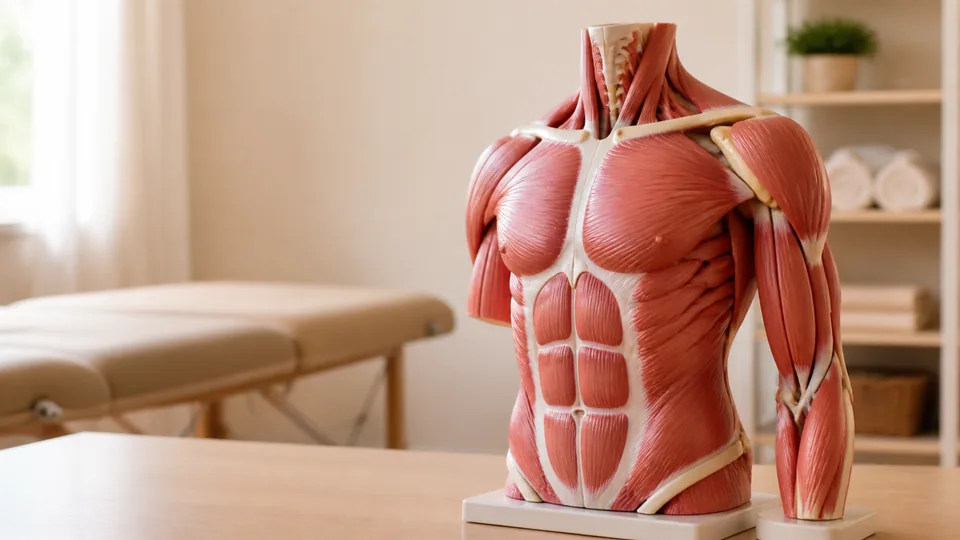
Massage anatomy becomes much clearer when a muscle, vertebra, or joint can be viewed from several angles instead of squeezed into a flat illustration. Picture explaining scapular movement to a client while tracing the structure on a desktop figure, or reviewing spinal landmarks before a practical exam with a life-size skeleton beside the treatment table. The right visual reference makes those conversations feel concrete rather than foggy.
The catch is that anatomy products vary wildly. Some emphasize superficial muscles, others reveal bones and attachment sites, and a few focus narrowly on the head and neck. Size, articulation, readable markings, portability, and cleanable materials matter most. Buyers often choose the largest model available without considering storage, or pick an attractive torso that omits the musculoskeletal details they actually need. Different priorities call for different tools, but the 20-inch Ultrassist muscle figure offers the most practical balance for everyday massage anatomy review.
For a fast overview, the table below compares all nine selections before the detailed reviews.
Quick Answer
Best overall: The Ultrassist Human Muscle Anatomy Model gives massage therapists a compact, colorful view of major muscle groups without occupying half the treatment room. For skeletal landmarks and movement demonstrations, the 70.8-Inch Human Skeleton Model is the stronger full-size choice. Buyers studying origins, insertions, and ligaments should look closely at the premium 70.8-Inch Skeleton with Muscle Insertions and Ligaments.
Best Anatomy Models for Massage Therapists Comparison Table
| Product | Best For | Size or Format | Key Feature |
|---|---|---|---|
| Ultrassist Human Muscle Anatomy Model | Everyday muscle reference | 20-inch figure | Color-separated major muscle groups |
| Basic Clinical Massage Therapy | Portable treatment reference | Printed book | Connects anatomy with massage applications |
| 70.8-Inch Human Skeleton Model | Full-body skeletal demonstrations | Life-size model | Posable joints and rolling stand |
| Basic Clinical Massage Therapy, Second Edition | Structured anatomy study | Printed book | Later edition of a massage-focused reference |
| Timethink 3D Spine Digital Wall Clock | Treatment-room decor | 12-inch wall display | Illuminated spine sculpture and clock |
| 70.8-Inch Skeleton with Muscle Insertions and Ligaments | Origins, insertions, and ligaments | Life-size model | Painted attachment points and flexible ligaments |
| 17-Inch Removable Human Torso Model | Organ relationships | 17-inch, 16-part torso | Removable internal structures |
| Human Half-Head Neurovascular Model | Head and neck anatomy | Life-size regional model | Muscles, vessels, nerves, and sagittal structures |
| 67-Inch Disarticulated Human Skeleton | Individual bone study | Full-size bone set | Separate bones plus articulated hand and foot |
The reviews below show where each option fits in a massage classroom, study space, or client-education setting.
1. Ultrassist Human Muscle Anatomy Model, 20-Inch Figure: Best Overall
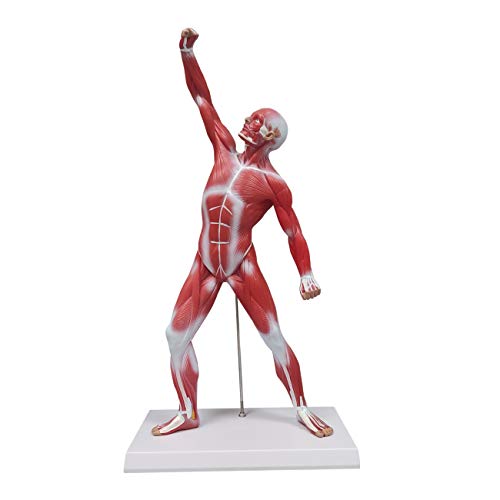
The Ultrassist figure lands in a useful middle ground between a tiny desk ornament and a towering classroom skeleton. At roughly 20 inches tall, it can sit near anatomy books, travel between a massage school and home, or remain visible in a treatment room without looming over clients. Its bright muscle colors make the chest, abdomen, back, and limbs easy to distinguish during a quick review.
That whole-body muscular view has obvious value for massage students learning how regions connect. Following the posterior chain from the back into the legs feels more natural on a three-dimensional figure than on separate textbook plates. The PVC surface is described as smooth, durable, and easy to clean, which suits a shared teaching environment where fingerprints and dust are part of daily life. Detailed markings support identification, although the smaller scale cannot display every subtle attachment point with the clarity of a premium life-size model.
Pros
- Shows major muscle groups across the front and back of the body
- Compact 20-inch height works well on desks and shelves
- Bright color separation supports quick visual recognition
- PVC construction is smooth and easy to wipe clean
- Portable enough for study sessions and classroom demonstrations
Cons
- Smaller scale limits the visibility of fine anatomical landmarks
- Does not provide the removable structures or joint movement of specialized models
This is the strongest fit for massage therapists who want one approachable muscular reference for routine study, client explanations, and treatment planning discussions. A school needing room-wide demonstrations may prefer a life-size skeleton, while advanced students focused on precise attachment sites should consider the painted insertion model. For most buyers, though, the Ultrassist figure delivers the most useful anatomy per inch of shelf space.
To buy this product, click here.
2. Basic Clinical Massage Therapy: Integrating Anatomy and Treatment: Best Portable Reference

This selection is a book rather than a physical anatomy model, so it fills a supporting role in the roundup. A sculpted figure can show where a muscle sits, but massage students also need context about how anatomy relates to palpation and treatment. This title belongs to the LWW Massage Therapy & Bodywork Series and is built around that connection, making it useful beside a muscle or skeleton model.
Its practical advantage becomes apparent in cramped spaces. A student can slip a book into a bag, open it beside a portable massage table, and compare written guidance with anatomical landmarks on a study partner. The supplied listing identifies the copy as used and in good condition, so condition details deserve attention before ordering. It also represents an earlier edition, which matters to buyers seeking the newest available organization or instructional material.
Pros
- Connects anatomy study with massage-oriented treatment concepts
- Portable format suits classes, study groups, and home review
- Useful as a companion to a physical muscle or skeleton model
- Requires no dedicated display or storage area
- Part of a bodywork-focused educational series
Cons
- It is a printed reference rather than a three-dimensional model
- The listed copy is used, and condition can vary between sellers
Buyers wanting a tactile demonstration tool should skip this as their primary purchase. For students who already have access to school models, however, it offers a more portable bridge between anatomy and massage practice. Check the listing carefully for binding, highlighting, and seller condition notes, especially if clean pages are important for formal coursework.
To buy this product, click here.
3. 70.8-Inch Human Skeleton Model with Nervous System and Stand: Best Full-Size Option

Full-body alignment is easier to discuss when the skeleton in front of you stands at approximately human height. This 70.8-inch PVC model gives instructors and therapists a broad view of the skull, spine, rib cage, pelvis, and limbs. Hinged joints allow flexible posing, while the rolling metal stand makes it possible to move the model from a corner to the center of a teaching area without awkward lifting.
The extra structures help distinguish it from a bare-bones display. According to the listing, it includes nervous-system and carotid-artery details, a removable skull cap, movable jaw, and three detachable teeth. Color illustrations, assembly instructions, and a bone-identification poster add reference material for students. Imagine demonstrating shoulder elevation, pelvic position, or the relationship between the cervical spine and jaw. The scale makes those explanations visible from several feet away, although skeletal anatomy alone cannot show the bulk and layered paths of soft tissue.
Pros
- Life-size format supports clear full-body demonstrations
- Hinged limbs and joints allow a range of teaching poses
- Rolling five-wheel stand improves room-to-room mobility
- Includes a removable skull cap, movable jaw, and detachable teeth
- Comes with illustrations, instructions, a poster, and a dust cover
Cons
- Requires considerably more floor and storage space than a desktop model
- Lacks painted muscle origins and insertions found on the premium skeleton below
This model suits massage schools, larger clinics, and instructors who routinely explain posture or joint relationships. Independent therapists working from a compact studio may find its footprint excessive. It is also a skeletal reference first, so pairing it with a muscular figure can create a fuller view of the structures encountered during massage education.
To buy this product, click here.
4. Basic Clinical Massage Therapy: Integrating Anatomy and Treatment, Second Edition: Best Book Companion

The second edition of Basic Clinical Massage Therapy is another reference rather than a three-dimensional anatomy model. It earns a place as a study companion for readers who want anatomy framed around massage and bodywork. Sitting beside a colorful muscle figure, a book like this can supply the terminology and treatment-oriented context that molded PVC cannot convey by itself.
This edition makes the most sense for coursework, exam preparation, or a therapist rebuilding anatomy knowledge after years away from school. Picture reviewing a chapter at the kitchen table, then turning to a skeleton to locate the relevant bony landmarks. That back-and-forth rhythm can be productive because the resources answer different questions. The Amazon data supplied here gives limited feature information and describes a used copy in good condition, so buyers should inspect the seller’s condition description rather than assume a pristine book.
Pros
- Massage-specific focus connects anatomical concepts with bodywork
- Second-edition format may suit courses that specify this version
- Pairs naturally with muscle, skeleton, or regional anatomy models
- Portable enough for classroom and home study
- Provides written depth beyond what a molded model can display
Cons
- Cannot provide tactile, three-dimensional anatomical visualization
- Used-copy condition may include wear or markings depending on the seller
Choose this book if structured reading is central to your study plan and the second edition matches your syllabus or preferred reference. Buyers seeking an object for client demonstrations should put their budget toward the Ultrassist figure or a full-size skeleton first. As part of a mixed study setup, however, this edition can add the clinical language missing from a standalone model.
To buy this product, click here.
5. Timethink Chiropractor Digital Wall Clock with 3D Spine: Best Anatomy-Themed Decor

This Timethink clock is anatomy-themed office decor, not a serious teaching model. That distinction matters. Its 12-inch display combines a three-dimensional spine sculpture with a digital clock and warm light, creating an eye-catching focal point for a waiting room or massage studio. The illuminated profile can spark conversation, but it lacks the movable vertebrae and identified structures needed for rigorous anatomy instruction.
As a functional wall piece, it displays the time in 12-hour or 24-hour format, date, and temperature in Fahrenheit or Celsius. USB power and the supplied 70.8-inch cord make placement reasonably flexible, though the listing says a plug is not included. In a softly lit treatment room, the warm glow may feel more inviting than a stark clinical poster. Buyers must still treat the spine as decorative sculpture rather than a reference for precise landmark identification.
Pros
- Combines a 3D spine motif with a functional digital clock
- Warm illumination can complement a calm treatment-room setting
- Displays time, date, and temperature
- Supports both 12-hour and 24-hour time formats
- Long USB cord provides flexibility during wall placement
Cons
- Decorative spine lacks the detail and mobility needed for formal anatomy study
- USB power adapter is not included according to the listing
This clock works best for a therapist who already owns educational references and wants anatomy-themed decor with practical utility. Students choosing their first study aid should pass it by, since a muscle figure, regional head model, or articulated skeleton will teach far more. Think of it as atmosphere with a useful display, not a substitute for a classroom model.
To buy this product, click here.
6. 70.8-Inch Skeleton Model with Muscle Insertions and Ligaments: Best Premium Option
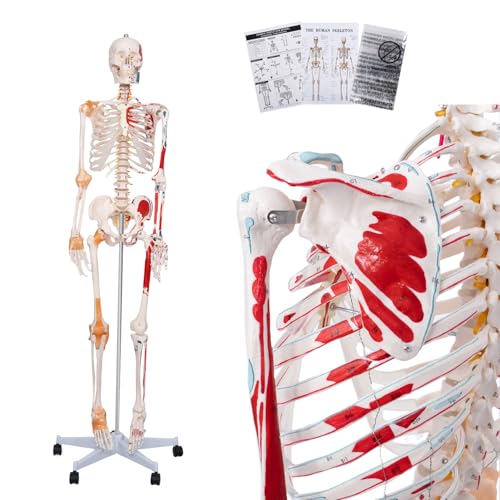
Painted origins and insertion points make this life-size skeleton especially relevant to massage anatomy. Rather than asking students to imagine where soft tissue attaches to a plain bone, the model places color-coded information directly on the 70.8-inch frame. Numbered bones and flexible joint ligaments add another layer for discussing attachment, movement, and structural relationships.
The supporting hardware is equally practical for a permanent classroom or spacious clinic. A metal stand with five rolling wheels allows repositioning, and a dust cover helps protect the PVC surface between sessions. The skull cap is removable, the jaw moves, and three teeth detach, while hinged limbs permit posing. Nervous-system and carotid-artery structures are also listed. There is plenty here to explore, though the visual density may feel busy to beginners who are still memorizing basic bone names.
Pros
- Painted muscle origins and insertions support attachment-site study
- Flexible ligaments help illustrate joint relationships
- Life-size scale works well for group demonstrations
- Numbered bones assist identification and guided lessons
- Includes a rolling stand, dust cover, poster, and color illustrations
Cons
- Large footprint is impractical for many home offices and mobile therapists
- Dense markings may be visually overwhelming during early anatomy study
This is the most compelling selection for instructors and advanced students who repeatedly discuss muscular attachment sites. Its combination of skeleton, markings, and ligaments is more massage-specific than a plain articulated skeleton. Buyers needing a portable desktop tool can save space with the Ultrassist figure, but a dedicated teaching room can make excellent use of this model’s scale and detail.
To buy this product, click here.
7. 17-Inch Human Body Model with 16 Removable Parts: Best for Organ Relationships
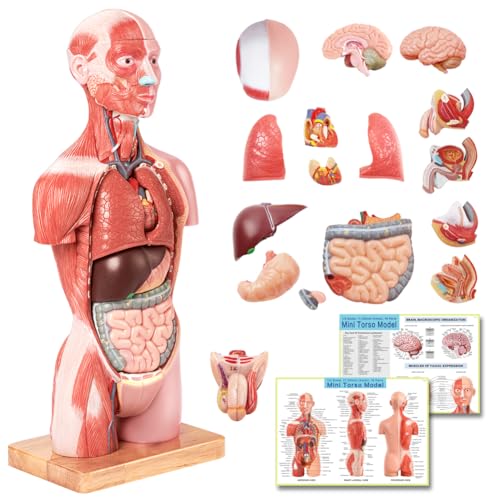
Despite “musculature” appearing in the longer listing title, this 17-inch product is primarily a removable torso and organ model. Its 16 components include the trunk, skull cap, two brain pieces, two heart pieces, two lung pieces, stomach, liver, intestines with pancreas, caecum cover, and male and female parts. That arrangement helps learners see how internal structures occupy the torso in three dimensions.
Massage therapists usually spend more time with musculoskeletal anatomy than removable organs, yet visceral position and general body orientation still have educational value. Pulling out the lungs, heart, and digestive structures can make the crowded thoracic and abdominal cavities easier to grasp. The hand-painted PVC model sits on an oak-wood base and comes with an educational brochure. Small components require organized storage, particularly in a busy classroom where pieces can migrate surprisingly fast.
Pros
- Sixteen-part design allows hands-on exploration of internal structures
- Includes removable brain, heart, lungs, and digestive components
- Compact 17-inch size is easier to store than a life-size torso
- PVC construction is described as easy to clean
- Wooden base gives the model a stable display platform
Cons
- Organ-focused design provides limited detail for muscle attachment study
- Small removable pieces require careful handling and storage
This torso suits broad anatomy lessons, especially for students who want to understand the relative positions of major organs. It is less useful for palpation landmarks, muscle layering, or joint movement than the muscular and skeletal models in this guide. Choose it as a supplementary classroom piece rather than the sole anatomy reference for massage training.
To buy this product, click here.
8. Human Half-Head Superficial Neurovascular Model with Musculature: Best for Head and Neck Anatomy
Head and neck anatomy packs muscles, vessels, nerves, glands, airways, and vertebral structures into a remarkably tight region. This life-size half-head model opens that crowded area through a midsagittal section while also showing superficial structures on the outer face and scalp. A rotating base allows a learner to turn the model through 360 degrees instead of craning around a fixed display.
The visible features include superficial facial muscles, blood vessels and nerves, the parotid and submandibular glands, portions of the brain, nasal and oral cavities, tongue, larynx, pharynx, cervical vertebrae, and spinal cord. The ear detaches for observation of the external acoustic opening, and an included manual identifies the structures. For someone studying the face, jaw, upper neck, or scalp, that concentrated detail can be far more useful than squinting at the same region on a small whole-body figure.
Pros
- Life-size regional format provides concentrated head and neck detail
- Shows superficial muscles alongside vessels and nerves
- Midsagittal view reveals internal airway and brain structures
- Rotates 360 degrees for easier viewing during instruction
- Includes a detachable ear and labeled reference manual
Cons
- Regional design offers no reference for the trunk or limbs
- Large amount of nearby detail may require the manual for confident identification
Therapists specializing in facial, scalp, jaw, or neck work will find this model more relevant than a general torso. It also suits instructors who want to explain why this compact region demands careful anatomical study. A student seeking one model for the entire body should start elsewhere, then add this piece once head and neck anatomy becomes a priority.
To buy this product, click here.
9. 67-Inch Disarticulated Human Skeleton Model: Best for Individual Bone Study

A disarticulated skeleton changes the learning experience completely. Instead of viewing bones locked into a standing frame, students can pick up an individual structure, turn it over, and inspect its contours from every side. This PVC set is described as a direct mold cast from a real male skeleton and includes full-size bones, intervertebral discs, the hyoid, coccyx, and other components.
An articulated left hand and foot preserve the relationships of those especially complicated regions, while separate pieces support close study elsewhere. The included laminated poster helps with identification. A massage student could place a scapula beside an anatomy illustration, examine the borders and angles, then compare it with palpated landmarks during supervised practice. The central limitation is explicit in the listing: this set cannot be assembled into a functional standing skeleton, and the ribs and thoracic cartilage are not intended for casual assembly.
Pros
- Separate bones can be handled and viewed from multiple angles
- Full-size format preserves realistic structural proportions
- Includes articulated versions of the left hand and foot
- Contains smaller structures such as the hyoid and coccyx
- Laminated skeletal poster supports bone identification
Cons
- Cannot be assembled into a standing skeleton for posture demonstrations
- Numerous separate pieces demand substantial, organized storage
This set is a strong choice for students who learn by handling individual bones and tracing landmarks with their fingers. It is much less convenient for demonstrating gait, alignment, or joint motion to a group. Buyers should plan dedicated trays, drawers, or labeled containers before opening the set, since loose anatomical pieces can quickly turn a useful lesson into a storage puzzle.
To buy this product, click here.
How to Choose an Anatomy Model for Massage Therapy
Start With the Structures You Need to See
Muscular figures make sense for reviewing muscle location, broad fiber direction, and relationships between body regions. Skeletons are better for bony landmarks, joint orientation, posture, and attachment-site study. A head model serves concentrated regional learning, while a removable torso helps explain organ position. Before shopping, write down the anatomical questions the model must answer. That small exercise prevents an impressive-looking product from becoming expensive shelf decor.
Match Scale to the Learning Environment
Life-size skeletons command attention in a classroom. An instructor can point to the pelvis from several feet away, roll the model beside a treatment table, and pose a limb for a movement discussion. They also occupy real floor space and need protection from bumps. Desktop models trade fine detail for portability, making them friendlier to apartments, shared offices, and mobile study sessions.
Look Closely at Muscle Markings
For massage education, painted muscle origins and insertions can be more useful than a plain skeleton. Markings help connect a muscle named in a book with its bony attachment, especially during early study. Color separation also makes large groups easier to identify at a glance. Confirm whether markings are numbered, identified in a manual, or merely decorative, since those approaches offer very different educational value.
Decide Whether Articulation Matters
Movable joints help instructors demonstrate approximate limb position and skeletal relationships. They are useful for conversations about shoulder, hip, knee, and spinal mechanics, although a hinged educational skeleton does not reproduce every nuance of living movement. Disarticulated bones serve another purpose. They allow close inspection of landmarks but cannot show whole-body posture without assembly, so the two formats should not be treated as interchangeable.
Consider Removable Parts Carefully
Removable pieces invite hands-on exploration. A detachable skull cap reveals internal spaces, while separate organs clarify their relative position inside the torso. Yet every loose piece creates another opportunity for loss or damage. Shared classrooms should use labeled storage, and therapists with curious young visitors should keep small parts secured away.
Check the Stand and Storage Plan
A sturdy wheeled stand is valuable for a life-size model that moves between teaching stations. Desktop figures need a stable base that will not wobble when someone points to a structure. Dust covers, cabinets, and wipe-clean surfaces also matter more than they first appear. Anatomy models tend to sit exposed for long stretches, collecting the fine gray film familiar to anyone with an open treatment-room shelf.
Use Books and Decor for the Right Purpose
A massage textbook can explain clinical terminology and organize a study plan, but it cannot replace three-dimensional visualization. Likewise, an illuminated spine clock can make a studio feel personal without functioning as an anatomical teaching aid. Spend the core educational budget on a model that matches your learning goals, then add references or decor around it.
Best Anatomy Models for Massage Therapists FAQ
What Type of Anatomy Model Is Most Useful for Massage Students?
A whole-body muscle figure is usually the most approachable starting point because it shows the regions massage students discuss daily. A skeleton with marked origins and insertions becomes more valuable as coursework moves into precise attachment sites and joint relationships. Many students ultimately benefit from access to both.
Is a Life-Size Skeleton Better Than a Desktop Muscle Model?
Neither format is universally better. Life-size skeletons suit classrooms, posture demonstrations, and bony landmark study. Desktop muscle models are easier to store and provide a clearer soft-tissue overview. Room size, curriculum, and portability should drive the decision.
Are Painted Muscle Origins and Insertions Worth Having?
They can be extremely helpful for visual learners studying where muscles attach. Painted markings reduce the mental leap between a textbook diagram and bare bone. Their value depends on clear color coding and a usable identification guide, so examine the listing for supporting labels or charts.
Can an Anatomy Model Be Used to Explain Concepts to Clients?
Yes, a clear model can support general educational explanations about body regions and structural relationships. Keep those conversations within your professional scope and avoid using a model to diagnose a condition. The model is a visual reference, not a diagnostic instrument.
How Much Space Does a Full-Size Skeleton Need?
Plan for more than the model’s height. The rolling base needs open floor area, and the limbs may extend outward when posed. There should also be a safe route through the room so the stand is not clipped by a door, stool, or treatment-table corner.
Are Removable Torso Models Useful for Massage Therapy?
They help with general anatomy and the relative positions of major organs, but they are less directly useful for muscle attachments and joint mechanics. A removable torso works best as a secondary resource alongside a muscular or skeletal model.
How Should an Anatomy Model Be Cleaned?
Follow the manufacturer’s care directions. For models described as wipe-clean PVC, use a soft cloth and avoid harsh solvents unless the maker specifically approves them. Remove dust gently around painted markings, small nerves, ligaments, and detachable pieces.
Can an Anatomy Model Replace a Textbook or Formal Instruction?
No. Models provide spatial visualization, while books, coursework, and qualified instruction supply terminology, context, and guided interpretation. Combining these resources creates a stronger study setup than relying on any single item.
Final Verdict
Among these nine selections, the Ultrassist Human Muscle Anatomy Model is the strongest overall choice for most massage therapists and students. Its 20-inch form is large enough to show major muscle groups clearly, yet compact enough for a bookshelf, classroom desk, or treatment-room cabinet. That practical balance matters when the model needs to be used regularly rather than admired from across the room.
For a permanent teaching space, the 70.8-Inch Skeleton with Muscle Insertions and Ligaments offers the richest massage-specific skeletal reference, especially for origins, insertions, and joint relationships. The more straightforward 70.8-Inch Human Skeleton Model is a sensible alternative for general full-body demonstrations. Match the purchase to the structures you study most, measure the available space, and check whether portability or fine anatomical detail matters more. The right model should answer real questions during study and teaching, not quietly gather dust behind the massage table.
