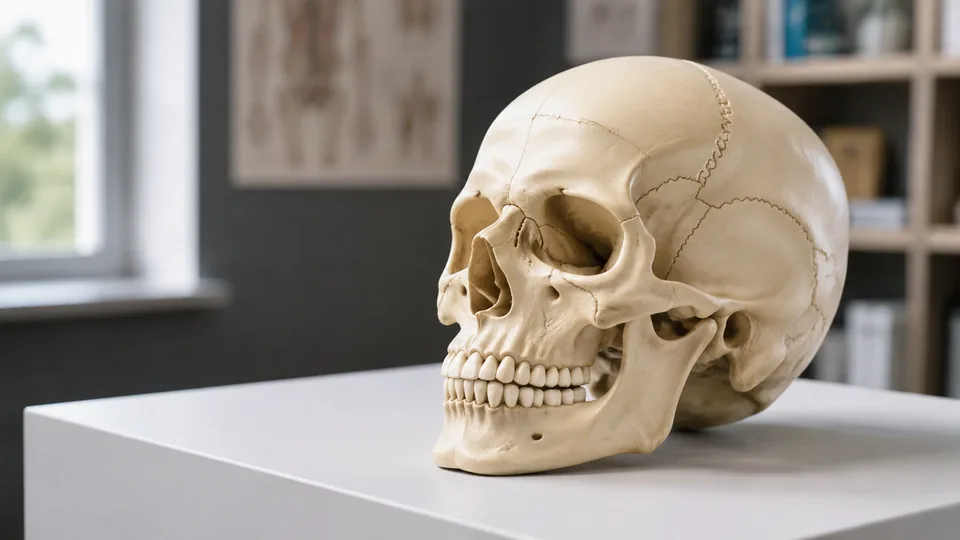
Human skull models may look broadly similar at first glance, but the differences become important once they are used for serious anatomy study. Some emphasize realistic bone contours and sutures, while others add numbered landmarks, color-coded structures, removable calvaria, or articulated mandibles. The right design can make it easier to examine the cranial cavity, trace foramina, compare individual landmarks, and build a clearer three-dimensional understanding of the skull.
The best choice depends heavily on how the model will be used. Life-size proportions are particularly helpful for examining small foramina, fossae, sutures, and other surface landmarks, while compact models trade some of that visibility for easier storage and portability. Students preparing for practical exams may prefer fewer visual cues, whereas numbered or color-coded models can make early-stage identification more efficient. Build quality matters as well, especially around removable calvaria, articulated mandibles, magnets, and other components that will be handled repeatedly.
The Axis Scientific Human Skull Model is the strongest all-around choice here because it combines life-size proportions, labeled internal and external structures, a three-part construction, and a photo-based manual. Still, a medical student cramming at midnight may prefer the study system included with the JENACAD model, while an instructor explaining neuroanatomy may get more mileage from QWORK’s separate eight-part brain.
Quick Answer
Best overall: The Axis Scientific Human Skull Model offers a particularly balanced mix of anatomical detail, removable components, labeling, and reference support. Best for structured student study: The JENACAD 55-Landmark Skull Model pairs visible landmarks with several learning resources. Best skull-and-brain set: The QWORK Skull and Brain Anatomy Model helps connect the bony cranial cavity with major brain divisions.
For a fast side-by-side view, the table below highlights the distinctions that matter most before the deeper reviews.
Best Human Skull Models Comparison Table
| Product | Best For | Size or Scale | Parts and Key Feature |
|---|---|---|---|
| Axis Scientific Human Skull Model | Best overall | Life-size | Three parts, labeled internal and external structures |
| JENACAD 55-Landmark Skull Model | Medical and health-science students | Life-size, approximately 7.5 by 5.5 by 6.5 inches | Three parts, 55 landmarks, painted sutures |
| QWORK Skull and Brain Anatomy Model | Skull and brain relationships | Life-size | 11 parts total, numbered skull and brain |
| 15-Part Color Exploded Skull Model | Individual craniofacial bones | Palm-sized miniature | 15 detachable, color-coded parts |
| Laser-Etched Numbered Skull Model | Long-lasting labels | Life-size | Three parts, permanently etched markings |
| Doctor Verified 55-Landmark Skull Model | Secure repeated handling | Life-size, 1:1 | Three parts, strong magnetic connections |
| Unnumbered Life-Size Skull Model | Active recall and art reference | Approximately 7.5 by 5.5 by 6.5 inches | Three parts, clean unmarked surface |
| Classic Numbered Human Skull Model | Guided anatomy review | Life-size, listed at 9 inches high | Three parts, 54 landmarks, painted sutures |
| Life-Size 3-Part Anatomical Skull Model | Simple, affordable study | Life-size | Three parts, realistic texture, study chart |
The detailed reviews below show how each model fits a different desk, classroom, course, or study routine.
1. Axis Scientific Human Skull Model: Best Overall

The Axis Scientific model earns the top spot through balance rather than a flashy gimmick. Its life-size form separates into the calvarium, skull base, and articulating mandible, giving students direct visual access to structures hidden inside an assembled skull. Imagine turning a dense textbook diagram sideways and finally seeing why one opening sits anterior to another. That three-dimensional context is where a proper model earns its shelf space.
Labels identify key structures on both the exterior and interior, which is useful for osteology, forensic anthropology, classroom demonstrations, and patient education. The full-color manual uses photographs of the actual model, so the contours in the guide correspond with the object in front of you. That detail saves the irritating back-and-forth caused by a generic diagram that never seems to match the angle in your hand.
Pros
- Life-size proportions provide a realistic adult scale reference
- Removable calvarium exposes the internal cranial cavity
- Articulating mandible supports study of jaw relationships
- External and internal anatomical structures are labeled
- Photo-based manual corresponds directly with the model
Cons
- Built-in labels can make unsupported active-recall drills less challenging
- Three-part construction does not separate individual cranial and facial bones
This is the safest choice for a buyer who needs one versatile skull rather than a highly specialized teaching aid. It can sit on a professor’s desk, move through a college lab, or help a student untangle foramina before an exam. Artists seeking a completely clean surface may prefer the unnumbered model, and learners focused on individual bones should look at the exploded design. For broad educational use, however, the Axis Scientific package has few distracting trade-offs.
To buy this product, click here.
2. JENACAD 55-Landmark Skull Model: Best for Students

For students who want a ready-made learning routine, the JENACAD model offers more guidance than a bare replica. Its 55 numbered landmarks work with a printed study card, downloadable guide, and guided study videos. A learner can cover the key, point to a black number, call out the structure, and check the answer. That quick loop feels much more active than staring at a page until every pale ridge blurs together.
Red painted sutures stand out sharply against the bone-colored PVC, helping beginners follow boundaries between cranial bones. The magnetic skullcap and removable, spring-supported mandible expose the cranial base and jaw relationship. At approximately 7.5 by 5.5 by 6.5 inches and about two pounds, it is sized for realistic tabletop study without becoming a bulky lab fixture.
Pros
- Includes 55 numbered landmarks for guided identification
- Red painted sutures make cranial boundaries easy to follow
- Printed and online resources support independent review
- Three-part design exposes the skull base and mandible
- Life-size proportions suit medical, dental, nursing, and A&P study
Cons
- Bright sutures and numbering look less natural than an unmarked replica
- Spring-supported jaw requires gentle handling during repeated demonstrations
A medical or dental student facing weekly spot tests is the clearest buyer for this model. Its visual prompts make early learning less intimidating, while the removable parts still support spatial study as the course becomes harder. A seasoned learner preparing for an unmarked practical might eventually cover the numbers or switch to a plain skull. For a first serious anatomy course, the organized resources can turn scattered study sessions into a repeatable drill.
To buy this product, click here.
3. QWORK Human Skull and Brain Anatomy Model: Best Skull-and-Brain Set

The QWORK set answers a question that a skull alone cannot illustrate clearly: how does the brain occupy the cranial cavity? Its life-size package contains a three-part skull and an eight-component brain, for 11 pieces in total. The brain includes cerebral hemispheres, sagittal sections, cerebellum, and brainstem components, letting an instructor move from the protective bony case to the delicate structures housed within it.
Numbered references cover 55 markers on the skull and 32 on the brain, according to the listing. Picture a classroom demonstration where the calvarium comes away, the brain is lifted out, and the brainstem’s position becomes immediately visible. That sequence has more teaching power than passing around separate models that may use unrelated scales. Robust PVC keeps the set light enough for routine lessons and patient-facing explanations.
Pros
- Combines life-size skull and brain anatomy in one set
- Eleven removable parts support layered demonstrations
- Numbered markers provide guided reference points
- Shows spatial relationships between the brain and cranial cavity
- PVC construction is practical for classrooms and study spaces
Cons
- More pieces require greater care during storage and transport
- Buyers studying osteology alone may not need the added brain components
This set makes the most sense for neuroscience introductions, science classrooms, patient education, or students covering skull and brain anatomy in the same unit. Its many components invite step-by-step demonstrations, though they also create more pieces to track after a busy lab session. For pure bone identification, the Axis Scientific or JENACAD choices are more focused. For connecting cranial landmarks with major brain divisions, QWORK offers the clearest bridge among these nine models.
To buy this product, click here.
4. 15-Part Color Exploded Skull Model: Best for Individual Bones
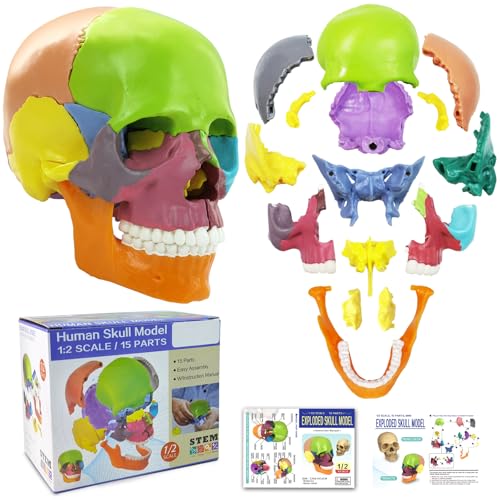
This colorful miniature takes a different route from conventional three-part skulls. Fifteen detachable components represent paired and unpaired bones associated with the face, orbit, nasal cavity, mouth, and skull. Pulling those pieces apart turns vague borders into physical edges. For a learner who repeatedly mixes up the palatine bone and vomer, that tactile separation can make the distinction click.
Color coding makes paired bones easy to recognize, while stable connectors allow the model to be reassembled along simplified sutures. The illustrated guide adds context and review questions. Its palm-sized form slips into a bag or fits beside a laptop, a welcome change for students working at a cramped kitchen table. The trade-off is scale. Tiny openings and subtle contours cannot command a lecture room like a full-size skull.
Pros
- Fifteen detachable pieces isolate important craniofacial bones
- Color coding helps distinguish neighboring and paired structures
- Compact size is convenient for storage and transport
- Reassembly supports tactile, puzzle-like learning
- Illustrated guide provides added study direction
Cons
- Miniature size is less suitable for studying very small landmarks
- Numerous detachable pieces are easier to misplace than a three-part model
Visual and tactile learners may find this little skull surprisingly memorable. It works especially well for identifying bone components and understanding how the face is assembled, almost like an anatomical puzzle with clicks and colorful seams. It is less convincing as a realistic proportion reference, and instructors addressing a room will need something larger. Choose it for bone-by-bone learning, portability, or desk study rather than fine-detail osteology.
To buy this product, click here.
5. Laser-Etched Numbered Anatomical Skull Model: Best Permanent Markings

Labels are useful until handling and cleaning make them faint, crooked, or difficult to read. This upgraded model addresses that concern with laser-etched fonts and numbers rather than handwritten markings. The characters are engraved into the skull surface, giving students a consistent reference during repeated study sessions. In a shared classroom, where the same model may pass through dozens of hands, that permanence has practical appeal.
The life-size PVC skull separates into the familiar calvarium, base, and mandible. An included instruction sheet helps users interpret the engraved references. Its design is particularly sensible for learners who like calling out numbered landmarks while rotating the skull under a desk lamp. The etched characters remain visible, though their presence means the model cannot fully imitate the clean appearance of an unmarked lab specimen.
Pros
- Laser-etched labels resist the fading associated with surface writing
- Uniform fonts make numbered references easier to read
- Life-size format supports realistic spatial study
- Three detachable parts reveal internal and jaw structures
- PVC surface can be cleaned with appropriate gentle care
Cons
- Permanent markings cannot be removed for a completely unprompted practical
- Included study support is less extensive than the JENACAD learning package
Shared labs, tutors, and students expecting frequent handling should put this model high on the list. The etched numbers are its defining advantage, especially where painted or handwritten labels could become less legible over time. Buyers seeking videos, painted sutures, or a broader guided curriculum may prefer JENACAD. Choose this one when durable, tidy labeling matters more than elaborate supplemental materials.
To buy this product, click here.
6. Doctor Verified 55-Landmark Skull Model: Best for Repeated Handling

A loose calvarium can interrupt a demonstration with an awkward clack against the table. This model emphasizes strong embedded magnetic joints and a close-fitting skullcap, making it appealing for study groups and classrooms where parts are removed repeatedly. Its 55 numbered landmarks include features around the skull base, an area where tiny foramina can otherwise turn into a confusing field of holes.
The life-size, three-part PVC design includes a movable mandible with visible dental structure. Students can inspect the calvarium, internal base, and lower jaw from several angles, then reconnect the pieces for a complete profile. Downloadable PDF materials accompany the model, providing a reference when a late-night study partner is unavailable and the numbers need decoding.
Pros
- Strong magnetic connections help keep the skullcap secure
- Fifty-five numbered landmarks support structured study
- Three-part construction provides internal access
- Movable jaw helps illustrate mandibular position and dentition
- Downloadable reference material supports independent review
Cons
- Numbering makes the surface less realistic for art or display use
- It lacks the removable brain components supplied with the QWORK set
This option suits an anatomy lab, tutor, or busy student who expects frequent assembly and disassembly. Secure connections matter when the model travels between a bookshelf, backpack, and study table several times a week. Its numbered format provides quick orientation, though advanced students practicing on plain specimens may prefer the unmarked alternative. It stands out less for novelty than for a sturdy, practical configuration.
To buy this product, click here.
7. Unnumbered Life-Size Anatomical Skull Model: Best for Active Recall and Artists

Numbers can become tiny visual crutches. This life-size model leaves the surface free of printed labels and color coding, forcing the learner to identify bones, sutures, openings, and contours from shape and position. That clean appearance also suits an artist sketching the sweep of the zygomatic arch or checking how the jaw sits beneath the cranium.
The skull measures approximately 7.5 by 5.5 by 6.5 inches and separates into three pieces. A magnetic-and-pin calvarium reveals the cranial cavity, while the spring-connected mandible can open, detach, and be repositioned. A paper manual and online study access provide backup when recall stalls, yet the model itself remains uncluttered. It resembles the challenge students may encounter during an unmarked lab station much more closely than a brightly numbered skull.
Pros
- Unmarked surface encourages genuine active recall
- Clean appearance works well for drawing and visual reference
- Life-size dimensions provide realistic adult proportions
- Removable calvarium exposes the internal skull base
- Movable, detachable mandible supports jaw study
Cons
- Beginners receive no immediate visual prompts on the model
- Students must consult the manual or another reference to verify structures
Choose this model if your professor points to an unlabeled structure and expects an answer on the spot, or if your sketchbook needs a neutral reference without black numerals scattered across the bone surface. Complete beginners may find it frustrating during the first week of osteology. Paired with flashcards or a labeled atlas, however, its lack of prompts becomes a purposeful study feature rather than an omission.
To buy this product, click here.
8. Classic Numbered Human Skull Model: Best Value for Guided Review
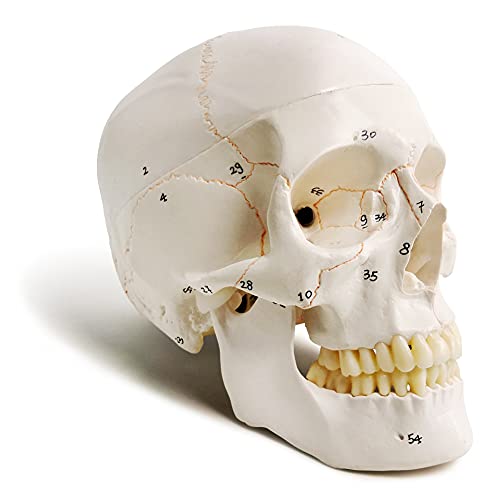
This classic model covers the features many A&P students need without piling on extra components. It has 54 numbered landmarks, painted suture lines, and a corresponding manual and study chart. During a quick review session, the learner can trace a colored seam, locate a nearby number, and check the key without building a complicated setup across the desk.
The listing describes a life-size skull cast from an adult specimen, with a height of nine inches. Its three parts include a removable calvarium, base, and spring-secured articulating mandible. Small magnets hold the cranial cap, helping it remain seated as the model is tilted to inspect inferior structures. The overall package is straightforward, familiar, and suited to students who value visible guidance.
Pros
- Fifty-four numbered landmarks support organized review
- Painted sutures help separate neighboring cranial bones
- Life-size construction provides realistic scale
- Magnetic calvarium and articulating jaw allow internal inspection
- Manual and study chart are included for reference
Cons
- Painted lines and numbers create a less natural-looking surface
- Offers fewer digital learning resources than the JENACAD model
This is a sensible middle-ground pick for introductory anatomy, tutoring, or a home study station. It supplies enough labeling to prevent constant atlas searches, and its removable top exposes structures a fixed display skull would hide. Learners who want permanent engraved text should move toward the laser-etched model. Those seeking a conventional numbered skull with painted boundaries may find this simpler package easier to use.
To buy this product, click here.
9. Life-Size 3-Part Anatomical Skull Model: Best Simple Budget Pick

Some buyers need a functional skull without a rainbow of painted bones, dozens of detachable pieces, or an elaborate digital course. This life-size PVC model keeps the formula simple. It separates into the calvarium, skull base, and mandible, while magnets and small pegs help locate and secure the removable cap. That is enough access for tracing major sutures, reviewing the cranial cavity, and demonstrating jaw position.
The listing highlights a realistic bone texture, clear sutures, and representation of foramina and fossae. A colorful reference chart accompanies the model, providing labels outside the skull rather than covering its entire surface with numbers. On a dorm-room desk or home-school table, that arrangement offers a clean object to inspect alongside a bright, easily scanned guide.
Pros
- Life-size format suits general anatomy study
- Three-part design exposes the cranial cavity and lower jaw
- Magnetic-and-peg cap supports easy removal and replacement
- Visible sutures, foramina, and fossae provide useful reference points
- Color anatomy chart is included for guided learning
Cons
- Lacks numbered landmarks for rapid keyed identification
- Supplemental learning materials are more basic than several higher-ranked options
This model is best for budget-minded students, home educators, artists, or curious learners who want the standard three-part experience. It provides more physical context than a poster and avoids the maintenance of an 11-part or 15-part set. Buyers preparing for demanding medical-school practicals may value clearer numbered landmarks and richer study resources. For foundational visualization and occasional demonstration, its uncluttered simplicity is appealing.
To buy this product, click here.
How to Choose the Best Human Skull Model
Match the Scale to the Lesson
Life-size models are easier to compare with textbook plates, clinical images, and adult anatomical proportions. They also make small foramina, fossae, and sutures easier to point out when two students lean over the same desk. A miniature feels wonderfully portable in a crowded backpack, but an instructor at the front of a bright classroom may find its tiny landmarks disappear from view.
Think about where the skull will live. A full-size model fits a dedicated study shelf or lab bench, while a palm-sized exploded skull works better beside a laptop in a coffee shop. Scale affects visibility and spatial accuracy, so portability should not automatically outrank the level of detail your course demands.
Decide Between Numbered and Unnumbered Models
Numbered models create a fast check-and-correct routine. Point to a mark, name the feature, and consult the key. Painted sutures add another layer of guidance when cranial boundaries still look like hairline cracks in a pale surface. These visual cues are especially useful early in an anatomy course or during a teacher-led demonstration.
An unnumbered skull is tougher and often more realistic for exam preparation. Without black digits whispering clues, the learner must rely on shape, orientation, and neighboring structures. Many students benefit from beginning with a labeled model, then covering the numbers or practicing on a clean replica as the practical approaches.
Look for Useful Removable Components
A removable calvarium provides a view into the cranial cavity and internal skull base. An articulating or detachable mandible helps demonstrate jaw placement, dentition, and the relationship between the lower jaw and temporal region. These two features carry substantial educational value and are worth prioritizing over purely cosmetic details.
More pieces can reveal more anatomy, but they bring a familiar classroom problem: something small rolls beneath a cabinet after cleanup. An exploded skull excels at separating individual bones, while a skull-and-brain set supports layered neuroanatomy lessons. A three-part model remains easier to manage for routine osteology study.
Examine the Labeling Method
Printed and painted markings are clear and common, though frequent handling may influence their long-term appearance. Laser-etched numbers sit within the surface and suit buyers who prioritize lasting legibility. Color coding makes boundaries pop at a glance, yet it creates a less natural reference for artists or advanced practical preparation.
The key or manual matters as much as the marks. A number without a clear corresponding guide is little help at 1 a.m. Photo-based manuals are particularly convenient because the pictured angles resemble the model itself, while downloadable guides are easy to open beside online coursework.
Consider Durability and Connections
PVC is widely used because it is lightweight, moldable, and practical for repeated educational handling. Check how the calvarium attaches. Magnets provide quick access, while locating pegs help align the cap. A secure fit becomes especially valuable when someone rotates the skull to inspect its underside and expects the top to stay put.
Mandibles often use springs or similar connectors, so gentle pressure is sensible during opening and removal. A model passed around a classroom needs more robust connections than one sitting beside an artist’s easel. Storage matters too. Keep detachable pieces together and avoid crushing small projections beneath heavy books.
Choose for the Intended Learner
A first-semester A&P student may benefit from painted sutures, numbers, and a concise chart. Medical and dental students often need deeper skull-base detail, consistent landmarks, and realistic scale. Teachers may prefer larger, highly visible features, while artists usually value an unmarked surface, natural contours, and a movable jaw.
Picture the actual study session rather than choosing the model with the longest feature list. Will you quiz yourself from numbers, demonstrate the brain inside the cranium, dismantle facial bones, or sketch three-quarter views under warm desk light? The answer quickly narrows these nine options to the model that will genuinely be used.
Best Human Skull Models FAQ
Is a Life-Size Skull Model Better Than a Miniature?
A life-size model is generally better for examining small landmarks, studying adult proportions, and demonstrating anatomy to another person. A miniature is easier to carry and store. Compact models work particularly well when their purpose is separating color-coded bones rather than reproducing every subtle landmark at full scale.
Should Anatomy Students Choose a Numbered Skull?
Numbering is helpful for beginners and guided self-quizzing because each mark corresponds with a key. Advanced students preparing for an unmarked practical may prefer a plain model. A useful compromise is to begin with numbered guidance, then cover the marks during recall practice.
What Are the Three Removable Parts on a Typical Skull Model?
Most three-part models divide into the calvarium, skull base, and mandible. Removing the calvarium opens the cranial cavity, while detaching or moving the mandible provides a clearer view of the jaw and lower facial structures.
Are Painted Sutures Useful?
Painted sutures make boundaries between cranial bones easier to trace, especially from several feet away or during early study. They are less realistic than natural-looking molded sutures, so artists and students simulating an unmarked practical may prefer a model without painted lines.
Can a Human Skull Model Replace a Course or Cadaver Lab?
No. A model is an educational visualization tool that supports textbooks, lectures, laboratory instruction, and qualified teaching. It simplifies certain structures and cannot reproduce all biological variation or the texture of real anatomy. Its strength lies in repeatable, low-pressure study from many angles.
Is a Skull-and-Brain Model Worth Buying?
It can be worthwhile for neuroscience, psychology, patient education, or courses covering the brain and skull together. The removable brain helps show how major divisions sit within the cranium. For a course focused strictly on osteology, a detailed skull alone is usually more efficient.
How Should an Anatomical Skull Model Be Cleaned?
Follow the manufacturer’s care instructions first. For many PVC models, a soft cloth and gentle surface cleaning are safer than harsh chemicals or abrasive scrubbing. Take extra care around painted labels, fine projections, springs, magnets, and removable connectors.
Which Skull Model Is Best for Drawing?
An unnumbered life-size model is usually the strongest drawing reference because it preserves clean contours without distracting labels or painted seams. A movable mandible adds pose variety, and a removable calvarium can help with studies of internal form. Miniatures remain handy for travel sketches but provide less fine detail.
Final Verdict
Among these nine human skull models, the Axis Scientific Human Skull Model is the strongest overall recommendation. Its life-size scale, removable calvarium, articulating mandible, internal and external labels, and model-specific photo manual create a balanced package for students, instructors, and educational demonstrations. It has enough guidance to be approachable without turning into a sprawling box of loose parts.
Different study goals point toward meaningful alternatives. The JENACAD 55-Landmark Skull Model is especially compelling for students who want numbers, painted sutures, and a structured group of study resources. The QWORK Skull and Brain Anatomy Model is the better fit for connecting neuroanatomy with the cranial cavity, while the Unnumbered Life-Size Skull Model suits active recall and art reference. Before choosing, match the scale, labeling style, removable components, and included guide to the way you actually learn. The best model is the one you will rotate, dismantle, quiz from, and reach for long after the first bright page of the anatomy atlas starts to feel familiar.
