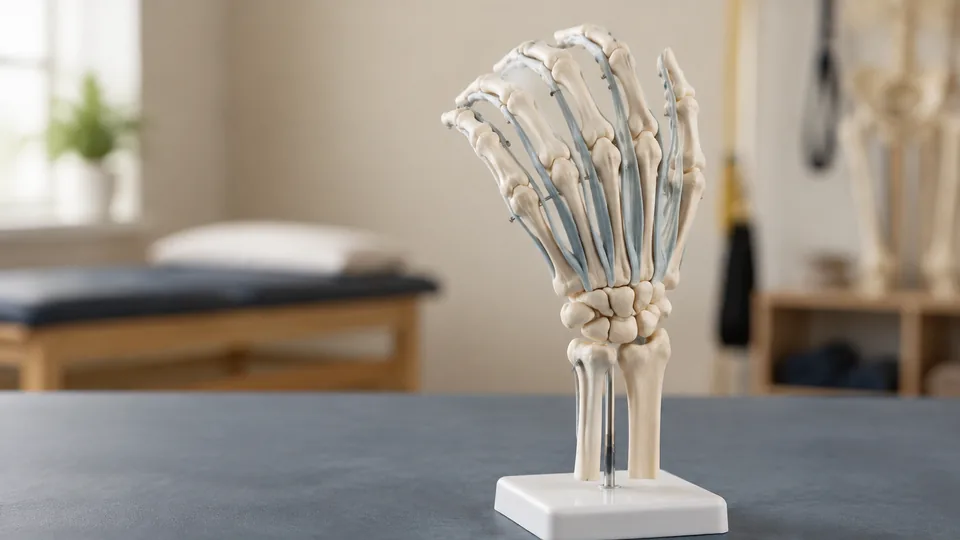
The hand looks simple until a student tries to trace a tendon through the wrist or explain how tightly packed carpal bones relate to the metacarpals. Suddenly, a crisp textbook illustration feels frustratingly flat. Hand anatomy models turn those crowded structures into something learners can rotate, separate, point to, and discuss around a desk or treatment-room table.
The models here serve rather different purposes. Detailed seven-part replicas expose muscles, ligaments, nerves, vessels, and deeper layers, while articulated skeletons focus on bones and joint movement. Artist mannequins prioritize gesture and proportion instead of internal anatomy. Scale, removable components, labeling, articulation, mounting, and the intended learning environment should guide the decision.
A common mistake is buying the most elaborate model without considering how it will be used. A medical student may value numbered landmarks and removable layers, while an art student needs fingers that hold a convincing pose. For broad anatomical study, the magnetic seven-part Medical Anatomical Hand Model is the strongest overall choice because it combines life-size structures, layered disassembly, and convenient mounting.
Quick Answer
Best overall: The Medical Anatomical Hand Model offers deep and superficial anatomy in seven magnetically mounted parts. The EVOTECH SCIENTIFIC Hand Skeleton Model is the better value for studying bones, movement, and painted muscle attachments. Artists should look toward the Posable Hand Mannequin, while the six-model joint set suits classrooms covering biomechanics beyond the hand.
For a quick side-by-side view, the table shows how the nine picks differ before the detailed reviews begin.
Best Hand Anatomy Models Comparison Table
| Product | Best For | Model Type | Key Feature |
|---|---|---|---|
| Medical Anatomical Hand Model | Detailed layered study | Life-size, seven-part hand | Magnetic removable parts |
| EVOTECH SCIENTIFIC Hand Skeleton | Value and muscle attachments | Articulated skeletal hand | Painted origins and insertions |
| Numbered Hand Skeleton Model | Numbered anatomical study | Seven-piece detailed hand | Bones, muscles, ligaments, nerves, and vessels |
| Axis Scientific Hand Model | Premium handheld learning | Seven-part anatomical hand | Removable layers and photo manual |
| LVCHEN Hand Skeleton Model | Basic classroom display | Life-size articulated skeleton | Flexible fingers and display base |
| Faruijie Hand Skeleton Model | Portable bone study | Life-size right-hand skeleton | Wire-connected joints |
| Posable Hand Mannequin | Artists and animators | Articulated surface-form model | Adjustable fingers and 360-degree stand |
| Six-Piece Joint Anatomy Set | Whole-body joint teaching | Six life-size joint models | Hand plus five major joints |
| Falling in Art Wooden Hand | Budget drawing reference | 10-inch wooden mannequin | Adjustable joints and anti-slip base |
The full reviews below explain where each model shines and which limitations matter during real study, teaching, or drawing sessions.
1. Medical Anatomical Hand Model: Best Overall

Peeling back anatomical layers is where this model earns its top ranking. Its seven removable components reveal superficial and deep muscles alongside tendons, ligaments, bones, nerves, and blood vessels. The superficial and deep palmar arterial arches are represented, and nearly 100 numbered landmarks support structured study rather than vague visual browsing. That depth is valuable when a learner needs to understand what sits above, below, or beside another structure.
Magnets hold the removable parts in place, making repeated disassembly far less fiddly than a model that relies on tiny hooks or tight friction fittings. Picture an instructor removing a layer during a demonstration, passing the model around, then returning it to the wooden base. That workflow feels natural and keeps the lesson moving. Hand-painted PVC gives the model its colorful, information-dense appearance, while the included full-color manual helps decode the numbered markings.
Pros
- Seven removable parts expose superficial and deep anatomy
- Strong magnetic connections simplify assembly
- Represents muscles, vessels, nerves, tendons, ligaments, and bones
- Nearly 100 numbered landmarks support guided identification
- Includes a wooden display base and full-color manual
Cons
- Dense detail may exceed the needs of introductory bone study
- Layered construction is less focused on demonstrating free finger movement
This is the most balanced pick for medical students, anatomy instructors, rehabilitation educators, and offices that want a clear patient-education prop. Buyers needing a simple skeleton can spend less and avoid visual clutter. Those studying spatial relationships across multiple tissue systems, however, will gain much more from removable layers than from a bare articulated hand.
To buy this product, click here.
2. EVOTECH SCIENTIFIC Hand Skeleton Model: Best Value

Painted muscle origins and insertions make this EVOTECH model more informative than a plain bone-white skeleton. Colored attachment areas help connect two ideas students often study separately: where a muscle attaches and how that attachment contributes to hand movement. The model includes the complete right hand plus lower portions of the radius and ulna, providing useful wrist context rather than ending abruptly at the carpals.
Stainless wire connects the articulated bones and allows limited movement through the hand. During a small-group lesson, a student can bend a finger, follow the phalanges back toward a metacarpal, and then identify the crowded carpal region without juggling loose pieces. The life-size PVC construction sits on an ABS base, so it works equally well beside a laptop during revision or at the front of a small classroom. A detailed guide adds welcome direction for beginners.
Pros
- Painted muscle origins and insertions add functional context
- Life-size hand includes portions of the radius and ulna
- Wire articulation permits movement demonstrations
- Mounted base keeps the model ready for display
- Instruction guide supports independent study
Cons
- Does not show layered nerves, vessels, and muscles like seven-part models
- Wire articulation provides limited rather than fully natural motion
Students concentrating on osteology, wrist orientation, and muscle attachment sites should find this a sensible middle ground. It delivers more teaching information than an unmarked skeleton without the complexity of a dissectible hand. Learners who need to trace nerves or vascular pathways should move up to one of the detailed seven-part choices.
To buy this product, click here.
3. Numbered Hand Skeleton Model: Best for Labeled Study

Numbered structures can turn a colorful model into a practical revision station. This seven-piece hand presents bones, muscles, ligaments, nerves, and arteries, giving learners several anatomical systems within one compact object. Rather than staring at a tangled patch of red, yellow, and white structures, students can use the markings to identify landmarks methodically and quiz themselves before checking a reference.
The removable construction also reveals relationships that become muddy in two-dimensional illustrations. An instructor discussing a common hand injury can lift away a superficial component and point toward the deeper anatomy, making the explanation easier to follow across a crowded table. Realistic textures and hand-applied coloring add visual separation, while the model’s broad educational focus suits medical classrooms, healthcare training, and patient-facing demonstrations.
Pros
- Seven-piece construction supports layer-by-layer exploration
- Numbered anatomy is useful for identification exercises
- Shows bones, muscles, ligaments, nerves, and arteries
- Suitable for classroom and patient-education demonstrations
- Detailed coloring separates closely packed structures
Cons
- Numerous structures may feel visually busy for early learners
- The supplied information does not emphasize highly flexible articulation
This model fits learners who remember anatomy by locating numbered structures and physically removing components. It is especially useful during study sessions where one person calls out a landmark and another finds it. Buyers mainly interested in skeletal motion will get clearer value from an articulated hand, while those wanting a comparable layered model with magnetic mounting should favor the top pick.
To buy this product, click here.
4. Axis Scientific Anatomy Model of the Hand: Best Premium Handheld Model

Some lessons work better with a model passed from person to person, and the Axis Scientific hand is built around that close-up style. Seven removable parts expose bones, muscles, ligaments, nerves, and arteries. A student can hold the piece near eye level, turn it toward the light, and examine internal relationships from angles that a fixed display model may make awkward.
The full-color manual uses photographs of the actual model, which is a thoughtful touch for matching numbered or colored structures to the physical object. Hand-painted details give instructors plenty to discuss during anatomy and physiology lessons. There is no stand, so the experience feels more like handling a study object than admiring a display piece. That distinction can be terrific in a seminar and less convenient on a busy office shelf.
Pros
- Seven removable parts provide access to internal structures
- Represents skeletal, muscular, ligamentous, nervous, and vascular anatomy
- Handheld design encourages close inspection from multiple angles
- Hand-painted construction provides strong visual differentiation
- Full-color manual uses photographs of the model
Cons
- No display stand is included
- Greater detail may be unnecessary for basic bone identification
Choose the Axis Scientific model for advanced coursework, interactive instruction, or curriculum development where a clear reference manual matters. Its handheld format encourages focused inspection around a study table. A clinic seeking a model that remains upright between conversations may prefer a mounted alternative, while beginners can save space and money with a simpler skeleton.
To buy this product, click here.
5. LVCHEN Human Skeleton Hand Model: Best Basic Classroom Display
For a clean introduction to hand bones, the LVCHEN model skips the colorful layers and puts the skeleton front and center. Its life-size PVC structure includes eight carpal bones, five metacarpals, and fourteen phalanges, along with the wrist and lower forearm context. That uncluttered layout helps a beginner see the shift from the compact carpal cluster to the long metacarpals and segmented fingers.
Slightly flexible wire allows the articulated fingers to move, opening the door to straightforward demonstrations of flexion and positioning. Imagine a teacher asking students to identify each bone as a finger curls toward the palm. The lesson stays concrete and visible. A sturdy display base keeps the model upright, which is useful in classrooms, offices, and home study areas where a loose skeletal hand might otherwise end up rattling around in a drawer.
Pros
- Life-size format makes major bones easy to identify
- Includes all eight carpals, five metacarpals, and fourteen phalanges
- Flexible wire permits basic finger positioning
- Mounted base supports clear desktop display
- Simple skeletal presentation reduces visual clutter
Cons
- Does not include muscles, ligaments, nerves, or blood vessels
- Wire-connected joints cannot reproduce the full range of living-hand motion
This is a practical choice for introductory anatomy, science classrooms, and basic patient education centered on bones. Its simplicity is the attraction. Students studying tendon paths, muscle layers, or neurovascular anatomy will outgrow it quickly, but learners who need a stable visual map of the wrist and fingers may find a complex dissectible model unnecessarily distracting.
To buy this product, click here.
6. Faruijie Hand Skeleton Model: Best Portable Skeletal Model

The Faruijie model targets learners who want a straightforward right-hand skeleton that can move between a dorm desk, lab table, and classroom. It is life size and includes the wrist, radius, and ulna along with the eight carpals, five metacarpals, and fourteen phalanges. Those lower forearm sections provide useful orientation when tracing how the hand meets the wrist.
Stainless-steel wire fixes the joints together while permitting limited flexibility. This is enough for repositioning and basic demonstrations, although it should be viewed as an articulated skeletal reference rather than a realistic motion simulator. The lightweight plastic base keeps the footprint manageable. During a late-night study session, the model can sit beside labeled notes without swallowing the entire desk, a small convenience that matters in cramped spaces.
Pros
- Life-size right-hand skeleton supports direct visual comparison
- Shows the wrist plus portions of the radius and ulna
- Stainless-steel wire provides limited articulation
- Lightweight stand makes the model easy to relocate
- PVC construction is suited to repeated educational handling
Cons
- Provides no painted muscle attachment markings
- Limited flexibility is less suitable for nuanced movement study
This model makes sense for students who need portable bone anatomy without added tissue systems or dense labels. Compared with the EVOTECH skeleton, it lacks painted origins and insertions, so its educational scope is narrower. That simpler surface can still be preferable for memorizing bones, especially when colored markings would pull attention away from skeletal landmarks.
To buy this product, click here.
7. Posable Hand Mannequin for Drawing: Best for Artists
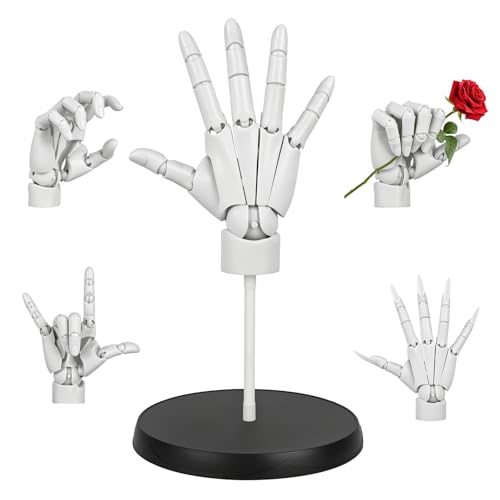
Hands are famously tricky to draw. One crooked finger can make an otherwise polished character look oddly rubbery, and photographs rarely offer the exact angle an illustrator needs. This right-hand mannequin addresses that problem with adjustable finger joints that can form a wide range of gestures. Artists can set a pose, rotate the stand, and watch how silhouettes and shadows change from one viewpoint to another.
The white PVC surface keeps visual distractions low, which is useful for studying proportion, foreshortening, and light. A round base and pole hold the mannequin upright for 360-degree viewing, making it practical beside a sketchbook or animation workstation. It can also serve as a jewelry display or photography prop. Its surface form is the point, though. There are no exposed bones, tendons, nerves, or labeled internal landmarks for medical anatomy study.
Pros
- Adjustable finger joints support varied drawing poses
- Plain white surface makes light and shadow easy to observe
- Included stand permits 360-degree viewing
- Useful for illustration, animation, painting, and photography
- Can double as a jewelry or desktop display
Cons
- Does not display internal anatomical structures
- Better for visual gesture study than precise joint biomechanics
Illustrators, anime artists, animators, and art students are the clear audience. For them, a removable muscle layer adds little compared with fingers that hold expressive poses under a desk lamp. Medical and therapy students should skip it because the smooth exterior omits the structures their courses require. As an artistic reference, however, it fills a role the skeletal models cannot.
To buy this product, click here.
8. Six-Piece Human Joint Anatomy Model Set: Best for Joint Comparison

A hand does not exist in isolation during a biomechanics course, and this collection widens the lesson considerably. It includes life-size models of the hand, foot, shoulder, elbow, hip, and knee joints. Connected ligaments and articulated movement help students compare how very different joint structures bend, rotate, and stabilize, all within one teaching set.
That range is useful in a lab where one group studies the hand while another examines the knee or shoulder. Later, the class can place the models side by side and discuss why movement differs across each region. PVC construction keeps the pieces lightweight enough for repeated handling. The trade-off is focus: the hand is one component among six, so buyers seeking fine hand musculature, nerves, or vascular pathways should choose a dedicated layered model.
Pros
- Includes hand, foot, shoulder, elbow, hip, and knee models
- Life-size joints support visible classroom demonstrations
- Connected ligaments clarify skeletal relationships
- Articulation helps illustrate bending and rotation
- Broad coverage suits anatomy and biomechanics courses
Cons
- The hand receives less anatomical depth than a dedicated model
- Six separate pieces require more storage and display space
Teachers, physiotherapy programs, nursing classrooms, and students covering multiple major joints will gain the most value from this set. It is a broader teaching purchase rather than the strongest hand-specific reference. For a learner facing an exam devoted entirely to hand muscles and neurovascular structures, the top seven-part choices are much more targeted.
To buy this product, click here.
9. Falling in Art 10-Inch Right Wooden Hand Model: Best Budget Drawing Model

The familiar wooden studio hand has a certain charm. It sits quietly beside pencils and charcoal, then twists into a pointing gesture or loose fist whenever an artist needs a reference. Falling in Art’s right-hand model measures 10 inches and uses segmented fingers, knuckles, and an adjustable wrist to create a variety of poses for sketching.
Hardwood construction gives the mannequin a warm, classic look, while the anti-slip base helps keep it planted as the pose is adjusted. It also works for displaying rings or adding an art-studio accent to a shelf. Compared with the white PVC artist mannequin, its simplified wooden segments make the mechanical structure more visible. That can help with basic proportions, but it does not reproduce the smooth contours of skin.
Pros
- Adjustable fingers and wrist support multiple drawing poses
- Ten-inch size fits easily on a desk or shelf
- Hardwood construction offers a traditional studio appearance
- Anti-slip base improves stability during reference work
- Useful for sketching, decoration, and jewelry display
Cons
- Segmented wooden forms simplify natural hand contours
- No internal anatomical structures or educational labels are shown
Beginning artists and casual sketchers who want an accessible pose reference should appreciate this model’s simplicity. It is also an appealing gift for someone assembling a first studio workspace. Serious medical study calls for a skeletal or layered replica, while illustrators seeking more lifelike surface form may prefer the articulated white mannequin above.
To buy this product, click here.
How to Choose a Hand Anatomy Model
Match the Model to the Learning Goal
Start with the task sitting in front of you. A student memorizing carpals, metacarpals, and phalanges needs a clean skeletal model that makes each bone visible. Someone studying muscle layers, arterial pathways, or nerves requires a detailed hand with removable components. An illustrator wrestling with a foreshortened pointing pose needs adjustable fingers and clear external proportions instead. Buying across those categories can leave a gorgeous model gathering dust.
The learning environment matters too. During individual revision, a handheld model can be rotated inches from the learner’s eyes. In a classroom, a mounted life-size hand stays upright as several students gather around it. A clinic or teaching office may favor clear coloring and a stable base so a structure can be indicated quickly during an explanation.
Decide How Much Anatomical Detail Is Useful
More detail creates richer study opportunities, but it also creates visual noise. Seven-part models can show superficial and deep muscles, ligaments, nerves, vessels, and bones in a dense patchwork of colors. That is excellent for advanced coursework. A new learner trying to identify the scaphoid may prefer the quiet clarity of a plain skeleton, where every edge is easy to follow.
Painted muscle origins and insertions offer a useful compromise. They preserve the shape of a skeletal hand while showing where muscles attach. This is especially handy during a lesson that links bone landmarks with movement, and it avoids the extra assembly involved with removable muscle pieces.
Compare Removable Parts With Articulation
Removable and articulated are different features. Removable components reveal deeper structures, much like lifting layers during a dissection demonstration. Articulation allows bones or external fingers to change position. A model may excel at one and offer little of the other, so the listing should be read with the intended lesson in mind.
Magnetic pieces are convenient for frequent layer-by-layer study because they lift away and return with a satisfying, simple connection. Hooked, wired, or tightly fitted components can still be educational, but they may demand more careful handling. Wire-connected skeletons usually provide limited movement rather than a faithful recreation of living joint mechanics.
Look at Numbering, Color Coding, and Reference Materials
Numbered landmarks are especially helpful during self-quizzing. Cover the manual, identify a structure, then check the key. In a study group, one person can call a number while another names the anatomy. Clear color coding also separates nerves, vessels, muscles, and connective tissues that would otherwise blend into a confusing cluster.
A strong manual makes a detailed model easier to use. Photographs of the actual model can be more intuitive than a plain numbered list because the viewing angle and painted structures match what is on the desk. Beginners should weigh the supporting material almost as carefully as the number of visible structures.
Consider the Stand and Storage
A stand seems mundane until a model tips over for the fifth time during a lecture. Broad bases work well for permanent display, while detachable models are easier to hold close and rotate. Wooden bases often look polished in an office, whereas lightweight plastic stands are convenient for students moving between rooms.
Storage becomes a bigger issue with sets and removable parts. A six-joint collection needs considerably more shelf or cabinet space than a single hand. Small detachable structures should also have a consistent storage spot, particularly in a shared classroom where pieces can wander after a busy practical session.
Balance Durability With Fine Detail
PVC is common because it can be shaped, painted, and handled repeatedly. Fine nerves, vessels, and ligament details still deserve care, regardless of the base material. A simple wired skeleton has fewer delicate surface structures, making it easier to transport, while a richly layered model rewards gentler handling.
Artists face a related trade-off. Tighter joints help a mannequin hold a dramatic pose, yet repeated forceful adjustment may strain articulated connections. Reposition fingers deliberately, support the joints during movement, and keep the model away from the edge of a crowded desk.
Best Hand Anatomy Models FAQ
What Is the Best Type of Hand Model for Medical Students?
A seven-part model showing bones, muscles, ligaments, nerves, and vessels provides the broadest anatomical reference. Removable layers help explain spatial relationships that are hard to interpret in flat diagrams. Students focused on osteology may prefer a life-size articulated skeleton with clear wrist and forearm context.
Are Hand Anatomy Models Life Size?
Many medical hand models are described as life size, including several skeletal and layered options in this guide. Artist mannequins can follow different dimensions, such as the 10-inch wooden model. Check the listing’s stated scale or measurements if direct comparison with a real hand is central to the lesson.
What Is the Difference Between a Skeletal and Layered Hand Model?
A skeletal model emphasizes the carpals, metacarpals, phalanges, wrist, and joint positioning. A layered model adds structures such as muscles, tendons, ligaments, nerves, and blood vessels. Skeletal models tend to look cleaner, while layered replicas offer greater depth for advanced anatomical study.
Do Art Mannequin Hands Work for Medical Anatomy?
They can help with external proportion, gesture, finger placement, and basic pose observation. They do not expose or label internal bones, muscles, nerves, ligaments, or vessels, so they are poor substitutes for medical anatomy models. Their strongest role is drawing, animation, photography, and display.
Are Articulated Skeleton Hands Fully Flexible?
Usually not. Wire-connected models commonly offer limited flexibility for positioning and basic movement demonstrations. They cannot reproduce every natural joint action or the resistance supplied by living tissues. Treat articulation as a visualization feature rather than a precise simulator of hand biomechanics.
Are Removable Parts Better Than a Fixed Model?
Removable parts are better for tracing anatomical layers and studying structures hidden below the surface. Fixed models are quicker to handle, harder to misplace, and often clearer for introductory lessons. The right format depends on whether the priority is internal depth or immediate simplicity.
Which Features Help With Self-Study?
Numbered landmarks, clear color coding, a detailed manual, and a stable stand are especially useful. These features support quick identification drills without requiring another person to guide the session. A manual featuring photographs of the physical model can make matching complex structures easier.
Final Verdict
Among these nine hand anatomy models, the Medical Anatomical Hand Model is the strongest overall option. Its seven magnetic parts, life-size format, nearly 100 numbered landmarks, and representation of deep and superficial structures create a useful bridge between textbook learning and three-dimensional study. It has enough depth for serious coursework while remaining practical to disassemble and return to its wooden stand.
The EVOTECH SCIENTIFIC Hand Skeleton offers better value for bone anatomy, articulation, and painted muscle attachment sites. For premium handheld study, the Axis Scientific model brings seven removable parts and a photo-based manual. Artists should ignore the medical complexity and choose the Posable Hand Mannequin or Falling in Art wooden hand according to the surface style they prefer. Match the model to the actual lesson, then check its articulation, removable layers, labeling, stand, and storage needs before making the final choice.
