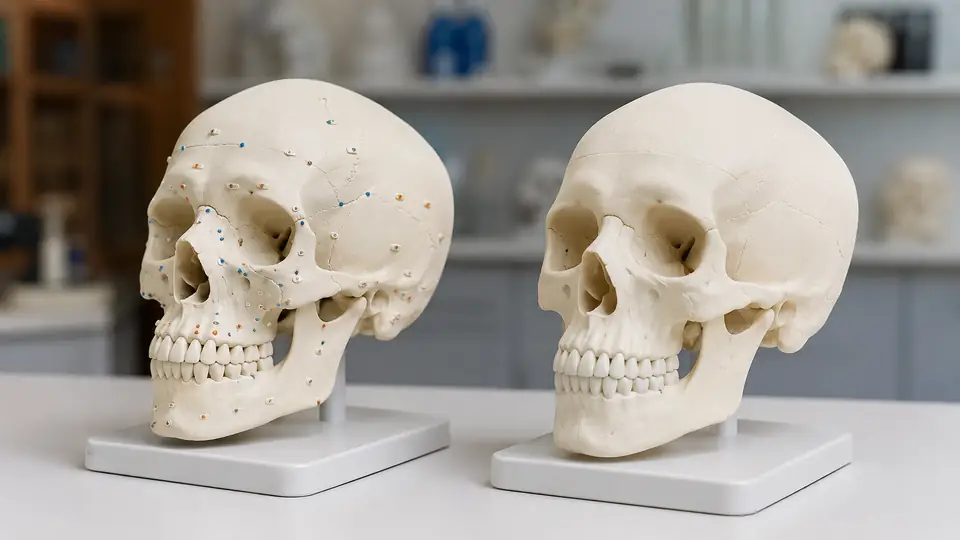
Two skull models may show the same bones, sutures, foramina, and landmarks, yet feel completely different during study. One has small numbers scattered across the cranium, while the other presents a clean surface with no visual prompts. That is the central distinction behind numbered vs unnumbered skull models: numbered models support guided identification, while unnumbered models are better suited to recall, labeling practice, and uncluttered demonstration.
The difference is not usually about anatomical accuracy or model quality. It is primarily about how information is displayed. A numbered skull may include a printed reference sheet or matching key, but numbering systems are not universal. The same number can identify different structures on models from different manufacturers, so the accompanying key matters as much as the markings themselves.
What Numbered and Unnumbered Skull Models Mean
Numbered Skull Models
A numbered skull model has labels represented by numerals placed near anatomical structures. Depending on the design, a number might identify a bone such as the frontal bone, a feature such as the mastoid process, or an opening such as the foramen magnum. The printed marking may appear on the bone itself, on a nearby base, or on a removable label system, so the exact format varies.
Most numbered models are intended to be used with a legend, chart, or identification guide. A learner sees “17” near a small opening, checks the key, and connects that location with the correct term. In a classroom, an instructor might point to several numbers while discussing cranial bones, facial bones, or foramina, giving everyone the same visual reference before the detailed questioning begins.
Numbering is especially useful when a structure is difficult to name from shape alone. The pterion, for example, is a region where several skull bones meet, while the optic canal is a passage through the sphenoid bone. A number can direct attention to a precise landmark without covering the model in long printed words.
Unnumbered Skull Models
An unnumbered skull model has no visible identification numbers or printed labels on its main surfaces. It may still include removable parts, color coding, a stand, or a separate teaching guide, but the skull itself remains visually open. Sutures, contours, foramina, processes, and bone boundaries are left for the learner to identify.
That clean appearance changes the task. Instead of matching “12” to a reference list, a student must look at the model and retrieve a name such as the zygomatic bone, mandibular fossa, or external acoustic meatus. During a study session, the absence of prompts can make a familiar-looking skull suddenly feel less forgiving, which is exactly why unnumbered models are often useful for self-testing.
| Feature | Numbered Skull Model | Unnumbered Skull Model |
|---|---|---|
| Visible prompts | Numerals direct attention to selected structures | No printed prompts on the main model |
| Reference material | Usually requires a matching key or legend | May be used with an atlas, textbook, or instructor-created labels |
| Best initial use | Guided identification and classroom explanation | Independent recall and practical-style questioning |
| Visual appearance | More instructional markings on the surface | Cleaner view of the skull’s form and landmarks |
| Main limitation | Numbers can become recognition cues rather than true recall | Can be challenging without prior instruction or a reliable reference |
How the Difference Changes Anatomy Study
Numbered models reduce the first layer of uncertainty. A student who is learning the cranial bones can locate a number, consult the key, and compare the listed name with the visible borders and shape. This is helpful when the skull is new, when several structures are crowded together, or when a teacher is introducing terms such as the temporal bone, ethmoid bone, or inferior nasal concha.
Consider a small study group examining the base of the skull. Without labels, the jugular foramen, hypoglossal canal, and foramen magnum can seem like a cluster of dark openings with few obvious clues. A numbered model gives the group a starting point, allowing them to identify one opening at a time and then discuss its position relative to nearby bones. The numbers act like signposts, not complete explanations.
That distinction matters because a number does not describe what a structure is, what passes through it, or how it relates to surrounding anatomy. Once a learner has identified the foramen magnum, for instance, further study is still needed to understand its location in the occipital bone and its relationship to the cranial cavity and vertebral canal. Numbered models support orientation, but they do not replace anatomical reasoning.
Unnumbered models place more responsibility on the learner. A student might rotate the skull, find the broad temporal squama, trace the coronal suture toward the pterion, and then name the structures without seeing a cue. That process can reveal whether the learner knows the anatomy or has simply memorized a position on a chart.
The same challenge appears during a practical review session. An instructor can point to the zygomatic arch or mandibular condyle, and the student must identify it from location, shape, and neighboring structures rather than from a printed code. The model becomes a prompt for retrieval, while an atlas or answer key can confirm the response afterward.
When a Numbered Skull Model Is Most Useful
Numbered models are well suited to initial orientation. They help learners build a vocabulary for the visible skull before they are expected to identify every ridge and opening independently. A first-year student studying the facial skeleton may use the numbers to distinguish the maxilla, mandible, nasal bone, lacrimal bone, and vomer while comparing the model with a textbook illustration.
They are also useful for group instruction. In a lecture or laboratory, “look at number 8” is more precise than describing a tiny opening by hand. Everyone can focus on the same area, even when the instructor is standing several feet away and the model is mounted on a demonstration stand.
A numbered model can support a gradual study sequence:
- Read the structure name in the reference key.
- Find the corresponding number on the skull.
- Trace the structure’s borders and neighboring landmarks.
- Cover the key and explain the location aloud.
- Test recall later with an unnumbered image, diagram, or model.
This progression prevents the reference sheet from becoming a permanent crutch. A learner who only says “number 8” has recognized a code, not necessarily mastered the anatomy, so the next step should always involve naming the structure and describing where it sits.
When an Unnumbered Skull Model Is More Effective
Unnumbered models are particularly valuable for active recall. The learner must retrieve information from memory, inspect the three-dimensional shape, and use orientation terms such as superior, inferior, medial, lateral, anterior, and posterior. That combination is closer to the challenge of identifying a structure when no printed clue is available.
They also show the skull’s visual form without interruptions. A clean calvaria makes the curves of the frontal, parietal, and occipital bones easier to appreciate, while an unmarked facial skeleton allows the margins of the orbit, nasal aperture, and zygomatic arch to remain visually distinct. For an instructor demonstrating overall skull architecture, fewer surface markings may keep attention on shape and relationships.
Imagine a learner preparing for a practical examination. The numbered model helped during the first week, but after several review sessions the student switches to an unnumbered skull and covers selected structures with small removable tabs. The exercise becomes more demanding when the model is rotated or viewed from below, and that variation exposes weak spots that a fixed frontal view might hide.
Unnumbered models can also support peer questioning. One student chooses a landmark such as the mastoid process, points to it without saying the name, and asks the other person to identify it and describe its location. Another round can focus on function or relationships, such as identifying the mandibular fossa and explaining its connection with the temporomandibular joint. The model remains the same, but the questions become richer.
Numbered Does Not Mean Fully Labeled
The word “numbered” can sound more comprehensive than it really is. A skull may have numerals for major bones only, or it may include a much broader selection of sutures, foramina, processes, and canals. The number of labels, their size, and their placement depend on the model’s design.
For example, one numbered skull might identify the frontal bone but omit the supraorbital foramen. Another might mark the foramen lacerum, optic canal, and superior orbital fissure while leaving smaller facial landmarks unlabeled. The accompanying key should therefore be reviewed before assuming that a particular structure is included.
Number placement can also affect visibility. A numeral printed directly beside a small foramen may help the learner find it, but a mark placed over a suture can obscure the boundary being studied. Raised labels, painted symbols, stickers, and printed graphics each have different effects on durability and visual clarity. These construction details are worth separating from the broader numbered-versus-unnumbered distinction.
Features That Matter Beyond the Numbering
Numbering is only one characteristic of a skull model. A model may be numbered and still differ substantially from another in its construction, scale, and removable components. Before interpreting the labels, check whether the skull includes a removable calvaria, detachable mandible, cutaway sections, separate teeth, or a brain cavity that can be viewed from different angles.
Articulation is another important term. On a skull model, an articulated mandible may open and close or move at the temporomandibular joints, depending on the design. That movement can help demonstrate the relationship between the mandible, temporal bone, mandibular fossa, and articular tubercle, but it does not automatically make a model better for memorizing cranial foramina.
Scale affects the experience as well. An enlarged skull may make small openings and thin processes easier to inspect, while a life-size model may provide a more familiar sense of proportion. A large model on a laboratory table and a compact model in a backpack serve different practical purposes, regardless of whether either one carries numbers.
Color coding should not be confused with numbering. Some models use different colors to separate bones, while others use a single color and rely on natural contours. A colored, numbered model may provide several visual cues at once, whereas an unnumbered, monochrome model may offer a quieter surface for identification practice. Neither approach communicates every anatomical relationship by itself.
A Practical Study Routine for Either Model
The most productive approach is often to use the two formats at different stages rather than treating them as rivals. Start with the numbered model or its reference guide to establish terminology. Then close the key and describe each structure from memory, using its position and neighboring landmarks as evidence.
Next, move to an unnumbered model or cover the numerals temporarily with removable, non-damaging markers. Ask questions that require more than a name: Which bone forms this boundary? What lies medial to it? Is the structure on the internal or external surface? Does the feature belong to the neurocranium or viscerocranium?
A student studying the orbit might begin by identifying the frontal, sphenoid, zygomatic, maxillary, lacrimal, ethmoid, and palatine contributions with a reference key. Later, the same student can trace the orbital margins on an unnumbered model and identify the superior orbital fissure, optic canal, and inferior orbital fissure without prompts. The progression moves from recognition toward explanation.
Pairing the model with an anatomical atlas or digital resource can add views that the physical object cannot provide, such as an internal cross-section or a rotating isolated bone. The physical model supplies scale and touchable spatial relationships, while the supplemental resource can clarify details that are hidden, too small, or difficult to view from one angle.
Care and Handling Considerations
Printed numbers, painted labels, adhesives, magnets, and removable components may respond differently to cleaning or friction. Follow the manufacturer’s care instructions whenever they are available, and avoid assuming that a household disinfectant is safe for every model surface. Abrasive cloths and strong solvents can blur markings, lift printed labels, or damage the finish.
When storing a numbered skull, keep its reference key with the model. A loose chart can disappear while the skull remains on a shelf, turning a clearly designed teaching aid into a puzzle with unexplained numerals. Removable jaws, calvaria sections, teeth, and stands should be stored in a way that prevents pressure on thin processes such as the styloid process or pterygoid plates.
An unnumbered model still needs careful handling, especially when it is used for repeated testing. Frequent rotation by the mandible, nasal bones, or small projections can place stress on joints and delicate parts. A stable base or padded storage area helps preserve the very contours that make an unmarked model useful for study.
Frequently Asked Questions
Is a numbered skull model better for beginners?
It can be easier for initial orientation because the numbers direct attention to selected structures. However, the reference key must be used actively. Beginners should progress from matching numbers to naming structures, describing relationships, and eventually testing themselves without visible prompts.
Are the numbers standardized across skull models?
No. Numbering systems are generally model-specific. Number 4 on one skull may identify a bone, while number 4 on another may identify a foramen or process. Always use the key supplied with that particular model.
Is an unnumbered skull model only for advanced students?
Not necessarily. It may be challenging at first, but it can also be used with an atlas, instructor, or temporary labeling system. The learner can begin with major bones and gradually add sutures, foramina, processes, and other landmarks.
Can one skull model be used for both guided learning and self-testing?
Yes, if its numbering can be covered without damaging the surface or if the learner uses the reference key only during certain stages. Some people also alternate between a numbered model for instruction and an unnumbered model for recall practice.
What should be checked besides whether a skull is numbered?
Look at the structures included, scale, material, removable parts, mandibular movement, color coding, label placement, and the quality of the accompanying key. These details often affect study use more directly than the presence of numbers alone.
Using the Distinction Effectively
Numbered skull models are strongest when the task is guided identification, shared classroom discussion, or first exposure to unfamiliar landmarks. Unnumbered skull models are strongest when the goal is retrieval, spatial reasoning, and a clean view of the skull’s form. Neither format replaces the other.
The most useful study pattern is simple: use labels to learn the map, then remove the prompts and navigate independently. Whether the model shows the optic canal, coronal suture, mandibular condyle, or a major cranial bone, the real objective is not memorizing a number. It is recognizing the structure, locating it in three dimensions, and explaining how it relates to the rest of the skull.
